Navigating Japan’s world-class transit system is a highlight of any trip. Still, there are times when a private ride is simply the most convenient choice, especially in rural gems like Shiga or when traveling with heavy luggage. However, catching a cab in Japan comes with its own unique set of etiquette rules and technology. From the famous automatic doors to the latest GO Taxi app, our comprehensive guide covers everything you need to know. Whether you are hailing a car on a busy Tokyo street or booking a ‘Jumbo Taxi’ for a group, these essential tips and Japanese phrases will ensure your journey is smooth, stress-free, and perfectly timed!
All You Need to Know About How to Call a Taxi in Japan and the Best Japan Taxi Apps
- Japan Taxi Phrase Cheat Sheet 🚖
- 💡 Pro-Tips for the First Time Japan Traveler
- How to Let the Taxi Driver Know Where You Want to Go in Japan
- Japan’s Taxis Have Many Colors
- How to Tell If a Japanese Taxi Is Available to Hail
- The Potential Reasons That a Taxi Would Not Stop When You Wave at It
- Taking a Taxi With Toddlers in Japan
- Getting a Taxi to Narita Airport
- Taking a Taxi in Rural Japan
- The-Taxi-Etiquette-in-Japan
- Commonly Used Phrases When Taking a Taxi in Japan
- The Best Taxi Apps in Japan
- Reserving Your Taxi in Japan by Phone or Using a Taxi Company’s Website
- Japan Taxi FAQ
Tip: If you catch a taxi by the road, it is best to have your destination’s name, address, and/or phone number ready so you can show it to the driver. This will avoid any potential miscommunication.
Taking a Taxi in Japan at a Glance
- How to Hail: Wave your hand at a taxi showing a Red (空車) light.
- Doors: Do not touch the door! It opens and closes automatically.
- Payment: Cash, IC Cards (Suica/Pasmo), and Credit Cards. Use the small tray.
- Tipping: No tipping required or expected.
Japan Taxi Phrase Cheat Sheet 🚖
| Situation | Japanese (Kanji/Kana) | Romaji (Pronunciation) | English Meaning |
| Hailing | すみません! | Sumimasen! | Excuse me! |
| Destination | [Place] までお願いします | [Place] made onegai shimasu | To [Place], please. |
| Using a Map | ここまでお願いします | Koko made onegai shimasu | To this place, please. |
| Luggage | 荷物があります | Nimotsu ga arimasu | I have luggage. |
| Trunk Help | トランクにお願いします | Toranku ni onegai shimasu | In the trunk, please. |
| Straight | まっすぐお願いします | Massugu onegai shimasu | Go straight, please. |
| Turn Right | 右にお願いします | Migi ni onegai shimasu | Turn right, please. |
| Turn Left | 左にお願いします | Hidari ni onegai shimasu | Turn left, please. |
| Stopping | ここでお願いします | Koko de onegai shimasu | Here is fine, please. |
| Payment? | いくらですか? | Ikura desu ka? | How much is it? |
| Pay by Card | カードでお願いします | Kaado de onegai shimasu | By card, please. |
| Pay by Suica | スイカでお願いします | Suica de onegai shimasu | By Suica, please. |
| Receipt | 領収書お願いします | Ryoushuusho onegaishimasu | Receipt, please. |
| Thank You | ありがとうございました | Arigatou gozaimashita | Thank you (at the end). |
💡 Pro-Tips for the First Time Japan Traveler
- The “Koko” Trick: If you have the address pulled up on Google Maps, just point to the screen and say “Koko made onegai shimasu” (To here, please). It’s the foolproof way to avoid pronunciation mishaps.
- “Touch” Payments: If you are using a contactless credit card (Visa/Mastercard Touch), you can say “Tacchi de” (By touch) while gesturing toward the reader.
- The Automatic Door Rule: Remember, the driver controls the rear-left door. Don’t touch the handle; just say “Arigatou” as it swings open for you.
- The “Receipt” Must: Always ask for the “Ryoushuusho” (receipt). It contains the taxi’s ID number and the company’s phone number—essential if you accidentally leave your phone or bag in the car!
How Much Does It Cost to Take a Taxi in Japan?
One thing to keep in mind when riding a taxi in Japan is that the base rate and per-kilometer rate differ by prefecture. For the same distance, the taxi fare in Tokyo will differ from that in Kyoto.
- You can use the Taxi Fare Calculator to estimate the taxi fare in Japan.
- Refer to HERE for the taxi rates in each prefecture in Japan. You can translate it using Google Chrome’s translation feature to the right of the address bar.
Important: A late-night surcharge of 20% of the bill will be applied between 10 pm and 5 am. Any tolls incurred during the taxi ride will also be added to the bill.
How to Let the Taxi Driver Know Where You Want to Go in Japan
If you don’t speak Japanese and you didn’t use an app to book a taxi, write the address on paper or type it on your phone. The driver will also appreciate it if you let him know the landmark of the place you want to go.
For example, instead of giving the taxi driver your hotel’s address, it will be easier for him if you also tell him the hotel name and the station that the hotel is close to.
Tip: If the hotel, Airbnb, or hostel isn’t well-known, you can ask the staff via email about nearby landmarks.
Japan’s Taxis Have Many Colors
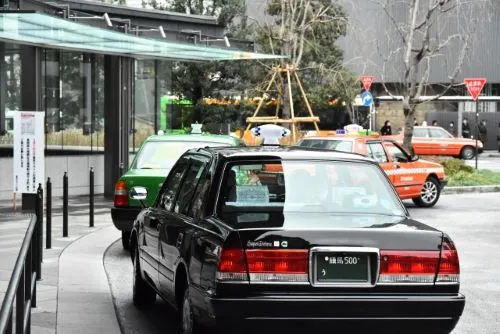
When you walk on the streets in Japan, you might notice the taxis running on the road are in different colors. If you get each one of them and line them together, a rainbow can almost be formed (´▽`*). This is because taxi companies or prefectures use different colors to distinguish their taxis from others.
Important: Japan’s taxis have a dark green car plate or a dark green outer frame. If the car has a white car plate, it isn’t a taxi and is taking customers illegally. Avoid them for your safety.
Gathering Points When Taking a Taxi in Japan
You might have noticed that point cards are common in Japan. Many shops and restaurants offer loyalty cards that let you collect points. The same concept applies to taxis. Many taxi companies have point cards. If you take taxis regularly in a certain area, check with the driver whether you can collect points to offset future fares.
How to Tell If a Japanese Taxi Is Available to Hail
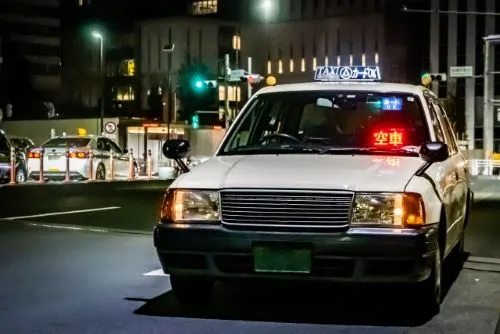
In Japan, all taxis display a small LED sign indicating their availability. The statuses are all in Japanese, so refer to the following for clarification.
| Japanese Sign | Pronunciation | Color | Meaning in English | What It Means for You |
| 空車 | Kūsha | RED | Vacant / Available | Wave your hand! The taxi is free and will stop for you. |
| 賃走 | Chinsō | GREEN | Occupied / Meter Running | The taxi is carrying passengers. Do not hail. |
| 迎車 | Geisha | ORANGE / RED | On Call / Booked | Reserved via app or phone to pick up someone else. |
| 支払 | Shiharai | GREEN / YELLOW | Paying | Passengers are paying inside. Taxi is unavailable. |
| 割増 | Warimashi | RED | Night Surcharge | Vacant, but the 20% late-night rate applies (10 PM–5 AM). |
| 回送 | Kaisō | OFF / DARK | Out of Service | The driver is off-duty or returning to the depot. Will not stop. |
The Potential Reasons That a Taxi Would Not Stop When You Wave at It
In Japan, if a taxi is available, the word Kūsha (空車) is displayed on the car’s roof or windscreen. But the taxi might not always stop for you when you signal the driver that you want a ride. Typically, there are two reasons that a taxi would not stop when you wave at it:
- The taxi driver didn’t see you.
- The taxi cannot park close to where you stand.
- Please ensure that where you stand doesn’t have a red road line and/or is not close to an intersection, a pedestrian crossing, or a bus stop. The taxis won’t stop for you if you are standing in a spot that isn’t deemed safe for them to park.
Taking a Taxi With Toddlers in Japan
Japan’s taxis usually don’t have child safety seats. So, if you want to take a taxi with a toddler, please have an adult sit in the back seat and let the toddler sit on an adult’s lap while you fasten the seat belt.
Please also try to calm the toddler if he starts crying or yelling, so the driver won’t be distracted.
Getting a Taxi to Narita Airport
How much is a taxi from Narita to Tokyo?
Taking a taxi from Narita Airport to Shinjuku or Tokyo Station usually costs around 23,000 yen. Although it is the most expensive mode of transportation, taxis are available 24 hours a day, making them a convenient option for those arriving late at night or early in the morning. Also, if you carry very large and/or multiple pieces of luggage, taking a taxi that can drop you off or pick you up from anywhere will make your travel to and from the airport much easier.
But just bear in mind that the cost and the required time will increase significantly if you run into traffic jams.
Tip: Besides the standard taxis, there are also flat-rate taxis (定額制タクシー) that you can consider. Below is a list of our recommendations you can choose from.
☛ Book your fixed-rate private transfer from Narita Airport through klook.
☛ KM Taxi (also has services to Tokyo Disney Resort)
Taking a Taxi in Rural Japan
If you plan to travel in rural Japan, taxi apps like Uber may not work. Thus, remember to check with the staff at your hotel for the local taxi company’s phone number. Note that when we say rural, even Kameoka in Kyoto counts as local. We had to call the area’s taxi company to arrange a pickup.
Below is a phrase that you can use to ask a passerby to make the phone call for you.
Taxi Kaisha ni Denwa Shite, Takushī o Yonde Moraemasen ka?
タクシー会社に電話して、タクシーを呼んで貰えませんか?
Could you please help me to call the taxi company to get a taxi for me?
The Taxi Etiquette in Japan
The taxis in Japan operate slightly differently, so it is better to know the nuances before hopping on.
Don’t Attempt to Close the Taxi Door in Japan
The biggest difference between taxis in Japan and the rest of the world is that the driver can control the opening and closing of the back door. The taxi driver in Japan will only open the back door for you to enter after he is sure that the car is parked properly. So please wait for the driver to open the back door for you instead.
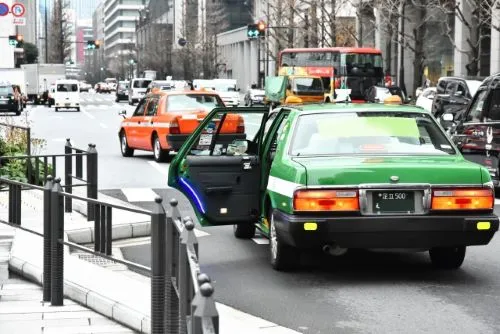
Similarly, after the driver confirms that all passengers are in the car, he will close the door. Please don’t close it after you enter or exit the taxi.
When Entering a Taxi at a Taxi Stand in Japan
Like many countries, there are taxi stands, or taxi ranks, outside train stations, airports, and popular sightseeing destinations. Please take the first taxi in the queue and don’t cherry-pick. Even if you are in a hurry and the closest taxi is at the back of the queue, please follow the rules and walk to the taxi at the front. In fact, the taxi driver will direct you to take the first taxi if you attempt to do so otherwise!
Can I Fit 5 People in a Japanese Taxi?
A standard taxi in Japan has a capacity to fit four people. If you have four people and a child, please do not ask the driver to accommodate. It is illegal and will cause trouble for the driver.
Under Japanese law, three children under 12 years old are treated as two adults in a car.
- If there are four people, please give the taxi driver a numbered hand gesture to signal that he need to clear the assistant seat for your group.
- If there are more than four people in your group, book a jumbo taxi or split your group into different taxis.
You can use the phrase below to ask the hotel staff to book a larger taxi for you.
すみません、タクシーに〇〇人で一緒乗りたいですが、ジャンボタクシーを呼んで貰えますか?
Sumimasen, taxi ni 〇〇 nin de isshoni noritaidesuga, jumbo taxi wo yonde moraemasuka?
Excuse me, we have 〇〇 people and would like to take a taxi together. Could you please assist us in getting a jumbo taxi?
Whether to Tip the Taxi Driver in Japan When You Have Many Suitcases
If you have many suitcases, let the taxi driver know. He will most likely help you move your belongings into the trunk. While tipping isn’t common in Japan, you can give him a small tip or ask him to keep the change if there is any to show your appreciation.
Please Enter the Taxi First If You Are the Person Who Will Pay
To save time for your group and the taxi driver, it is best for the person paying for the ride to sit in the assistant seat or board the taxi first. This way, other people can get out of the taxi first while you pay.
Before leaving the taxi, remember to check that nothing is left behind.
How to Make a Payment When Getting a Taxi in Japan
It is rude to hand cash or your card directly to staff in Japan. Many shops and restaurants have a small tray at the register. When you want to make a payment, leave the cash or your card in the tray.
The same applies to taxis. The driver will place a tray above the compartment between the front seats. Leave the cash or card on the tray. The taxi driver will then leave any change or your card and receipts back on the tray when payment is completed.

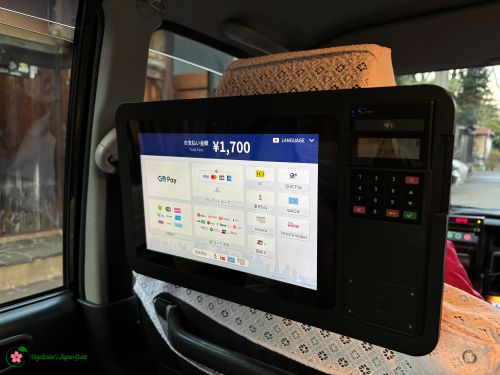
Do Japanese Taxis Take Credit Cards?
Please confirm with the taxi driver upon boarding. While most taxis in Japan now accept credit cards or transportation IC cards, such as Suica or ICOCA, it is always best to confirm rather than assume. When we were in Morioka, one of the main cities in the Tohoku region, taxis there only accepted cash.
Upon arrival, let the driver know you want to pay by card. He will activate the payment screen for you.
Commonly Used Phrases When Taking a Taxi in Japan
The taxi drivers in Japan generally can’t speak basic English. This is especially true in Japan’s rural areas. The phrases below will be handy if you are experiencing language barriers.
| Japanese Phrase | Pronunciation | Meaning in English |
| 〇〇に行きたいんです。 | 〇〇 ni ikitai desu | I want to go to 〇〇. |
| 〇〇まではいくらですか? | 〇〇 made wa ikura desuka? | How much does it cost to go to 〇〇? |
| ここまでお願いします。 | Koko made Onegai shimasu | Please take me here (please show the driver the address). |
| あと何分ぐらいで着きますか? | Ato nanfun gurai de tsukimasuka? | How much longer will it take to get to the destination? |
| すみません、急いでもらえますか? | Sumimasen, isoide moraemasuka? | Sorry, can you please drive faster? |
| ここで大丈夫です。 | Koko de daijōbu desu | You can drop me off here. |
| ここで降ります。 | Koko de Orimasu | I want to get off here. |
| 〇〇の前で停まってください。 | 〇〇 no mae de tomatte kudasai | Please stop in front of 〇〇. |
| クレジットカードを使えますか? | Credit card wo tsukaemasuka? | Can I pay with a credit card? |
| お釣りを要らないです。 | Otsuri wo iranaidesu | Keep the change. |
| レシートをください | Receipt wo kudasai | Can I have a receipt. |
| トランクに荷物を入れてもらえますか? | Trunk ni nimotsu wo irete moraemasuka? | Can you help me put my belongings into the trunk? |
| トランクを開けてもらえますか? | Trunk wo akete moraemasuka? | Can you open the trunk for me? |
The Best Taxi Apps in Japan
If you are in an area where a taxi doesn’t drive by every other minute, installing a taxi app on your phone can be handy. Requesting a taxi through an app can also minimize the inconvenience caused by language barriers.
Note that car-hailing remains illegal in Japan, so foreign car-hailing apps are connected to local taxi drivers. For most of the apps listed below, you can either pay for your ride in cash or via the app, which can be linked to your credit card.
Important: Booking a taxi in Japan incurs a booking fee. It is usually less than 500 yen.
Popular Taxi Apps in Japan: Quick Comparison
| App | Coverage | Key Features | Payment Methods | Best For |
| GO (Taxi Go) | Nationwide (45+ Prefectures; largest network in Japan) | • Advance booking & airport flat-rate rides • Vehicle type selection (e.g., sliding-door / wheelchair accessible) • In-app driver messaging | Credit Cards (Visa, Mastercard, JCB, AMEX, UnionPay), GO Pay, Apple Pay | Best overall for tourists visiting both major cities and regional areas. |
| Uber | Tokyo, Osaka, Kyoto, Nagoya, Fukuoka, and major airports | • English UI with zero setup if you already have an active Uber account • Dispatches local licensed taxis (UberX/Black available in select areas) | Foreign Credit/Debit Cards, Apple Pay, PayPal, Cash (in select cities) | First-time travelers who want a familiar app without creating a new account. |
| DiDi | Kansai region (Osaka, Kyoto), Tokyo, Hokkaido, Fukuoka | • Frequent promo codes & discount coupons for new users • In-app translation for messaging drivers | Credit Cards (Visa, Mastercard, JCB, AMEX), PayPay, In-app Cash option | Budget-conscious travelers exploring Kyoto, Osaka, or Tokyo. |
| S.RIDE | Tokyo Metropolitan Area & major urban centers | • “One-swipe” instant taxi hailing • Real-time taxi tracking on an interactive map • S.RIDE WALLET for paying in hailed cabs via QR code | Credit Cards, Apple Pay, S.RIDE WALLET, Cash | Quick, single-tap rides within central Tokyo. |
| Grab | Limited (Partnership roaming in Tokyo, Kyoto, Osaka, Nagoya, Okinawa) | • Works via roaming integration with local fleets (e.g., JapanTaxi/GO backend) • Uses your existing Southeast Asian account and settings | GrabPay Wallet / Credits, Linked International Credit/Debit Cards | Southeast Asian travelers (Singapore, Malaysia, Philippines, Thailand, etc.) who already use Grab daily. |
Taxi GO
Taxi GO is the most downloaded and the best taxi app in Japan. The most convenient feature of this app is that you can reserve a taxi to pick you up later in the day. This ensures that a car is at the door when the time is up.
The app has since been updated, which allows you to register an account with an overseas phone number and credit card. We have successfully registered the account with our WISE Card.
Tip: The WISE Card lets you buy Japanese yen whenever you want. The exchange rate offered by WISE is very competitive. So get a WISE Card and purchase some Japanese yen when the rate is good to save!
Uber
Uber works in Japan. As a foreign tourist, it is probably the best app to use, as it covers the most cities in Japan among foreign car-hailing apps. An advantage of using Uber is that there is no nighttime surcharge. But as we all know, it is more expensive to take Uber during peak hours.
Tip: Refer to Uber’s website HERE for a list of Japanese cities covered by Uber.
DiDi
DiDi is a Chinese car-hailing app. Its service in Japan launched in 2018. After the app is downloaded, create an account, and you can start using it right away by entering your destination and pick-up location.
Important: Something to keep in mind when choosing between DiDi and other Japanese taxi apps is that the price that first appears in DiDi’s app may be lower when ordering a taxi. But the cost can be around the same as other taxi apps. This happened to us previously, and we weren’t happy.
Tip: Refer to DiDi’s website HERE and translate it to English by using Google Chrome’s translation function at the right of the address bar for the app’s coverage cities and prefectures.
Grab
If you are a Singaporean, you might be wondering if you can use Grab in Japan. The good news is the platform is partnered with Japan Taxi (the company of Taxi GO), so you can use the app in Tokyo, Kyoto, Sapporo, Nagoya, and Okinawa if you are a Grab user.
Fulcul
Fulcul is an app that doesn’t require an account. All you need to do is shake your phone while using the app. This will send your location to the taxi drivers within 500m. When a taxi driver approaches, wave to them. The driver will stop to pick you up.
The best thing is that there is no pick-up fee charged by Fulcul!
Note that as no account is created, please pay the taxi driver directly by cash or card (although this is not always available).
Refer to Fulcul’s official website HERE for more information.
Important: Fulcul’s service is only available in most parts of Tokyo’s 23 wards, Musashino City, Mitaka City, and a part of Yokohama.
Reserving Your Taxi in Japan by Phone or Using a Taxi Company’s Website
Besides using a phone app, you can also call taxi companies to reserve a taxi in Japan. This can be handy if the taxi app on your phone doesn’t work or there is no taxi near you. Below is a list of taxi companies with English-language websites where you can reserve a taxi. There are also English-speaking operators if you want to make a call.
Tip: You can also ask the staff at your hotel or even at a train station to help you get a taxi.
Japan Taxi FAQ
Q: How can I tell if a taxi is available?
A: Look at the LED sign in the bottom corner of the windshield.
- Red Sign (空車 – Kusha): The taxi is Vacant and ready to pick you up.
- Green/Blue Sign (賃走 – Chinso): The taxi is Occupied.
- Yellow/Orange Sign (迎車 – Geisha): The taxi is Booked and on its way to a customer.
- Pro Tip: At night, if the roof light is glowing, the taxi is usually available.
Q: Do I need to tip my taxi driver?
A: No. Tipping is not part of Japanese culture, and most drivers will politely (and sometimes firmly) refuse extra money. If you want to show appreciation, a simple “Arigatou gozaimasu” (Thank you very much) as you exit is the best gesture.
Q: Can a taxi fit 5 people or a lot of luggage?
A: Standard taxis (sedans and the boxy black “JPN TAXI” models) are strictly limited to 4 passengers. If you have 5 or more people, you must either:
- Split into two taxis.
- Use an app like Uber or GO Premium to specifically request a “Large” or “Van” type vehicle (like a Toyota Alphard).
- Note that children under 12 are counted differently (usually 3 children = 2 adults), but luggage space is the real bottleneck!
Q: Do I need to open the door myself?
A: Never. This is the #1 rule for tourists! The left-rear passenger door is operated remotely by the driver. Wait for it to swing open automatically before stepping in, and do not try to pull it shut when you get out.
Q: Is it cheaper to use Uber or a regular taxi?
A: In Japan, Uber is not a “discount” service; it is a dispatch tool for professional taxis. The fare is almost always the same as the meter, plus a small “Dispatch Fee” (usually around 400 to 500 yen). The advantage of the app is its price transparency and the fact that you don’t have to explain your destination in Japanese.
Q: Can I pay with my Suica/IC Card?
A: Mostly yes, but check first. Almost all taxis in major cities like Tokyo, Kyoto, and Osaka accept Suica, Pasmo, and credit cards. However, in rural areas (like deep Shiga or Tohoku), some independent taxis are still cash-only. Always look for the payment stickers on the rear window before entering.
Q: Is there Uber in Kyoto/Osaka/Rural Japan?
A: Uber works fine in big cities such as Kyoto, Tokyo, and Osaka. However, Taxi Go is the best shot when you enter the rural area. We even had to call local taxi companies to book a ride while exploring Kameoka. The city is only a couple of stations away from Kyoto Station!
The Most Useful Apps for Traveling in Japan
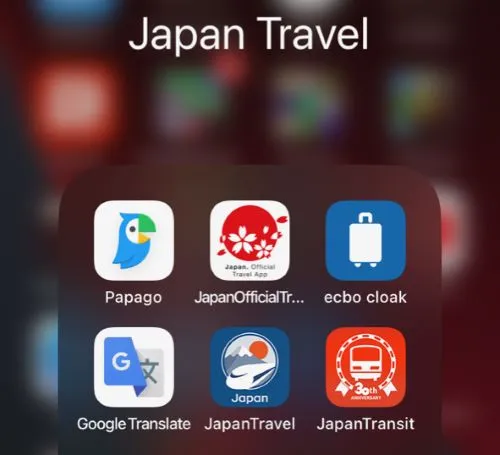
Using the right taxi app can save you from a long walk in the rain, but it is only one part of a stress-free trip to Japan. A truly curated ‘digital toolkit’ is essential for the modern traveler, from navigating complex train platforms with Jorudan and translating menus with Google Lens, to finding convenient luggage storage at local shops via ecbo cloak or locating free water refill stations with the mymizu app.
To see our full list of must-have downloads, including the navigation hacks, check out our comprehensive guide to the Most Useful Apps for Traveling in Japan.
Do I Need a JR Pass & Is the JR Pass Worth It?
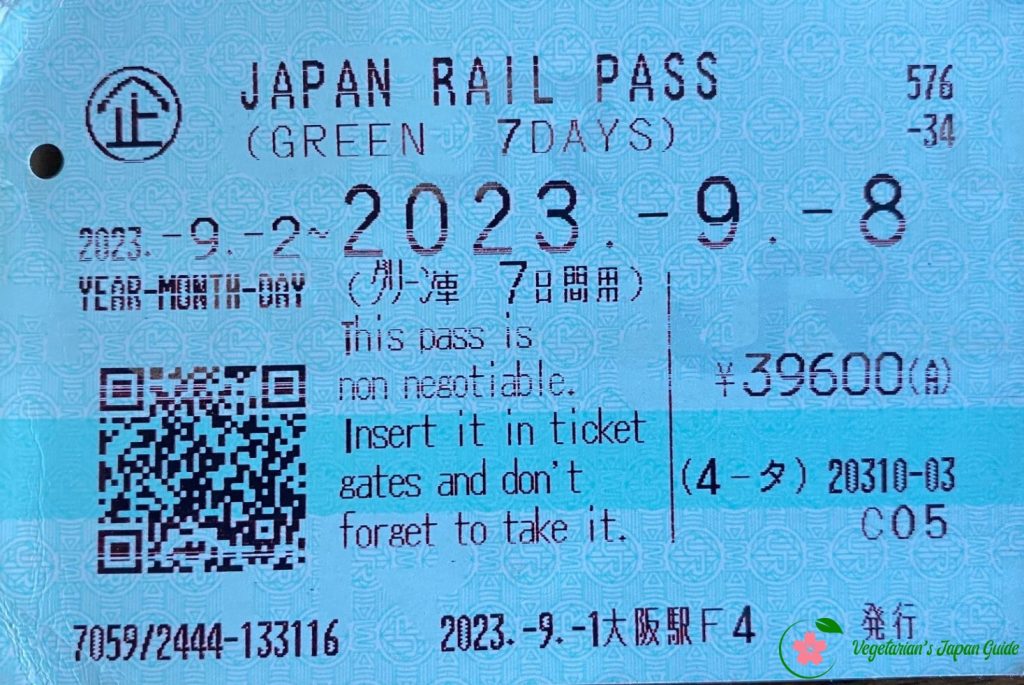
Once you have a rough idea of which prefectures and cities you want to visit during your next Japan trip, it is time to figure out if you need a JR Pass as not all itinerary requires one!
Our Guide to Do I Need a JR Pass & Is the JR Pass Worth It article has everything you need to know about the nationwide and regional JR Passes. It also covers other factors that can help you decide if a JR Pass is worth your upcoming trip or not!
SIM Card, eSIM, or Pocket WiFi: Which One to Use in Japan?
If you haven’t already, get your internet connection in Japan sorted out as soon as possible. The last thing you would want to do after landing in Japan is spend time deciding what product and from which company you should rent a pocket WiFi or purchase a SIM Card. Another common question is whether to rent a pocket Wi-Fi or purchase a SIM Card.
So refer to our SIM Card, eSIM, or Pocket WiFi: Which One to Use in Japan article that answers all your questions about how to stay connected to the internet when you are in Japan!