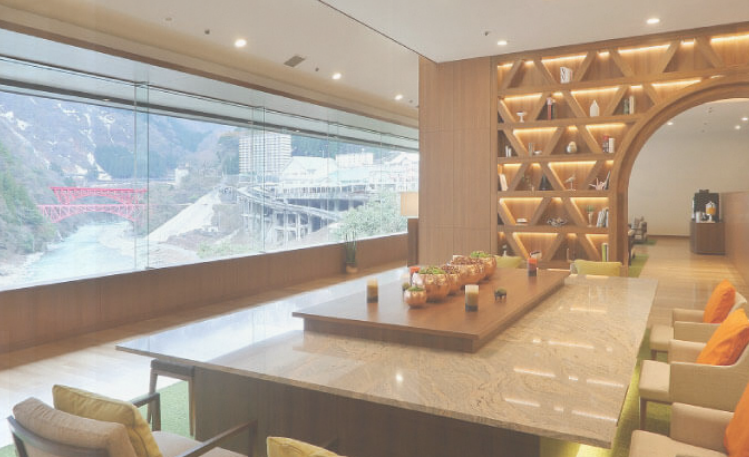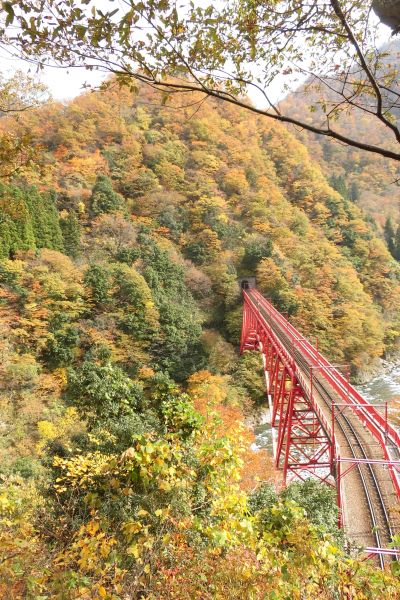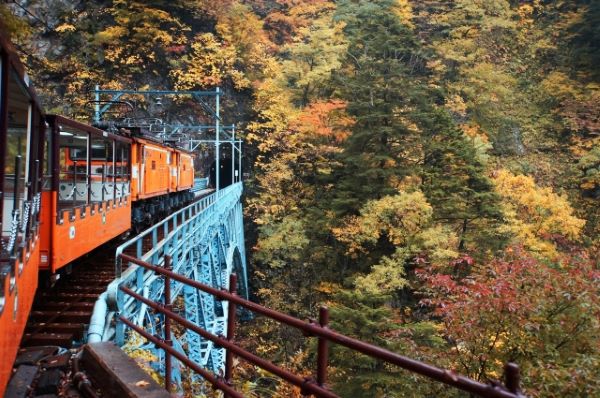
Experience the pinnacle of Japanese landscape design with our comprehensive guide to Kenrokuen Garden (兼六園) in Kanazawa. Widely regarded as one of Japan’s “Three Great Gardens,” Kenrokuen is celebrated for embodying the six essential attributes of a perfect garden: spaciousness, seclusion, artifice, antiquity, water-courses, and panoramic views. From the iconic two-legged Kotoji-toro lantern reflecting in Kasumiga-ike Pond to the ancient Karaki-no-matsu pine, every corner offers a masterclass in horticultural beauty. Whether you are visiting in winter to see the protective yukitsuri rope structures, in spring for the vibrant cherry blossoms, or for the stunning autumn foliage, Kenrokuen provides a timeless escape into nature.
What to See in Kenrokuen Garden
- Explore Kenrokuen and Kanazawa With a Guided Tour
- It Took 180 Years to Complete the Kenrokuen Garden
- Where to Start Your Visit and the Best Spots in Kenrokuen Garden
- Kotoji Stone Lantern (徽軫灯籠)
- Shichi-Fukujin-Yama (七福神山) – Seven Lucky Gods Hill
- Neagari-no-Matsu (根上松) – Raised Roots Pine
- The Meiji Monument (明治紀念之標)
- Hanami-Bashi (花見橋) – The Flower Viewing Bridge
- Yamazakiyama Hill (山崎山)
- Yugao-Tei (夕顔亭) – The Gourd Tea House
- The Shigure-Tei Tea House (時雨亭)
- Kenrokutei (兼六亭): The Vegan-Friendly Restaurant in Kenrokuen
- How Long Will It Take to Explore Kenrokuen
- Kenrokuen’s Opening Hours
- Nighttime Light-up at Kenrokuen
- Kanazawa Castle and Kenrokuen Free Guided Tour
- Kenrokuen Mobile App
- The Four Seasons at Kenrokuen
- How to Get to Kenrokuen
Tips:
☛ Avoid the crowd and visit Kenrokuen as early as possible by staying in a hotel close to the garden, such as Toyoko Inn Kanazawa Kenrokuen Korimbo. If you get up early enough, you can explore the garden for free!
☛ You can also make a reservation HERE to be dressed up in a kimono before exploring Kenrokuen and the rest of Kanazawa!
☛ The Kenrokuen+1 Tickets (兼六園プラスワン利用券) allows admission to Kenrokuen Garden and one more cultural facility within the city, is available for 500 yen.
Explore Kenrokuen and Kanazawa With a Guided Tour
If you prefer a guide to introduce you to Kenrokuen or a photographer to take professional photos, how about joining one of the following tours?

It Took 180 Years to Complete the Kenrokuen Garden
The origin of the Kenrokuen was said to be the garden of the new villa built for the fifth lord of the Kaga Domain (加賀藩), Maeda Tsunanori (前田綱紀). From then on, 14 successive lords of the Kaga Domain spent another 180 years perfecting the garden to the point that it has all six important characteristics of a garden landscape! To find out what those six characteristics are, refer to Ishikawa Prefecture’s website HERE for a detailed explanation.
As the world of samurai ended, the garden was opened to the general public in 1874, with many tea houses (where the Geishas serve their clients) opened around the same time.
In 2009, the garden earned the highest honor in travel destinations worldwide: a Michelin Three-Star! From this point on, the garden has attracted more and more international admirers every year.
Where to Start Your Visit to Kenrokuen Garden
Kenrokuen is a garden with a size of around 11 hectares. With a garden of this size, where should you start your exploration?
According to our guide, since it was known as a typical strolling garden during the Edo period, there is no set sequence for where you should go first.
But if you are coming from Kanazawa Castle, the easiest way to get into the garden is by crossing the Ishikawa Bridge (石川橋), located at the front of the Ichikawa Gate (石川門) of the castle. One of the seven entry points of the garden, Katsurazaka Gate (桂坂口), will be right in front of you in no time.
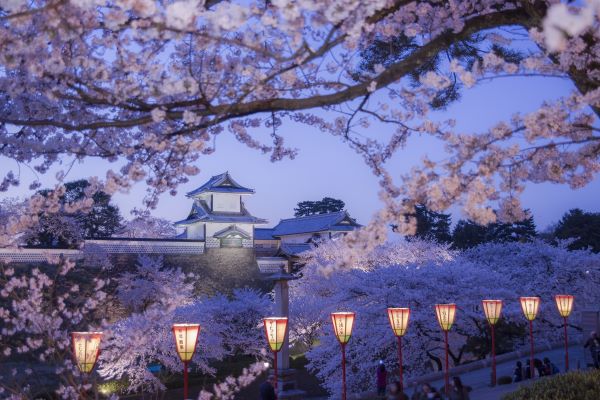
Kenrokuen is a place for visitors to walk around at their own pace, just as the feudal lord would have done back then. Whilst there are certainly far more stunning spots in the garden, which we will introduce below, the spot that you personally feel is the most beautiful is likely the best spot for you.
Kotoji Stone Lantern (徽軫灯籠)
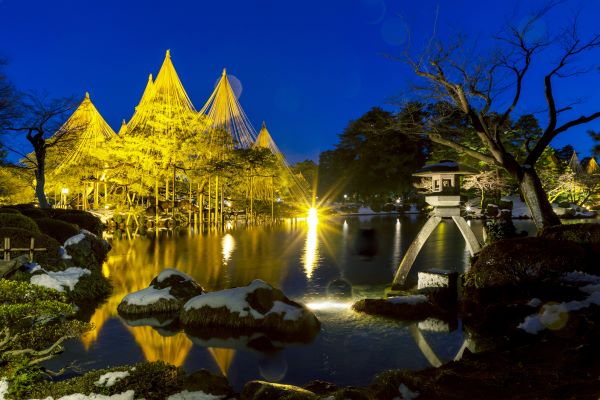
The most popular spot is the Kasumiga-ike Pond (霞ヶ池). However, getting the right angle is very important! To get the best photo, stand in front of the garden’s famous Kotoji Stone Lantern, where you will then see the Karasaki Pine Tree covered by umbrella-like ropes in the background. This view is THE SYMBOL of Kenrokuen!
Just note that the ropes around the pine trees will only be up from November to March each year. It is seasonal as the purpose of the ropes is to protect the hundreds of years old pine trees from the heavy snow.
Shichi-Fukujin-Yama (七福神山): Seven Lucky Gods Hill
Amongst the 8,000 + trees in the garden, the pine trees here at Shichi-Fukujin Yama are said to be one of the most beautiful-looking trees.
The pine trees are gorgeously shaped, looking like gigantic versions of Japanese Bonsai!
But remember to pay close attention to the seven black stones under the tree to see if you can spot seven gods out of them. Lacking imagination and creativity, we just couldn’t figure out how the stones would look like the seven lucky gods to the samurais back then…(´▽`*) You probably will have better luck than us!

Neagari-no-Matsu (根上松): Raised Roots Pine
Another pine tree that is certainly worth your attention is the 15-meter-tall Neagari-no-Matsu. Whilst it might not look as clear in the photo, with part of the tree’s roots separating by about 2 meters from the ground, it almost looks as if the tree is standing up!

Because the root in Japanese pronouncing as “ne” has the same meaning as income, and “agari” means going up, you might see some Japanese people joining their hands together as they pray to the tree. Although you won’t be able to hear what they are praying about, it is no doubt that they are praying for fortune or a higher salary (≧▽≦).
But if it is a student doing so, rather than income, they might be praying for better grades, just like what our guide’s primary school teaching had taught him to!
The Meiji Monument (明治紀念之標)
Very close to Neagari-no-Matsu, there is this 5-meter-tall bronze statue of a legendary hero called Yamatotakeru-no-Mikoto (ヤマトタケルノミコト). As the oldest bronze statue in Japan, it was made to honour the soldiers who died in the Satsuma Rebellion (西南戦争) in 1877.

Hanami-Bashi (花見橋): The Flower Viewing Bridge
There are 33 bridges in Kenrokuen, with the most famous probably being this left bridge, which is surrounded by different kinds of flowers from spring to summer.

If you intend to visit the garden during spring, when you get to the Meiji Monument, your attention might be drawn to the cherry blossoms by the Hanami Bridge instead of the gigantic statue!
From late March, cherry blossoms, Azaleas, Japanese Irises, and more will bloom one after another, making this spot the perfect place to admire their beauty. This is why the bridge is called “Hanami”.
Yamazakiyama Hill (山崎山)
If you come to Kenrokuen in autumn, the beautiful fall foliage scenery at Yamazakiyama Hill will be right there soon after you cross the Hinami Bridge.
Close to the Kotatsuno Gate (小立野口) at the north of the garden, this small hill is known as the best place for anyone who wants to enjoy the fall color. That is why it was a nickname, Momijiyama (紅葉山), which means maple tree mountain.

At the top of the hill, there is a small pavilion for you to take a nap or rest. It is also the perfect place to admire the vibrant foliage color (=゚ω゚)ノ.

Yugao-Tei (夕顔亭): The Gourd Tea House

On the other side of the garden, close to the Renchi-mon Gate (蓮池門口), there is a smaller pond known as Hisago-ike Pond (瓢池). Apparently, the entire Kenrokuen started from here!
On one side of the pond, you will find an old tea house built in 1774. The tea house is the only architecture in the entire garden that has retained its original form at the time of construction.
For those who have been to a traditional Japanese tea house, the entrance is usually very small, just a little bigger than a square meter. As one can hardly enter the tea house, this type of entrance is called Nijiriguchi (躙口), which translates to Squeak Entrance.
If you are wondering what the purpose is of having such a small entrance, it is so that the samurais cannot enter the tea room with their swords at their waist, ready to attack or kill anyone.
The special thing about Yugao-Tei is its standard-size entrance. The lord of the Kaga Clan didn’t need a Nijiriguchi back then, as he was the only one who was permitted inside the tea house. He wouldn’t need to worry about being attacked by his guests, as no one else was allowed in.
The Shigure-Tei Tea House (時雨亭)
Speaking of tea houses, does anyone feel like a bowl of freshly made matcha green tea? If your answer is “YES!”, come to Shigure-Tei for a bowl of matcha with a premium Japanese sweet!
The Japanese sweets served at Shigurei-Tei change color and shape with the seasons. The taste may differ depending on whether there are any special fillings inside.

If matcha isn’t your thing, the tea house also serves sencha with a different kind of sweet.
- Shigure-Tei is open from 9 am to 4:30 pm daily except from December 29 to January 3.
- The last admission is at 4 pm
- A bowl of matcha that comes with a premium Japanese sweet will cost you 800 yen
- A cup of sencha that comes with a Japanese sweet will cost you 340 yen
Note that between 12 pm and 1 pm, no tea or sweets will be served.
Kenrokutei (兼六亭): The Vegan-Friendly Restaurant in Kenrokuen
Two restaurants in the garden are very popular amongst the visitors, but only Kenrokutei is vegan/vegetarian-friendly. Miyoshian (三芳庵) is another restaurant in Kenrokuen. But it doesn’t have any vegan meals. However, it serves traditional Japanese plant-based desserts.
Nevertheless, if you don’t book in advance, you might not be able to enjoy the incredible food and traditional vibe at either one of them.
Although in Japanese, HERE is Kenrokutei’s menu. It has a Vegan Yudofu Course (湯豆腐のヴィーガンコース). This set is made using plant-based ingredients only. The boiled tofu is served in a gentle kelp broth.
- You can make a reservation with AutoReserve.
- The traditional restaurant also offers a Tea Ceremony experience in English.
- Kenrokutei is open from 9 am to 4 pm.
How Long Will It Take to Explore Kenrokuen
We recommend allocating at least 90 minutes for Kenrokuen, especially if you want to enjoy a hot cup of tea at Shigure-Tei. But if your itinerary is really tight, 40 minutes should be enough for you to stroll through the main spots of the garden, which consists of all six characteristics of a great landscape.
- On Ishikawa Prefecture’s website, the 40-minute “Barrier-Free Course” can be accessed HERE.
- For a detailed explanation of each spot in the garden, please visit the Ishikawa Prefecture website HERE.
Kenrokuen’s Opening Hours
Apart from the normal opening hours, Kenrokuen also opens early, with 4 am the earliest (free entry). So if you want to enjoy the garden without many others while saving on admission, wake up early and head out!
Just note that only two entrances are accessible for early admission. You will also have to leave the garden 15 minutes before its normal opening hours as visitors will pay for their entry.
For more information, please refer to their official website HERE.
Nighttime Light-up at Kenrokuen
Throughout the year, the garden will light up at night during the four seasons. When the lights are up at night, the garden entry is FREE!
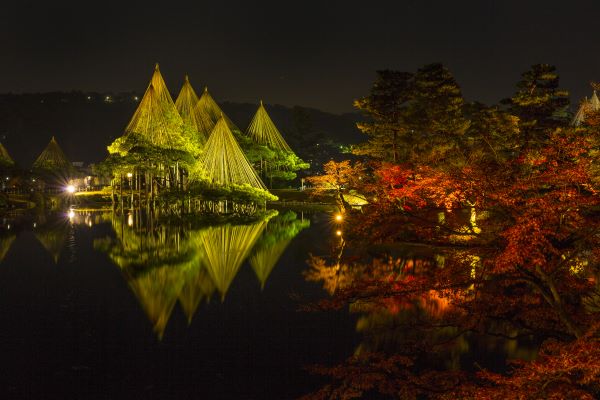
- Spring: around one week in early April, when the cherry blossom is blooming and from late April to early May from sunset to 9:30 pm
- Summer: early June and from late July to mid-August, from sunset to 9 pm
- Autumn: from early to late November, from sunset to 9 pm
- Winter: mid to late February
For the exact dates, please refer to Kenrokuen’s website’s event page HERE. If the individual event page isn’t translated, you can translate it by using Google Chrome’s translation function to the right of the address bar.
Kanazawa Castle and Kenrokuen Free Guided Tour
To access this service, you will need to drop by Kanazawa Castle first. For more information, please refer to our article about Kanazawa Castle!
Kenrokuen Mobile App
Before you head to the garden, downloading the garden’s introductory app might be worthwhile, as it offers an instant, detailed guide. To download the same, please follow the links below. Although the pages are written in Japanese, once you download the application, it should automatically convert to the set language on your phone.
The Four Seasons at Kenrokuen
- From early to mid-March each year, around 20 different species of the 200 plum blossoms planted close to Shirure-Tei will bloom.
- From early to mid-April each year, around 20 different species of the 420 cherry blossoms in the garden will bloom.
- Fugenzo Cherry: mid-April to early May
- Azalea: April to June
- Iris: May
- From late June to early July, you might be able to see some fireflies around the Hanami Bridge
- Japanese clover: August to September
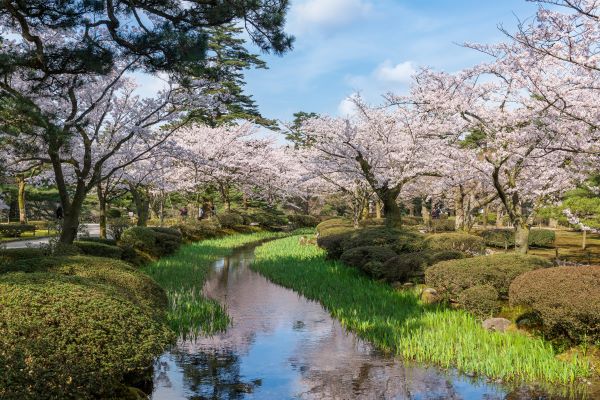
- Mid to late November is the best time to appreciate autumn foliage.
- Camellia: December to March
How to Get to Kenrokuen
There are two bus services to choose from. Please get off the bus at Kenroku-en Shita (兼六園下).
- Kanazawa Loop Bus (城下まち金沢周遊バス)
- There are two types of loop buses, the Right Loop Bus and the Left Loop Bus. Both routes go through the same stops but in different directions.
- Both routes depart from JR Kanazawa Station’s east exit bus stop no. 6 every 15 minutes.
- For the timetable of the services, please refer to the official brochure on Hokutetsu’s website HERE.
- If you will take the bus more than 4 times a day, consider purchasing the Hokutetsu One-Day Pass, which gives you unlimited bus rides for the day and discounts at participating facilities.
- Please purchase the pass from Hokutetsu’s Bus Terminal before boarding. Refer to HERE for more details.
- Kanazawa Light-up Bus (金沢ライトアップバス)
- This special bus service only operates on Saturdays. Refer to HERE for the timetable.
- The service runs every 15 minutes from 7 pm to 9:40 pm, departing from bus stop no. 6 at the east exit of JR Kanazawa Station.
- The bus fare is slightly higher for this service
- 300 yen for adults
- 150 yen for elementary school students
- You can also purchase a Kanazawa Light-up Bus Pass for 500 yen (250 yen for elementary school students) from Hokutetsu Ekimae Center / Honkutetsu Bus ticket office (北鉄駅前センター) close to the station’s east exit’s bus stop no. 1.
Chamise-dōri (茶店通り): The Tea House Street
Outside of Katsurazaka Gate (桂坂口), there is a series of traditional housing. Those houses were originally built to accommodate the 300 attendants of Princess Tama. She is the daughter of the second Tokugawa shogunate, Tokugawa Hidetada (徳川秀忠), and was married into the Kaga clan.
As Princess Tama and her attendants all came from Edo (now Tokyo), this area was nicknamed “Edo-machi,” meaning Edo town.
There are many stores and cafes on this street, including Kimono rental shops and ice cream shops that sell the Kanagawa specialty, gold leaf ice cream. This is great for those who would love to stroll around Kanazawa in their kimono while eating a shiny golden soft serve cream (^_-)-☆.

Discover Other Fascinating Attractions in Kanazawa City
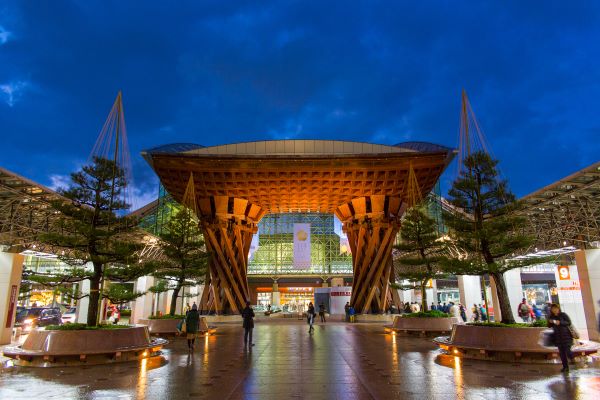
Step into a world where samurai legacy and modern artistry collide with our guide to Kanazawa (金沢), Japan’s “Little Kyoto.” Whether you are wandering the perfectly preserved wooden teahouses of the Higashi Chaya geisha district or admiring the circular architecture of the 21st Century Museum of Contemporary Art, Kanazawa offers a deep dive into Edo-period culture without the overwhelming crowds of larger cities.
Refer to our Kanazawa article for information about our recommended spots in Kanazawa, including where to meet the Geishas and an amazing art museum!