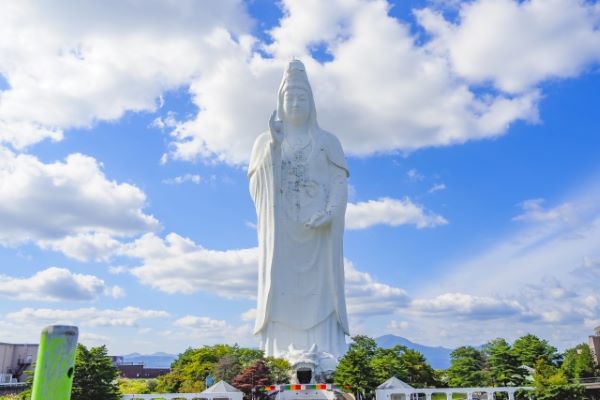
If you ever get a chance to head up to the observatory area at Sendai’s SS30‘s top floor on a clear day, you should see the white Kannon Buddha statue sticking out of a residential area. The Sendai Daikannon (仙台大観音) is the second-tallest Buddha statue in Japan (the tallest is the Ushiku Buddha (牛久大仏) in Ibaraki Prefecture). The 100-meter-tall Buddha statue doesn’t just have a beautiful, calming appearance; it is a temple!
How to Get to Sendai Dai Kannon
To get to Sendai Daikannon by public transportation, you can just take a bus from Sendai Station (仙台駅), and you will be at the Kannon Bodhisattva’s foot in around 30 minutes.
Around the bus stop, Sendai Daikannon-mae (仙台大観音前) is the best place to get a full shot of the spectacular Kannon Bodhisattva. Some describe her magnificence as that of the final boss, with a sacred power that can’t be matched by human power!
Tip: Instead of getting off at the closest bus stop, you can get off at Nakayama Nanachō-me (中山7丁目) for the sensation of the Bodhisattva slowly becoming larger (´▽`*). Just note that the bus stop is 1 kilometer from Sendai Daikannon.

Sendai Dai Kannon and Daikanmitsu-Ji Temple (大観密寺)
The statue was completed by a businessman called Sugawara Yorozu (菅原萬) in 1991 to pray for world peace and the eternal happiness of mankind. Its formal name is Sendai Tendō Byakue Daikannon (仙台天道白衣大観音). He then later donated the gigantic Kannon statue to Daikanmitsu-Ji Temple.
What she is holding in her right hand is a Nyoi Hōjyu Ball (如意宝珠) that grants our prayers. The water jar is tilted in her left hand, so the water of wisdom is poured upon us.
Interestingly, the Kannon Bodhisattva is directly facing the Sendai Station!
Heading Inside Sendai Daikannon
As you get closer to Sendai Daikannon, you will notice a dragon’s mouth at her foot. That is the entrance to the Buddhist art gallery inside the Kannon Bodhisattva.
The internal space of Sendai Daikannon is divided into 12 stories. On the first floor, you can worship the Twelve Divine Generals (十二神将), the Thirty-Three Images of Kannon Bodhisattva (三十三観音), Indra (帝釈天), Vaisravana (毘沙門天), celestial maidens, and many more.
Each of the Divine Generals has a zodiac sign assigned. Find your Divine General and pray for good luck!
Tips:
☛ Ask the staff for an English information sheet. The staff should be able to communicate with you in simple English words.
☛ Pray to the Divine General that looks after your birth year/zodiac.
Fun fact: There are 10 time capsules underneath Sendai Daikannon. The plan is to open one capsule every ten years. Once a capsule is opened, new things representing the era are placed inside again. The first capsule was opened in 2001. So you might encounter something completely irrelevant to Buddhism on Sendai Daikannon’s first floor, such as a car catalogue (´▽`*).
Sendai Daikannon’s Top Floor

There is a cross-sectional model of Sendai Daikannon near the entrance. Just staring at the model probably would already make you feel tired (´▽`*). So, an escalator takes you to the 12th floor, 68 meters above the ground!
Located on the 12th floor is Goshinden (御心殿), the center of worship at Sendai Daikannon. The worship hall is interestingly situated where the Kannon Statue’s heart is.
What is enshrined here is the hidden image, Vairocana (大日如来). Kannon Bodhisattva’s Nyoi Hōjyu Ball is also placed here. Let’s quietly join our hands and repeat the mantra of Byakue Kannon (白衣観音) three times (refer to below).
On Shibeitei Shibeitei Handara Bashiniyowaka (オン シベイテイ シベイテイ ハンダラ バシニソワカ).
Tip: If a part of your body is unhealthy, stroke the corresponding part of the Maitreya statue in front of the Goshinden.
After worshipping Vairocana, you can head to the observatory area for a wide view of Sendai’s city center from the small windows. From the window facing away from Sendai Station, you can see as far as the mountains at the borders of Yamagata Prefecture, such as the famous Zaō Mountains (蔵王連峰)!
One thing we complained about is that some views were blocked by the lighting attached to the Sendai Daikannon…
The 108 Buddha Statues inside Sendai Daikannon
If you have taken the escalator up, consider heading back down by the stairs. From the 3rd to the 11th floor, there are a total of 108 marble Buddha Statues placed!
Even if you aren’t interested in seeing the Buddha statues, still stop by the staircase for a very mysterious atmosphere created by the illuminated central pillar where the Buddhas are enshrined (=゚ω゚)ノ.
The number 108 has its meaning. According to the Buddhist sutra, we human beings have 108 worldly desires. Worshipping the 108 Buddha statues symbolizes eliminating each worldly desire one by one.
In fact, the correct way to explore Sendai Daikannon is to hike all the way up. Each of the 108 Buddha statues represents a worldly desire. The higher you go, the closer you get to enlightenment.
Also, you might notice the staircases have a light blue line drawn on them. It represents the water of wisdom flowing from Kannon Bodhisattva’s water jar we mentioned earlier, symbolizing the conferral of wisdom to Sendai’s citizens and visitors to the temple.
Tip: You can access the elevator on the 6th, 10th, and 12th floors (refer to the 5th photo in the IG post). Benches can also be found as you travel down.
Daikanmitsu-Ji Temple (大観密寺)
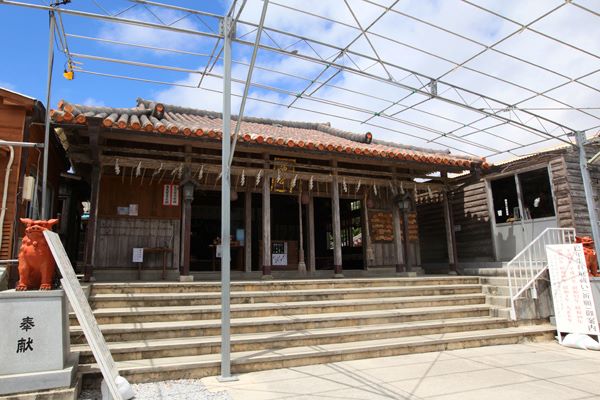
To get to Daikanmitsu-Ji, head left after you get out of Sendai Daikannon. It will take a minute or two before you see the temple shown in the Instagram post.
The most popular image in Daikanmitsu-Ji, next to Sendai Daikannon, is the Mahakala (大黒天).
It is said that around 500 years ago, a young man who worked for the village’s headman accidentally spilled oil on Mahakala’s statue. Strangely, the business of the village’s headman became really prosperous after the incident. The youngster also benefited from his lord’s success, became rich, got a good wife, and lived happily ever after.
Of course, the rumor spread. And the locals began praying to Mahakala for good fortune and marriage ties while pouring oil over the statue.
Tip: If you are a cat lover, you might spot a few cats that linger around Daikanmitsu-Ji.
How to Pray to Daikanmitsu-Ji’s Mahakala
First, light a candle, then an incense. Then pour oil on the Mahakala statue while saying your wish aloud seven times.
This ritual is called Yokuyuhō (浴油法), a practice in Esoteric Buddhism that is usually performed only by priests. So one of the reasons that Daikanmitsu-Ji is so popular is because you can perform Yokuyuhō without a reservation (^_-)-☆.
Another way to pray for a good life partner is to tie the Enmusubi ribbon (縁結びリボン) purchased from the temple office to the designated rack, after writing your wish on it.
Sendai Daikannon’s Opening Hours, Admission Fee, and Access Information
- Sendai Daikannon is open from
- 10 am to 4 pm on weekends and public holidays
- 10 am to 3:30 pm on weekdays
- The admission fee is 500 yen for high school students and adults.
- From Sendai Station (仙台駅) bus stop no. 14, take the Sendai City Bus route 815, 825, X910 bound for Izumi Village (泉ビレジ4丁目) and get off at Sendai Daikannon-mae (仙台大観音前).
Important: There is no toilet inside Sendai Daikannon. If you need it, there is one in front of the statue. Otherwise, utilize the one in Daikanmitsu-Ji Temple.
Discover Other Fantastic Attractions in Sendai
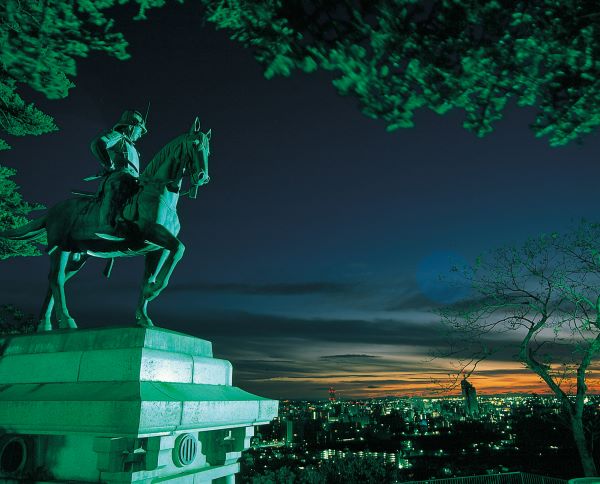
You might not be aware of it, but Sendai, the Tōhoku region‘s biggest city, receives more than 20 million tourists each year!
So if you want to find out how Sendai managed to attract so many visitors, refer to our article on Sendai, which is filled with historical, cultural, and natural attractions (=゚ω゚)ノ.