As the crown jewel of Aomori’s cultural landscape, Hirosaki Castle (弘前城) and the surrounding Hirosaki Park (弘前公園) offer one of Japan’s most iconic historical experiences. Built in 1611 by the Tsugaru Clan, the castle remains one of only twelve “original survivors” in the country, standing as a rare testament to Edo-period architecture. While the park is legendary for the Hirosaki Cherry Blossom Festival (弘前さくらまつり), featuring over 2,600 trees and the famous “petal moat,” it is a year-round destination known for its striking botanical gardens, the colorful Chrysanthemum and Autumn Foliage Festival, and the magical Snow Lantern Festival in winter. Whether you are exploring the triple moats or visiting the centuries-old main keep, our guide covers the best photography spots, seasonal events, and travel tips for visiting this National Historic Site.
Furthermore, if you are a fan of the anime, “Demon Slayer”, you may also want to see the tree that might have inspired Nezuko’s (Tanjiro’s sister) namesake.
What to Do at Hirosaki Castle and Hirosaki Park in Aomori
- Dress-Up Experience and Guided Tour at Hirosaki Park
- Hirosaki Castle’s History
- The Castle Keep that Doesn’t Sit on the Stone Wall
- Things to Do at Hirosaki Castle
- Hirosaki Castle’s Admission Fee and Opening Hours
- Hirosaki Park
- Hirosaki Castle Sannomaru Ōtemon Gate (弘前城 三の丸追手門)
- The Famous West Moat (西濠)
- Hirosaki Castle Lotus Pond Moat (弘前城 蓮池濠)
- The Most Romantic Spot at Hirosaki Park
- The 500 Years Old Tree for Fans of the Anime “Demon Slayer” (鬼滅の刃)
- Festivals at Hirosaki Park
- How to Get to Hirosaki Castle/Park
Tips:
☛ Refer to the map HERE for the best photo spots at Hirosaki Park.
☛ Refer to HERE for the Hirosaki Park map.
Explore Hirosaki with a Professional Guide
If you prefer a guide to introduce you to Hirosaki, consider joining one of the following tours.
- Hirosaki Castle Cherry Blossom Private Charter One-Day Tour (Cherry Blossom Season Exclusive)
- Apple Picking and Hirosaki Castle Private Tour
Dress-Up Experience and Guided Tour at Hirosaki Park
If you ever dream of becoming the lord or the princess of the castle, don’t miss out on the dress-up experience offered at the park! Starting from 500 yen, your dream will temporarily come true!
HERE is the official Japanese website for the most up-to-date information.
Also, if you arrive at Hirosaki Park outside the snow or cherry blossom season, try their smart glasses tour guide so you can still see the park’s most beautiful side! For more information, please refer to the official website HERE.
When Is the Best Time to Visit Hirosaki?
The people of Hirosaki must have a keen business mind. Each season, at least one major festival attracts 200,000 or more people to enjoy what Hirosaki has to offer. Those cherry blossom trees, and the trees that produce a vibrant autumn color weren’t just planted overnight. You will surely be amazed by how grand each festival is!
Refer to our article on The Best Time to Visit Hirosaki for more information!

Hirosaki Castle’s History
The planning of the construction of the Hirosaki Castle started in 1610 by Tsugaru Tamenobu (津軽 為信), the domain’s first lord. Construction took only a year and was completed in 1611. Since the completion of the castle, it was the base of the Tsugaru Domain (津軽藩) for 260 years.
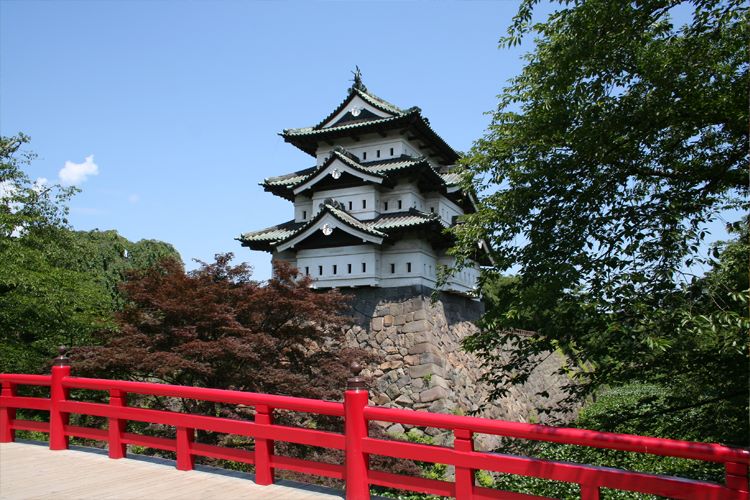
Originally, the castle was named “Takaoka Castle (高岡城)”. Since the completion of the castle, the construction of a “castle town” that aimed to strengthen the castle’s defence facility while also serving an administrative and commercial function began.
In 1628, the completion of the castle town (and the three-story turret to replace the castle keep) prompted the renaming of the castle as “Hirosaki Castle”.
The Hirosaki Park today, where we may now stroll freely, wasn’t actually built for the locals’ leisure. The fortified moats, castle gates, and several corner turrets were there to protect the Hirosaki Castle from any potential invaders (´▽`*).
The original five-story castle keep was unfortunately struck by lightning in 1627 and was consequently burnt to the ground (the lightning just happened to strike the explosives storage). Despite the castle keep’s importance as a defensive structure, rebuilding it did not begin. The Tokugawa Shogunate didn’t approve of rebuilding the castle keep, instead opting to build a three-story turret.
The reconstruction of the castle keep was allowed only in 1810 to keep an eye on Russian ships entering the Tsugaru Strait. It took 8 years to complete.
After Matsumae Castle’s castle keep in Hokkaidō was burnt down in 1949, the Hirosaki castle keep is now the northernmost castle keep in Japan. It is also the only castle in Northeastern Japan to have retained its “original” appearance since the Edo period (1603 – 1867), and one of the 12 Castles With the Original Castle Keep in Japan.
The Castle Keep that Doesn’t Sit on the Stone Wall
If you visit Hirosaki Castle before 2025, you won’t be able to see the castle tower sitting atop the stone walls, as shown in the video/photo.
As of 2015, the castle keep has been moved to another spot in Hirosaki Park (just 70 meters away from where it was) so that the stone wall can be repaired. It is simply amazing how they managed to move the castle tower!
As you can see in the Instagram post below, there is nothing on top of the stone base at the moment. According to the explanation board inside the castle keep, the entire castle keep structure was lifted and moved using a temporary rail track installed (the 3rd photo in the left IG post below).
Like other castle keeps in Japan, Hirosaki Castle’s interior is a small museum about its history. You can also overlook Hirosaki Park and Mt. Iwaki from the windows.
Mt. Iwaki Observation Deck at Hirosaki Park
The best thing about moving the castle keep to its current location is that you can get a photo of the castle with Mt. Iwaki as a backdrop.
Mt. Iwaki s also known as “Tsugaru Fuji” due to its similar shape to that of the actual Mt. Fuji. The snow cap may remind you of the view of Mt. Fuji in Yamanashi Prefecture (*´ω`)?
From where the castle keep is located, you can easily get a nice photo of the tallest mountain in Aomori Prefecture. Don’t forget to take a selfie with it before exploring Hirosaki Park!

Hirosaki Park
After the Edo period, the vast grounds of the Hirosaki Castle were turned into a park where commoners like you and I could enjoy in 1895. The Hirosaki Park spans 492,000 square meters. The park features a variety of plants, from approximately 2,600 cherry blossom trees (52 different types) to ginkgo and chrysanthemum, all adding seasonal color throughout the year (*’▽’). Many of the cherry trees were donated by the locals in the early 20th century.
Most parts of Hirosaki Park are free to access. However, you must pay an admission fee to enter the areas below.
- Hirosaki Castle
- Visit Hirosaki Castle Botanical Garden (弘前城植物園)
HERE is the map for Hirosaki Park’s admission area.
Hirosaki Castle Botanical Garden (弘前城植物園)
If you love being surrounded by various plants, don’t miss out on the Hirosaki Castle Botanical Garden! During the cherry blossom season, the garden is a haven to escape from the massive crowds.
Boasting a size of 76,500 square meters and around 1,500 different types of plants, this well-maintained garden is as pretty as a painting from spring to autumn. You may also find cherry blossom trees that can’t be found elsewhere here in Hirosaki Park (*´ω`).

If you are interested in which flowers bloom in what month, refer to HERE on their official website and translate it using Google Chrome’s translation function at the right of the address bar!
This Japanese garden is said to be the origin of the Tsugaru region’s gardening style and is thus treated as a valuable asset in Hirosaki.
Do not worry if it rains during your visit. There are free resting areas and a cafe (=゚ω゚)ノ.
HERE is a simple map of the garden. The English map is on page 2 of the pdf.
It will take you approximately 40 minutes to an hour to stroll around the garden (^_-)-☆.
Hirosaki Castle Entrance Fee and Opening Hours
HERE is a complete map of Hirosaki Park (in Japanese, as there is currently no English version). The part coloured light orange can only be accessed with an admission fee. The light orange area on the left is where the Hirosaki Castle is located, and the area to its right is the botanical garden.
Hirosaki Castle (弘前城本丸・北の郭)
- The admission fee is
- 320 yen for adults
- 100 yen for children
- The castle is open from 9 am to 5 pm between April 1 and November 23.
- During Cherry Blossom Festival in late April, the castle is open from 7 am to 9 pm.
Tip: From November 24 to the end of March, it is FREE to stroll around this area. However, you could not explore the interior of the castle during that time.
Hirosaki Castle Botanical Garden (弘前城植物園)
- The admission fee is
- 320 yen for adults
- 100 yen for children
- The garden is open from 9 am to 5 pm from mid-April to November 23.
- The last admission is at 4:30 pm.
- During Cherry Blossom Festival in late April, the castle is open from 7 am to 6 pm.
- The last admission is at 5:30 pm.
Tip: Visit the garden on the last Sunday in May to explore the Garden for FREE!
A combo ticket is also available to enter both areas (520 yen for adults and 160 yen for children). With this combo ticket, you can also access Fujita Memorial Garden (藤田記念庭園), another popular attraction spot in Hirosaki City, for free (=゚ω゚)ノ.
Hirosaki Castle Sannomaru Ōtemon Gate (弘前城 三の丸追手門)
Apart from the castle tower, the garden gates and three other turrets also feature historical monuments worth a visit.
This gate is just meters away from the Hirosaki Botanical Garden mentioned above. If you are getting there by bus, get off at Shiyakusho Mae (市役所前), and you will see this gate as soon as you get off!
Before you enter the garden, however, consider checking out the Ōtemon Square (追手門広場) opposite this gate for some Miniature Structures (ミニチュア建造物). There you will find 14 miniature buildings that were built during the Meiji and Taisho periods (1868 – 1926)!
For more information, please refer to our article on Hirosaki City (=゚ω゚)ノ.

The Famous West Moat (西濠)
Hirosaki Park isn’t just stunning in areas where you can stand under the cherry blossom trees. The view of the flowers on either side of the moat is equally famous! Whether it is the reflection of the blossoms during the day or the romantic atmosphere in the illuminated night, you will never regret dropping by one of these moats (especially the one in the west of the castle)!
You will also find the cherry blossom tunnel at the West Moat (^_-)-☆.
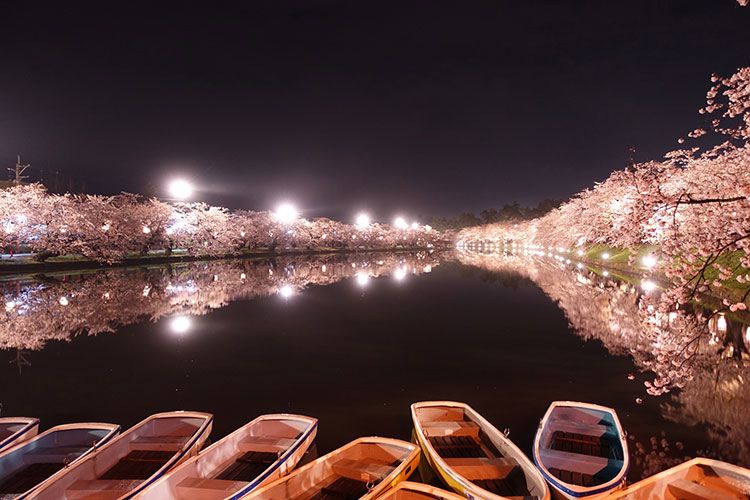
If you are curious what the boats are for in the photo above, they can be rented from 9 am to 5 pm from mid-April to early May (the last admission is at 4:30 pm).
The cost is 1,000 yen for a 60-minute boat ride. The boat’s capacity is three people.
You have probably seen photos of Japan’s roads covered by cherry blossom petals in spring, and the photo on the left-hand side might look like one of them.
But, if you attempt to walk on this “road” you will find yourself bathing in flower petals – which sounds quite nice… except you might catch a cold the next day (´▽`*).
Underneath these petals is actually the castle’s moat! The Japanese call it the Floral Raft (花筏). It is one of the must-visit spots if you ever visit Hirosaki around late April!
Tip: A relatively unknown great photo spot to many tourists is at the north end of the west moat. You can get an amazing photo of the Shunyō-bashi Bridge (春陽橋). It is where many professional photographers gather.
Hirosaki Castle Lotus Pond Moat (弘前城 蓮池濠)

Opposite the West Moat, you will find this moat, filled with lotus.
In summer, from July to August, hundreds of brightly colored lotus flowers bloom (*´ω`).
If you happen to visit Hirosaki for its Neputa Festival at the beginning of August, this scenery might be something to chill out to (´▽`*).
The Most Romantic Spot at Hirosaki Park
Looking for ideas for where to propose to your loved one? How about Hirosaki Park (≧▽≦)! The spot is the most romantic when pink cherry blossom flowers cover the branches of the trees. But throughout the year, even in winter, this heart shape can be seen!
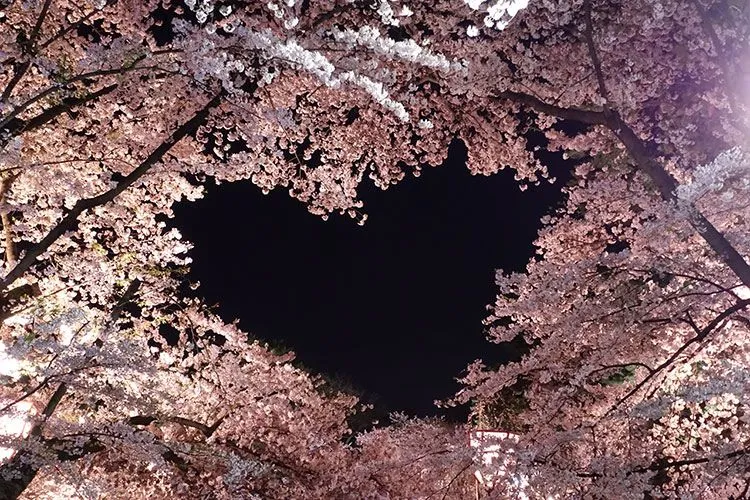
Now, if you pay attention to the ground, you will find a heart-shaped mark on the ground (refer to the Instagram post above). As soon as you find this mark, look up. The heart shape is just above you (if you are tall, you might need to lower yourself a bit)!
During the cherry blossom season, the spot is easy to identify. There will be many people in front of it. Even if you weren’t’ aware of this natural attraction, those people will definitely make you curious about what they are taking photos of!
This was initially a hidden spot in Hirosaki Park up until the summer of 2014.
And if you aren’t good at finding things, here is the map to guide you (^_-)-☆.
The 500-Year-Old Tree for Fans of the Anime “Demon Slayer” (鬼滅の刃)
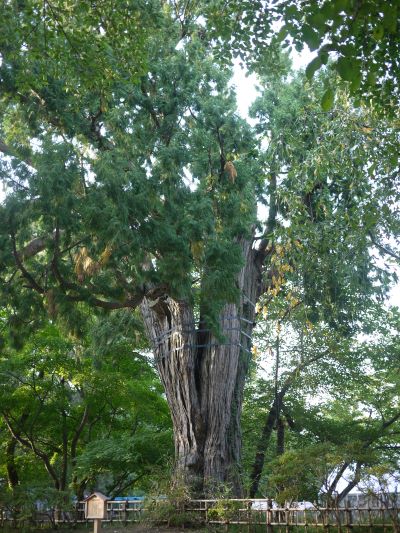
If you love the anime “Demon Slayer”, you might want to visit this old tree called “Nezuko”. Yes, it has the same name as the main character’s little sister in the anime!
Hirosaki Park’s grounds were originally a massive virgin forest with many more Nezuko trees. As the city develops, this tree might be the only Nezuko tree left in the Northern part of Japan in the future.
The tree is, therefore, precious to Aomori Prefecture and has been under good care for a long time. When students come to Hirosaki Garden on an excursion, they are told how valuable this tree is. The fact had not gained much attention from the audience until after the anime became a big hit. These days, the guides of the park can clearly see more excitement on the students’ faces (´▽`*).
To find this tree, find your way to the Hirosaki City Gardening Information Center (弘前市緑の相談所). The tree is just next to it (^_-)-☆.
How to Get to Hirosaki Castle and Park
- From JR Hirosaki Station (弘前駅), Hirosaki Park is a 30-minute walk.
- To get from Aomori Cruise Port/Terminal to Hirosaki Castle, you need to either walk or take a taxi to Aomori Station. From there, follow our How to Get to Hirosaki by Public Transport article to get to Hirosaki Park.
- To get to Hirosaki Castle from Tokyo, take the Tohoku Shinkansen to Shin-Aomori Station. From there, follow our How to Get to Hirosaki by Public Transport article to get to Hirosaki Park.
- You can also cut your travel time by taking a bus from Hirosaki Bus Terminal(弘前バスタミナール) in front of JR Hirosaki Station for 100 yen.
- Dotechō Junkan Bus (土手町循環バス) departs from bus stop no. 8 between 10 am and 6 pm from April to November every 10 minutes (10 am to 5 pm from December to March).
- You can either get off at Shiyakusho Mae (市役所前), Mutsu Shinpō Yashiromae (陸奥新報社前), or Bunka Sentā Mae (文化センター前).
- Refer to HERE for the service’s timetable in Japanese.
- If you don’t read Japanese, use one of Japan’s Transport Apps to plan your visit.
Tip: Refer to our How to Get to Hirosaki by Public Transport article to plan your visit to Hirosaki. You won’t regret reading it, especially if you plan to visit Hirosaki for the cherry blossoms.
The JR Passes That Cover Aomori Prefecture
Below is a list of JR passes covering Aomori Prefecture and other regions. Please keep in mind that, depending on your itinerary, a JR pass may or may not be worthwhile for your trip. Refer to HERE for ways to determine if a JR Pass is worth it for your trip.
- JR Pass (7-Day, 14-Day, or 21-Day)
- JR EAST PASS(Tohoku area)/ 5 Days
- JR East-South Hokkaido Rail Pass (6 Days)
Tip: During cherry blossom season, trains to and from Hirosaki are packed. If you have one of the JR Passes that covers Aomori Prefecture, reserve your seats on one of the limited express or the sightseeing train, Resort Shirakami.
Where Else to Visit in Hirosaki?

As the cultural heart of Aomori Prefecture and Japan’s undisputed cherry blossom capital, this historic castle town offers a perfect blend of feudal history, stunning botanical gardens, and unique Western-style architecture. So, in addition to Hirosaki Castle Park, allocate some time to explore other attractions in one of the big cities in northeastern Japan!
Refer to our Hirosaki City article for our recommended Hirosaki attractions!