Nestled in the historic town of Iwadeyama (岩出山) on the way to Naruko Gorge, lies the Former Yūbikan and its Garden (旧有備館および庭園). Originally built as a retirement villa for the Date clan, this site evolved into one of Japan’s oldest surviving provincial schools, where the children of retainers once balanced the study of literature with archery and horsemanship. While the elegant thatched-roof main building stands as a symbol of resilience, the surrounding strolling pond garden remains its highlight. Designed by a master of the tea ceremony in 1715, the garden “borrows” the dramatic cliffs of the Iwadeyama Castle ruins as its backdrop, creating a living tapestry of 300-year-old trees and tranquil islands. For travelers seeking to uncover the cultural roots of the Miyagi countryside, the Yubikan offers a quiet, scholarly sanctuary where the legacy of the Date family continues to bloom through every season.
Iwadeyama: The 12-Year Home of Date Masamune
Long before Lord Date Masamune (伊達 政宗) built his famous castle in Sendai, he spent 12 formative years living and ruling from Iwadeyama. In 1591, the legendary warrior, Date Masamune (伊達政宗), moved from Yonezawa (米沢) to this very spot, then known as Iwatezawa (岩手沢), and renamed it Iwadeyama (岩出山). Although he moved to Sendai Castle in 1601, Iwadeyama remained a vital stronghold for the family, governed for generations by the Iwadeyama Date branch, starting with Masamune’s fourth son, Muneyasu (宗泰).
The Former Yubikan: Japan’s Oldest Scholar’s Retreat
The Yubikan was originally built around 1677 as a retirement villa at the northern foot of the castle hill for Date Munetoshi (宗敏), the second lord of the Iwadeyama Date clan. The residence was later transformed into a Hankō (domain school) in 1850 by the 10th lord, Kuninao (邦直), where the children of samurai were educated in both literature and military arts.
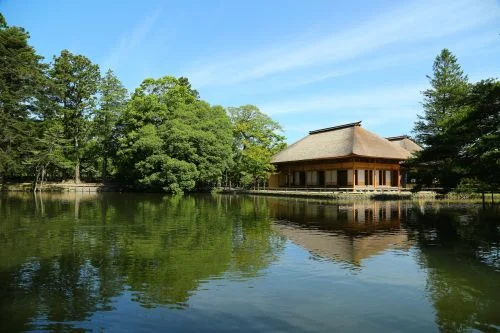
The main building (Oaratamedokoro, 御改所) is believed to have been built around 1677 as a retirement villa for the 2nd lord, Munetoshi. It is a quintessential example of Shoin-zukuri architecture, featuring a grand thatched roof and simple, elegant wooden interiors. In its heyday, the grounds were not just for literature. They included a shooting range (iba, 射場) and a riding ground (baba, 馬場), where the children of samurai retainers polished both their scholarly knowledge and their martial skills. In 1933, its historical and aesthetic value was officially recognized when it was designated as both a National Historic Site and a Place of Scenic Beauty.
The national treasure was meticulously restored in 2016 to its original Edo-period elegance after being damaged in the 2011 earthquake.
The Yubikan Garden: A Masterpiece of Borrowed Scenery
Yubikan’s surrounding garden, completed around 1715 during the era of the 4th lord, Murayasu (村泰), is considered a masterwork of Japanese landscaping. The magnificent strolling pond (Chisen Kaiyu-shiki, 回遊式池泉庭園) garden offers breathtaking views that shift with the calendar, from vibrant spring blossoms and lush summer greens to the fiery maples of autumn.
The garden was crafted by Shimizu Dōkan (清水道竿), the third-generation master of the Sekishu-ryu tea ceremony school and head of tea ceremony for the Sendai Domain.
- Shakkei (Borrowed Scenery): The garden cleverly uses the steep cliffs of the Iwadeyama Castle ruins as a natural backdrop, making it feel much larger and more dramatic than its actual borders suggest.
- The Four Islands: The 500-meter perimeter pond features four distinct islands, including Kameko-nakashima (Turtle Island) and Tsurugashima (Crane Island), which are traditional symbols of longevity and auspiciousness in Japanese landscaping. The largest, Onakajima (御中島), is connected by a charming earthen bridge and features a traditional tea pavilion at its center.
- 300-Year-Old Spirits: Some of the ancient trees within the garden have stood for over 300 years, offering a constantly shifting tapestry of blossoms, lush summer greens, and stark winter silhouettes that have remained virtually unchanged since the Edo period.
Yubikan no Mori Park
Surrounding the historic site is Yubikan no Mori Park, a sprawling green space that protects the cultural landscape while offering a peaceful place for reflection. It is an ideal spot to take in the “borrowed scenery” of the nearby cliffs and woods that have watched over the town for centuries.
- Relaxation & Recreation: The park features open lawns, walking paths, and a bamboo grove, providing a peaceful spot for a picnic or a quiet stroll.
- Cultural Connection: It often serves as a venue for local events, helping to keep the “samurai town” spirit alive for the modern community.
The Former Yubikan and Its Garden’s Opening Hours and Access Information
- The Former Yubikan and Its Garden is open from 9 am to 5 pm from Tuesday to Sunday.
- The last admission is at 4:30 pm.
- If Monday is a public holiday, it will close the next business day.
- The villa is closed from December 29 to January 3.
- The admission fee is
- 400 yen for adults
- 300 yen for senior high school students
- 200 yen for elementary and junior high school students
- The villa is a one-minute walk from JR Yūbikan Station (有備館駅).
Tip: While you are in Iwadeyama, don’t miss the Kankaku Museum (Senses Museum) or the Bamboo Craft Museum, both of which are within easy walking distance and showcase the town’s creative heritage.
Continue Your Journey to Naruko Onsen
While the scholarly halls of the Yubikan offer a glimpse into the disciplined world of the samurai, the next stop on your journey promises a different kind of restoration. As you continue westward on the Rikuu East Line, the refined gardens of Iwadeyama give way to the rugged, volcanic beauty of the mountains. To plan your arrival and discover the best healing waters to soak in after your history walk, head over to our Comprehensive Guide to Naruko Onsen, where we detail the village’s top baths, local crafts, and seasonal trails.