Imagine stepping onto a mountain ridge at dawn to find a 400-year-old feudal fortress completely suspended over a brilliant, white ocean of mist. Bitchu Matsuyama Castle (備中松山城) in Okayama Prefecture, famously known as Japan’s “Castle in the Sky”, is the country’s highest original surviving castle, and catching its ethereal unkai (sea of clouds) phenomenon is a bucket-list experience for any traveler. However, navigating rural transit lines, coordinating early-morning taxis, and finding reliable plant-based food in the countryside can be challenging. So, read on for information about how to witness the breathtaking Bitchu Matsuyama Castle sea of clouds, how to easily book your transport, and how to comfortably survive a day trip to Takahashi City as a vegetarian or vegan explorer.
All You Need to Know Before Visiting Bitchū Matsuyama Castle
- Why Is Bitchu Matsuyama Castle Famous?
- Meet Sanjuro, Bitchū Matsuyama Castle’s Resident Cat Lord
- How to See the Bitchu Matsuyama Castle “Sea of Clouds” (Unkai)
- Accessing the Bitchu Matsuyama Castle Observation Deck
- How to Get to Bitchū Matsuyama Castle Keep
- Best Season to Visit Bitchū Matsuyama Castle
- Guided Tours at Bitchū Matsuyama Castle
- Bitchū Matsuyama Castle Opening Hours and Admission Fee
- Vegetarian & Vegan Guide to Takahashi City
Why Is Bitchu Matsuyama Castle Famous?
While Japan is famous for its majestic fortresses, Bitchu Matsuyama Castle, known as the Takahashi Castle (高梁城), stands completely in a league of its own. Unlike iconic giants like Osaka or Himeji Castle, which draw massive city crowds, this mountaintop stronghold offers an intimate look into feudal Japan, entirely preserved in its natural, rugged environment. Because of its history and location, history buffs or photography enthusiasts flock to this remote peak in Okayama Prefecture.
The Highest Surviving Original Castle Keep in Japan
Out of the thousands of castles that once protected feudal Japan, only 12 original keeps (Tenshu) survive today. The rest were destroyed by fires, wars, or the Meiji Period dismantling decrees, with modern replacements built out of concrete.

Bitchu Matsuyama Castle is not only one of these precious 12 originals but also the highest mountain castle (yamajiro) in Japan, featuring an intact keep at an elevation of 430 meters (1,410 feet) above sea level.
When you step inside, you are walking on the exact timber floors trodden by samurai centuries ago. Because of this architectural rarity and historical integrity, it has been designated as one of Japan’s National Important Cultural Properties.
A Turbulent 800-Year Feudal History
The story of Bitchu Matsuyama Castle spans nearly eight centuries of shifting power, complex military strategy, and architectural evolution:
- 1240 (The Origin): The castle’s long history goes as far back as 1240 AD. It was originally built by Akiba Shigenobu (秋庭重信) as a small turret on top of Mt. Ōmatsu (大松山), one of the peaks in the greater Gagyūzan (臥牛山) mountain range.
- 1331 (Relocation and Expansion): In 1331, the fortress was officially transferred to its current home on Mt. Komatsu (小松山) and expanded into a proper, fortified castle to take advantage of the sheer, impenetrable cliffs.
- The Sengoku Period (1467–1615): Because Bitchu Matsuyama Castle was located at a highly strategic point connecting the San’yo and San’in regions, civil wars were frequent. As a result, the lord of the castle changed frequently during this bloody era. Along with these frequent changes in ownership, the fortress’s physical scale gradually increased as each successive lord added their own “home renovations” and defensive upgrades.
- The Edo Period (1600–1868): During this time, the castle keep was heavily renovated, becoming the structure we see today.
The Genius of the Two-Story Keep
Different from other famous castle keeps in Japan, Bitchu Matsuyama Castle’s keep is only two stories tall.
Why is it so short? Because it simply didn’t need to be any taller! Back then, the samurai utilized the mountain’s natural geographical advantage, sitting high at 430 meters above sea level. This massive elevation offered them a sprawling, unobstructed view of the valley below, so a massive, multi-tiered tower wasn’t necessary to spot incoming enemies.
Meet Sanjuro, Bitchū Matsuyama Castle’s Resident Cat Lord
Beyond the architecture and bloody battles, the castle is world-famous for its current honorary lord: Sanjūrō (さんじゅーろー).
Named after Tani Sanjuro (谷三十郎), a local samurai captain from the late Edo period, this friendly white-and-orange stray cat wandered up the mountain during a natural disaster in July 2018. He quickly won the hearts of the staff and visitors, eventually being officially welcomed as the castle’s worthy lord, loved by all his subjects. He even has an Instagram Account documenting his relaxing life in the Castle (´▽`*).

Today, Sanjuro roams the grounds, greets tourists, and has single-handedly boosted local tourism. So next time you visit the castle, remember to look for this super cute new lord and greet him properly with a bow!
Tip: Sanjūrō usually patrols the castle grounds at 10 am and 2 pm. As the route isn’t fixed as it’s based on his mood, ask the staff for the lord’s location in case you can’t spot him.
How to See the Bitchu Matsuyama Castle “Sea of Clouds” (Unkai)
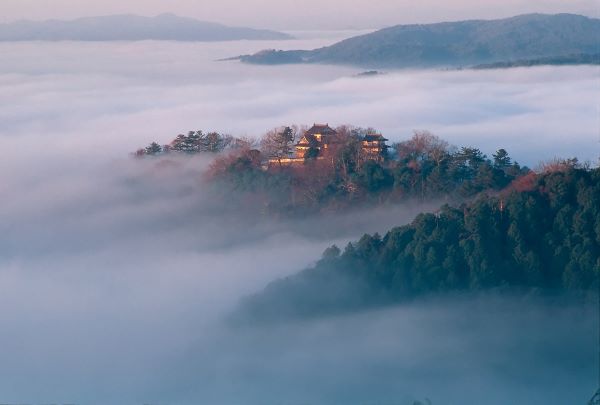
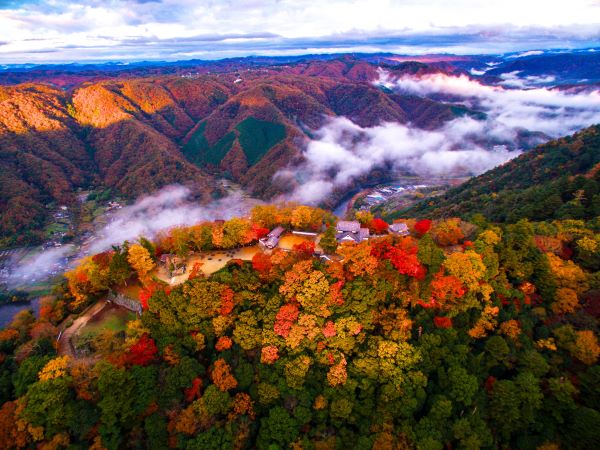
Bitchū Matsuyama Castle is most famous for its view, floating eerily in the sky. When the cloud shrouds the rest of the mountain below the castle, a fantasy painting of a castle floating in the sky is complete!
However, the ethereal sight is not a daily occurrence. Known in Japanese as unkai (海雲), this natural phenomenon requires an exact recipe of season, timing, and specific weather patterns. If you want to maximize your chances of witnessing this breathtaking spectacle, you must plan your morning around the following conditions.
The Best Months: Autumn to Early Spring
While the clouds can technically form anytime from late September to early April, your absolute best window is from late October to early December.
November is universally considered the gold-standard month to visit. Not only is the fog at its thickest and most reliable during this period, but it also perfectly coincides with Japan’s peak autumn foliage (koyo), framing the floating fortress in brilliant red and gold maple leaves.
The Exact Weather Formula
The mist that fills the Takahashi City valley is a type of radiation fog. To predict whether the unkai will appear on any given morning, look closely at the local weather forecast the night before. You are looking for three critical factors:
- Peak Season: Late September to early December (Late autumn is best)
- Best Time of Day: Sunrise until around 8 am
- Ideal Weather: A clear, sunny day with little to no wind
- The morning forecast must be clear and sunny. High wind or rainy conditions will immediately disrupt and scatter the delicate fog layer.
- The Temperature Trigger: A sharp drop between day and night temperatures (at least 10°C difference)
- Recent Rainfall: Mist is highly likely to manifest in the early mornings roughly two to three days after a rainstorm, as the lingering humidity in the valley gets trapped by the dropping temperatures.
Local Pro Tip: Before leaving your hotel at dawn, check the “Unkai Shutsugen NAVI“ or look up the live YouTube stream of the castle to see if the fog has successfully formed before paying for your transit up the mountain.
Timing Your Morning Arrival
The unkai begins to accumulate at dawn and generally puts on its best show from sunrise until around 8 am.
As the sun climbs higher in the sky, it warms the valley, causing the mist to evaporate quickly. To secure a prime viewing spot on the observation deck and watch the castle periodically appear and disappear through the moving waves of fog, aim to arrive at the Sea of Clouds Observatory (Unkai Tenbodai) by 7 am.
Accessing the Bitchu Matsuyama Castle Observation Deck
Because the Sea of Clouds Observation Deck (Unkai Tenbodai, 雲海展望台) sits on a completely separate mountain ridge across the valley from the castle itself, you cannot rely on local trains or regular city buses to get there. Walking from the train station is impossible due to the distance and steep mountain roads.
For travelers without a rental car, the absolute best, most cost-effective way to witness the floating castle is by using the local Unkai Shared Sightseeing Taxi (天空の城備中松山城観光雲海乗合タクシー).
Important:
☛ You might encounter some wild monkeys around the Observatory Deck. Please leave them alone and don’t disturb them.
☛ From December to February, some snow may accumulate at the Observatory, so please take care and watch your step!
Shared Taxi Fast Facts
- Operating Season: Daily from October 1st to March 31st (the peak unkai season).
- Fare: 3,000 yen per person for the round-trip journey.
- Departure Point: Directly outside the JR Bitchu-Takahashi Station (備中高梁駅) West Exit / Tourist Information Center.
- Outbound Trip Departure Times: The taxi departs twice every morning, typically at 7:30 am and 8 am from JR Bitchū-Takahashi Station.
- Returning Trip Departure Times: 8:40 am and 9:10 am
- Reservation is essential by 5 pm the prior day. To reserve your spot, you can either call them at +81-866-22-8666 from 9 am to 5 pm or email them at [email protected].
If you read Japanese, you can also refer to the official website, which includes a link to the shared taxi service. There is also a link to Reserve Online.
Step-by-Step Guide to Booking and Riding
To successfully secure your seat and see the morning mist, you must navigate a strict reservation window:
Step 1: Make a Phone Reservation the Day Before
Reservations are mandatory. You must call the Takahashi City Tourist Information Center at +81-866-22-8666 no later than 5:00 PM on the day before your planned visit.
- Note: The local tourism staff may have limited English proficiency. If you do not speak Japanese, it is highly recommended to ask the front desk staff at your hotel in Okayama or Kurashiki to make the phone call on your behalf.
Step 2: Catch the Early Morning Train to Takahashi
If you are staying in Okayama City, you will need to wake up before dawn. Take an early morning train on the JR Hakubi Line or the JR Yakumo Limited Express from Okayama Station to ensure you arrive at JR Bitchu-Takahashi Station well before your taxi’s scheduled departure.
Step 3: Board the Taxi at the Station West Exit
When you arrive at Bitchu-Takahashi Station, head down to the West Exit. The shared sightseeing taxis park near the station front, adjacent to the tourist information office. Simply check in with the driver or coordinator using the name you gave during your reservation.
Step 4: Enjoy 70 Minutes of Sightseeing and Photography
The taxi ride up the winding mountain pass takes roughly 15 to 20 minutes. Once you arrive at the Observation Deck, the driver will park and grant all passengers approximately 30 to 40 minutes of free time to take photos, enjoy the viewing platforms, and watch the castle float above the clouds.
Step 5: Return to the Train Station
After your photography session, everyone boards the same shared taxi for the 15-minute ride back to JR Bitchu-Takahashi Station.
Important Itinerary Note: Once you arrive back at the train station around 9 am, your morning journey is only half complete! To actually hike up to the castle keep and explore the ruins up close, you will need to book a completely separate sightseeing taxi or shuttle bus that departs from the station and climbs up to the Fuigo-Toge Pass (8th Station) trailhead.
How to Get to Bitchū Matsuyama Castle Keep
Reaching the actual castle ruins and original keep requires a completely different approach than visiting the morning observation deck. Because the fortress sits atop Mount Komatsu at 430 meters above sea level, your journey will involve a combination of local trains, dedicated mountain transit, and a short, scenic hike.
Whether you are starting your morning fresh or returning to the station after watching the sunrise unkai (sea of clouds), here is the exact step-by-step route to reach the summit.
Step 1: Travel from Okayama to JR Bitchu-Takahashi Station
The gateway to the castle town of Takahashi is JR Bitchu-Takahashi Station (備中高梁駅).
- The Fast Option: Take the JR Yakumo Limited Express (やくも) from Okayama Station (岡山駅). It takes roughly 35 minutes and costs approximately 1,950 yen one way.
- The Budget Option: Take a local train on the JR Hakubi Line (伯備線) from Okayama Station. This takes about 55 minutes and costs 860 yen one way (fully covered by the JR Pass).
Step 2: Journey Up the Mountain to Fuigo-Toge Pass (8th Station)
You cannot take public transport or a standard city bus all the way to the top of the castle. Vehicles can only drive as far as the Fuigo-Toge Pass (ふいご峠), which serves as the 8th station trailhead. To get from the train station up to the trailhead, you have two primary options:
Option A: The Castle Shared Sightseeing Taxi (Recommended)
This is a dedicated shared shuttle taxi operating directly between the station and the 8th station trailhead.
- Cost: 1,000 yen per person, one way.
- Departing Schedule: Taxis depart the station at fixed intervals throughout the day (10 am, 11:30 am, 1 pm, and 2:20 pm).
- Returning Schedule: 11:50 am, 1:20 pm, 2:40 pm, and 4:10 pm
- Reservation: Just like the morning observation deck taxi, you must call the Takahashi City Tourist Information Center (高梁市観光案内所) (+81-866-22-8666 between 9 am to 5 pm) by 5 pm the day before to reserve your seat.
Option B: The Weekend Castle Shuttle Bus (備中松山城登城整理バス)
If you are visiting on a weekend, national holiday, or during peak travel seasons (April, May, September, October, and November), a dedicated castle shuttle bus operates out of the Shiromibashi Park Parking Lot (城見橋公園駐車場), up to the Fuigo-Toge Pass trailhead for 500 yen round trip (200 yen for elementary and junior high school students). When shuttle bus services are operating, you won’t be able to drive all the way up to the castle car park, so you have to park at the 5th Station.
- Bitchū Matsuyama Castle Weekend Shuttle Bus operates from 8:45 am to 5:45 pm from April to September (the last service to the castle departs at 4:30 pm) .
- Between October and March, the bus’s last service back to Takahashi Station departs at 4:45 pm (the last service to the castle departs at 3:30 pm) .
- If you read Japanese, more information can be found on Takahashi City’s website.
Tip: If you can’t speak Japanese, kindly ask the station staff or the staff at your accommodation to help you book a shared taxi!
Note for Drivers: When shuttle bus services are operating, you won’t be able to drive all the way up to the castle car park, so you have to park at the free Shiromibashi Park Parking Lot (城見橋公園駐車場) at the 5th Station.
Step 3: Hike the Mountain Trail to the Castle Keep
Once you arrive at the Fuigo-Toge Pass clearing, motorized transport ends. From here, everyone must embark on a 20-minute uphill hike (approx. 700 meters) to reach the castle gates.
The trail is well-maintained but contains steep dirt steps, slopes, and stone pathways. As you climb, you will pass towering, 10-meter-high stone walls built directly into the natural mountain bedrock, a testament to why this mountain fortress was considered completely impregnable by feudal samurai.
Ensure you wear comfortable walking shoes or sneakers; high heels or slick sandals are not recommended for this section.
Tip: Refer to our Top 3 Comfortable Walking Shoes for Overseas Travel article if you need a new pair.
The Takahashi City Loop Bus (高梁市内循環バス) + Hiking Approach
You can also take the Takahashi City Loop Bus (高梁市内循環バス) from the Takahashi Bus Center (高梁バスセンター), which is just opposite the JR Bitchū-Takahashi Station and get off at Matsuyamajō Tozan Kuchi (松山城登山口), which is the Matsuyama Castle Trailhead.
From the trailhead, it will take around 50 minutes to get to the castle.
- Refer to the 2nd table on Biko Bus Website (備北バス) for the service’s timetable. The timetable is in Japanese, so please use the Japanese characters listed above to read.
Hiking All the Way Up to Bitchū Matsuyama Castle Keep
- You can also trek all the way up to the castle, which will take you around 90 minutes from JR Bitchū-Takahashi Station.
- From Sea of Cloud Observatory (雲海展望台), it will take you around 60 minutes to trek to the castle.
Best Season to Visit Bitchū Matsuyama Castle
While the mountain scenery is beautiful year-round, your experience will change dramatically depending on when you choose to hike:
- Autumn (Late October to Early December) – The Best Overall Season: This is the undisputed prime time to visit. It is the only season where you can reliably catch the early morning “sea of clouds” phenomenon and view the castle framed by breathtaking crimson autumn leaves.
- Spring (Early April) – The Cherry Blossom Window: A beautiful, less intense alternative to autumn. The mountain slopes and castle walls come alive with sakura (cherry blossoms), making the uphill hike even more scenic.
- Summer (June to August) – Proceed with Caution: Summer offers lush, vibrant green forests, but the humidity in Okayama is exceptionally high. The 20-minute uphill mountain trek can be exhausting in the heat, so packing plenty of water is essential.
Bitchū Matsuyama Castle Opening Hours and Admission Fee
The average required time at Bitchū Matsuyama Castle is 2 hours, including the hike from Fuigo-Tōge (ふいご峠).
- April to September: 9 am to 5:30 pm
- The last admission is at 5 pm
- If traffic restrictions are in place on the day and shuttle bus services are running, please head to the stop where you get off at 4:30 pm.
- October to March: 9 am to 4:30 pm
- The last admission is at 4 pm
- If traffic restrictions are in place on the day and shuttle bus services are running, please head to the stop where you get off at 3:30 pm.
- The castle is closed from December 28 to January 4.
- The admission fee is
- 500 for adults
- 200 yen for elementary and junior high school students
Tip: Get a set ticket that allows you access to Bitchū Matsuyama Castle, Takahashi City Old Samurai Residence (武家屋敷館), and Raikyū-ji Temple (天柱山 頼久寺) for 1,000 yen. 1,500 yen set ticket will give you access to Bitchū Matsuyama Castle, Takahashi City Old Samurai Residence (武家屋敷館), and Raikyū-ji Temple (天柱山 頼久寺), Takahashi Local History Museum (高梁市 郷土資料館), and Yamada Hokoku Museum (山田方谷資料館)
Guided Tours at Bitchū Matsuyama Castle
If you understand Japanese and would like someone to share interesting facts about the castle and the surrounding nature, book your personal guide at least 10 days before your travel date!
The guide will wait for you at the 8th Station, where you will be getting off the sightseeing taxi. Over 2 hours, your guide will not only talk about the history of the castle and its natural surroundings, but they will also introduce you to some local gourmet food. If you have any special dietary requirements, it might be worthwhile to let them know if they can do some advanced research for you!
The cost is 3,000 yen. You can book by calling +81-866-21-0461 or by filling out the web form.
Important: The guided tours are conducted in Japanese only at the moment.
Vegetarian & Vegan Guide to Takahashi City
Because Bitchu Matsuyama Castle is located in a rural mountain region of Okayama Prefecture, finding dedicated plant-based or vegan-friendly restaurants in Takahashi City can be incredibly challenging. Most local eateries rely heavily on traditional dashi (fish stock) for hidden seasoning, and English menus or ingredient transparency are rare.
To prevent you from hiking to the summit on an empty stomach, use this practical survival guide to navigate your dining options.
Local Cultural Highlight: “Tofu Meshi” (Tofu Rice)
When looking for traditional regional cuisine, keep an eye out for Tofu Meshi (とうふめし). Takahashi City is actually the main historical lore area for this local specialty!
Dating back to the Meiji era, Tofu Meshi originated as a dish heavily utilized in Buddhist vegetarian cuisine (Shojin Ryori). It features raw tofu that has been boiled, mashed, roasted, and delicately seasoned with soy sauce, layered over a bed of white rice alongside a mix of seasonal vegetables like burdock root (gobo) and dried shiitake mushrooms.
- ⚠️ Important Vegetarian Warning: While the core dish is rooted in Buddhist vegetarianism, modern local variations frequently use dried sardines (niboshi) in the soup base poured over the top, or include a shredded egg garnish. If you encounter it in a local diner, always double-check the soup base and request it without egg or fish stock (“Dashi nashi, tamago nashi”).
Essential Packing and Convenience Store Tips
Because sit-down vegan options near JR Bitchu-Takahashi Station are highly limited, the best strategy for a stress-free day trip is preparation:
- Pack a Bento from Okayama Station: Before boarding the JR Hakubi line to Takahashi, utilize the massive shopping centers at Okayama Station. You can pick up vegan-friendly macrobiotic treats or customized onigiri (rice balls) from specialty shops like Yamadamura (where the plain salt, plum/ume, and kombu kelp varieties are entirely plant-based).
- Stock Up at Local Combini: If you need to grab food in Takahashi, there are convenience stores located around the station area. Stick to reliable vegan convenience store staples like:
- Umeboshi (pickled plum) onigiri.
- Plain salted edamame.
- Banana packs, mixed nuts, and soy milk.
- Refer to Is It Vegan’s Website for a list of vegan food you can get at convenience stores.
Where to Eat Fully Plant-Based Nearby
If you are craving a robust, entirely vegan sit-down meal or course menu, your absolute best bet is to eat your main meals before or after your day trip in the surrounding cities:
- In Okayama City (35 mins away): Visit CBD Green right next to Okayama Station. It is a fully vegan cafe serving exceptional plant-based katsu curry, nourishing lunch plates, and raw vegan carrot cakes.
- In Kurashiki City (40 mins away): If you are pairing the castle with the historic Kurashiki Bikan Historical Area, stop by Tsubame Cafe for excellent, dedicated vegan-friendly Veggie Hamburger Teishoku.
Discover Where Else to Go Close to Bitchū Matsuyama Castle
Watching the castle float above the valley is an unforgettable experience, but the historic town below has even more hidden gems to offer.
If you want to maximize your day trip, check out our comprehensive guide to Takahashi City and the Amazing Sea of Clouds View. It highlights the best traditional streets, local samurai residences, and additional panoramic viewpoints you can easily explore after your morning mountain hike.