The Snow Monkey Park, or Jigokudani Yaen Kōen (地獄谷野猿公苑), formally in Japanese, is the world’s only wild monkey onsen resort. The park, nestled in the snowy mountains of Nagano Prefecture, Japan, was established in 1964. It offers an unforgettable glimpse into the unique lives of the Japanese hot spring monkeys. This world-famous attraction is the only place on earth where you can witness wild monkeys bathing in natural hot springs. Read on and learn why thousands of visitors flock to this beautiful, remote valley each year to see these captivating snow monkeys relax and play, especially during the colder winter months!
About Jigokudani Monkey Park
In 1970, the world learned about snow monkeys enjoying hot springs thanks to an article in LIFE Magazine. These wild monkeys’ charm was further broadcast when athletes who competed in the Nagano Winter Olympics visited the park in 1989. The onsen has since become a popular destination among photographers and animal lovers worldwide!
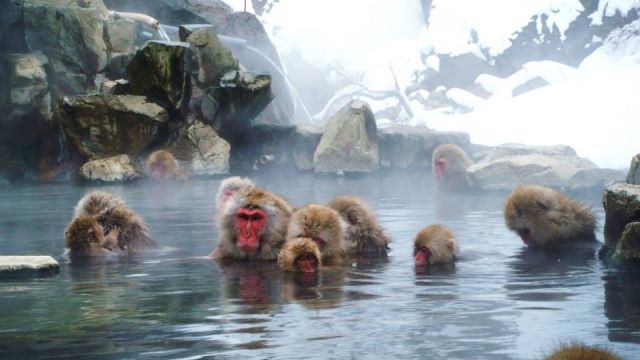
Winter is the best time to visit Jigokudani Monkey Park to see many Japanese monkeys in the hot pools. Situated at an altitude of 850 meters near Japan’s biggest snow resort, Shiga Kōgen (志賀高原), the snow in the valley can accumulate a layer of 1 meter.
But don’t worry; the staff will clear the snow on the promenade for us (^_-)-☆.
The Japanese macaque, also known as the snow monkey, has a habit of staying within a specific zone where they can find continuous food sources. Utilizing this habit, the park can lure the snow monkeys to visit during the day. Established away from surrounding villages and crop fields, the Jigokudani Snow Monkey Park protects crops from wildlife damage and provides the snow monkeys with an exclusive area to live.
All You Need to Know About Jigokudani Wild Monkey Park
- Jigokudani Snow Monkey Park Tours
- Jigokudani Monkey Park Facts and History
- How to Get to Jigokudani Monkey Park
- Jigokudani Monkey Park’s Opening Hours and Admission Fees
- Jigokudani Onsen Kōrakukan (後楽館)
- Some Interesting Knowledge About the Snow Monkeys
- What Do Snow Monkeys Eat
- What Not to Do at Jigokudani Snow Monkey Park
- Before You Head Out to Jigokudani Snow Monkey Park
- Inside Jigokudani Snow Monkey Park
- The Best Time of the Year to Visit Jigokudani Snow Monkey Park
Jigokudani Snow Monkey Park Tours
You can book Jigokudani Snow Monkey Park tours that include an English-speaking tour guide and transportation!
- Nagano Snow Monkey Park and Zenko-ji Temple Day Tour with Sake Tasting
- Suitable if you also want to discover one of the country’s oldest, largest, and most important Buddhist temples.
- Snow Monkeys and Shiga Kogen Day-Tour
- Suitable for those who also want to enjoy the snow at Shiga Kōgen.
- Other tours that include Jigokudani Snow Monkey Park as a destination.
Jigokudani Monkey Park Facts and History
If you have read our articles on other onsen resorts in Japan, you might remember that many of the hot spring sources in Japan were discovered in the same way. Centuries ago, when hunters were out in the wild chasing their prey, they noticed that their prey used hot springs to heal. Fast-forward to after the Industrial Revolution, and the scene of wild animals entering a hot spring has never been seen again. This is probably why those stories of how the hot springs were discovered are now mostly considered legends.
But somewhere in the 20th century, a small snow monkey was seen enjoying the hot spring at onsen Ryokan Kōrakukan (後楽館) near Jigokudani Monkey Park. It is said that it mimicked what the guests were doing. Upon seeing the small monkey relaxing in the hot spring, his mates eventually learned to enter it too!
For hygiene reasons and to protect wildlife and nature, an open-air bath was constructed exclusively for these monkeys at the Jigokudani Monkey Park. The joy of spending time in the hot spring has since been passed down among monkeys for generations.
Important: Especially the smaller monkeys, they might be so friendly and curious that they manage to stand on your belongings, such as your professional camera. Please don’t touch them; they might get frightened and bite you in return.
Why Is the Area Named Jigokudani
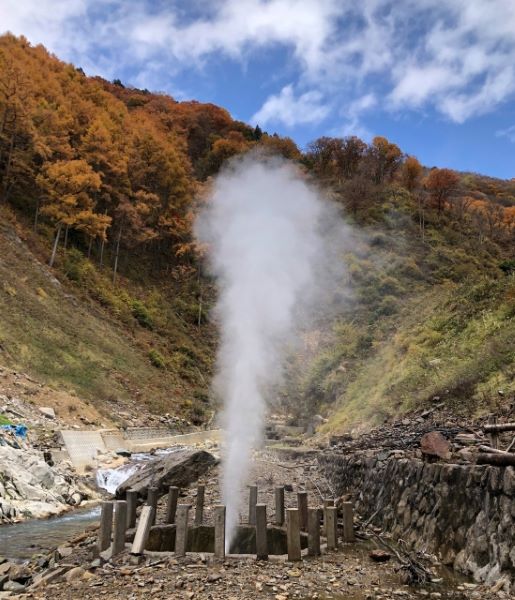
Back in the 19th century, in the valley where Jigokudani Snow Monkey Park is located, a couple of geysers produced awful sounds, creating the image of hell in locals’ minds.
Of course, the smell of the sulfur-based hot spring played an important role in making the area even more hell-like. This is why the valley was named Jigokudani, which means Hell Valley.
Over time, only this large geyser in the photo remains active. Although it is the only one left, the spring can reach up to 20 meters tall!
Nonetheless, the hot spring is still active, allowing the monkeys and us to warm up in the cold winter.
The Founding Jigokudani Onsen Kōrakukan
According to Kōrakukan’s history, the wife of the third owner of the ryokan saw snow monkeys lingering around the onsen when she got up in the morning. So, although she had never seen one in the hot spring pool, she doubted whether the monkeys had been enjoying themselves when humans were still sleeping.
In 1957, due to ski resort construction, the snow monkeys in the area were chased out of their original habitat, causing damage to locals’ crop fields. Feeling sorry for the monkeys, the wife of the 5th owner of Kōrakukan tried to lure the snow monkeys to the ryokan.
It wasn’t successful initially, but with advice from a Kyoto University professor and the help of a university researcher, they successfully changed the monkeys’ target to the apples they were given.
Why did a monkey go into a hot spring pool in the first place? Well, he was chasing a piece of apple that was thrown at him. The apple accidentally fell into the pool, and so did the monkey!
Before the ryokan staff realized, the snow monkeys had become regulars at the onsen pool.
Later, due to the persuasion of one of Nagano Dentetsu’s employees, a regular at Kōrakukan, the company established Jigokudani Monkey Park!
How to Get to Jigokudani Monkey Park

While the stunning scenery of the Jigokudani Wild Monkey Park is world-famous, its remote mountain location in Nagano Prefecture, Japan, can make the journey feel complicated. So let us break down exactly how to get to the Snow Monkey Park from major hubs like Tokyo and Nagano Station.
Refer to our article on How to Get to Jigokudani Monkey Park for more information!
Tip: You can also rent a bicycle from Bike Rentals and cafe maaru. The bicycle rental shop is in Obuse, where you can enjoy delicious chestnut desserts.
Important: Before you head in to meet the snow monkeys, please put all plastic bags and any food you might be holding in your hands into your bag. If you do not, the snow monkeys could attack.
Jigokudani Monkey Park’s Opening Hours and Admission Fee
- From April to October, Jigokudani Monkey Park is open from 8:30 am to 5 pm.
- From November to March, Jigokudani Monkey Park is open from 9 am to 4 pm.
- The admission fee is
- 800 yen for adults
- 400 yen for elementary school to high school students
Important: The opening hours above is just a rough guide. Hours may change depending on the monkeys’ activities. The day’s opening hours are announced at the top of their official website HERE.
Jigokudani Onsen Kōrakukan (後楽館)
Remember the aforementioned ryokan where a snow monkey was first found in a hot spring pool? It is still accepting travelers today!
Jigokudani Onsen Korakukan is a ryokan near Jigokudani Monkey Park. Established in 1864, it existed 100 years before Jigokudani Wild Monkey Park. The open-air onsen pool where the monkeys were spotted bathing is still there. If you are brave enough, it is probably your only chance to enjoy an onsen with wild animals (≧▽≦).
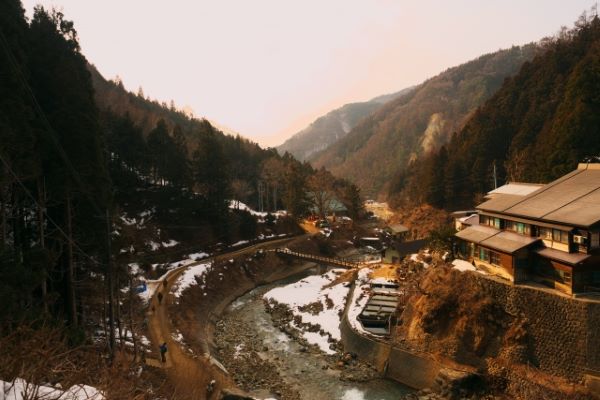
Why do you need the courage to do so? Besides the fact that they aren’t the pets that won’t attack you, the female-only onsen pool is quite exposed. People heading to the Snow Monkey Park can see everything from the promenade!
Also, Kōrakukan has two private baths for you to utilize if you don’t want to share your relaxing bathing time with strangers!
As the snow monkeys don’t always show up at Jigokudani Snow Monkey Park, you can spend a night at Jigokudani Hot Spring Korakukan to increase your chance of seeing this unique scene! To book your stay, please reserve through their website HERE.
Important: The Ryokan doesn’t offer pickup or drop-off service. So it is best to leave your luggage at one of the coin lockers at Nagano Station.
Tips: Jigokudani Onsen Kōrakukan can cater to special dietary requests. Remember to let them know when you book! Also, they have staff who can speak English (albeit not fluently).
Some Interesting Knowledge About the Snow Monkeys
- They are like humans in that they eat, drink, and sleep. The only difference is that they don’t have to work.
- They don’t have a “nest” where they head back to each night. As the sun disappears from the horizon, it signals them to search for a bed for the night.
- When the weather is cold, they keep themselves warm by sticking together. You might also find one that is sleeping like a ball.
- They drink from the hot spring pool where they bathe. The hot spring in the onsen pool is controlled to be around 40 degrees. Whilst the temperature each monkey likes varies, the best temperature for them is generally 40-42 degrees.
- So if you see a monkey staring at the water surface for a while, it’s most likely rehydrating.
- The snow monkeys mate in autumn (mainly in October to early November) when food is abundant. It takes half a year for the babies to be born (i.e., in spring, from late April to late June).
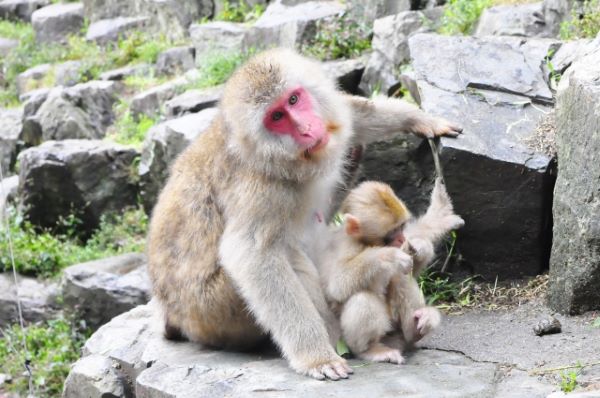
- Baby snow monkeys stick with their mother until they are 2 to 3 months old before mingling with their peers.
- They become adults at 5 to 6 years old.
- Snow monkeys are said to live up to 30 years. But most of them won’t survive past their 20s.
- Not all snow monkeys like hot springs, just like not all humans like to bathe.
- Snow monkeys don’t need to dry their fur coat after a hot spring session. The hair closest to their bodies doesn’t get wet, and their bodies are structured so that it’s difficult for heat to escape in winter.
What Do Snow Monkeys Eat
- When the long winter ends in April, snow monkeys typically eat the young leaves and flowers on trees (such as beech and elm).
- They do eat insects, but they don’t eat meat or seafood.
- In autumn, they enjoy all sorts of nuts, such as chestnuts and walnuts. It is their busiest time of year, as it is also their mating season.
- In winter, with little food available, they eat tree bark and even soil (apparently, for the minerals that they can’t source from the plants they eat in winter)
What Not to Do at Jigokudani Wild Monkey Park
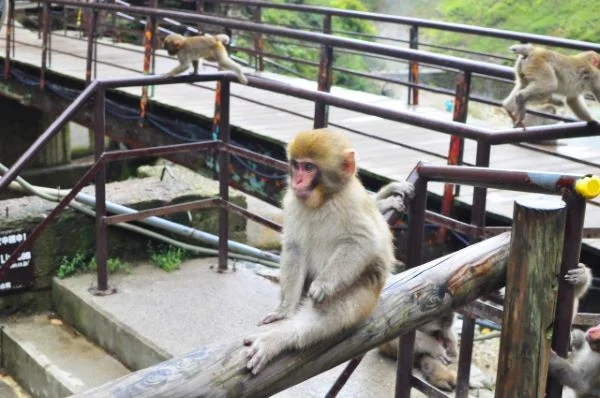
- You can’t bathe with the monkeys.
- Please don’t feed the monkeys.
- Please don’t eat inside the park for your safety. The monkeys will try to grab the food from you.
- Don’t try to touch any snow monkeys. They will fight you if they feel threatened.
- Don’t look into a monkey’s eye. It is a sign to the monkey that you hold hostility.
- Also, if you see the monkeys open their mouth wide, they are trying to scare you off. Please leave them alone and leave the scene slowly.
- If you run, they might chase you.
- A selfie stick is not permitted.
- Photography is permitted. But again, watch the distance between the monkeys and your hand when you stretch your arm out. They won’t be happy if your hand holding your phone gets too close to them.
- No pets are allowed if you are traveling with one.
Before You Head Out to Jigokudani Wild Monkey Park
As snow monkeys are wild animals, there is no guarantee that they will show up in the park every day between the park’s business hours. Although the staff tries to search and guide them to the park (to the point that some snow monkeys will start heading to the park when they see the staff), it is best to check the live camera on their official website HERE to avoid disappointment.
Important: If you arrive at Jigokudani Snow Monkey Park in the late afternoon, bring a torch. To preserve the animals’ natural habitat in the area, the promenade under the cedar forest is unlit.
Inside Jigokudani Snow Monkey Park
The first thing you will notice in the park is that no fence separates you from the monkey. The intention is for us to observe the monkeys up close, in a state as close to nature as possible. Because feeding is prohibited in the park, the snow monkeys usually show little interest in visitors (except for the curious young ones).
If you ever see a person surrounded by snow monkeys, it is either that person has broken the rule, or they are the staff member who gives out the feeds.
In Jigokudani Snow Monkey Park, you get to witness the satisfied faces of the snow monkeys when they warm up in the hot spring pool. Just as the Japanese love to bathe each night to keep warm and relax, the monkeys do the same to escape the winter cold.
If you stay in the park long enough, you will realize these snow monkeys act just like us human beings. Siblings chase after each other. And some of them like to jump into the pool from somewhere high (≧▽≦).
The Best Time of the Year to Visit Jigokudani Snow Monkey Park
From late November to February, when Jigokudani is freezing cold, it is the time of the year when snow monkeys like to stay in the onsen pool built for them.
Like human beings, no one likes to take a hot bath in the hot summer. So don’t expect to see many snow monkeys enjoying the onsen in warmer months from March to October. It is simply too hot for them, especially with their furry coat.
March is also a month in which snow monkeys visit the park almost every day. But as the weather is warmer, it is doubtful they will be in the onsen pool.
Furthermore, in spring, from April to June, you have a high chance to meet the newborns (but make sure you check the LIVE CAMERA to confirm there are monkeys around before you head over)!
The Time of the Year When Snow Monkeys Are Likely to Be Absent
- Apart from winter, snow monkeys may be absent for the day, arrive late, or leave early.
- From October to early November is the most active period for the snow monkeys. There is too much food in the mountain, and they are busy mating. So they might not be bothered to come down for the feed.
The Feeding Time at Jigokudani Snow Monkey Park
The feeding in Jigokudani Snow Monkey Park is only a means to keep monkeys observable. So the amount of food given and the feeding time are not set. It is all dependent on the situation on the day.
If you ever wonder how the monkeys know whether there will be no more feeding for the day, the answer is applse. When the apple is given out, that is the signal for the monkeys to start leaving and securing a place for a good night’s sleep.
Important: Don’t wait around for the staff to feed the monkeys with apples. This usually occurs around 5 pm, which may mean it will be too dark on your way back to the bus stop. Also, monkeys will not necessarily wait around for the apple.
Explore the Chestnuts Town: Obuse
If you aren’t in a hurry, we recommend you stop by Obuse for the delicious chestnut desserts and the dramatic ukiyo-e that the town is famous for. The town is conveniently located on the same train line as Jigokudani Monkey Park.
Find out more about what you can do and where to go, and of course, where to eat when you get to this gorgeous town with our Obuse article (=゚ω゚)ノ.
You can even visit someone’s backyard without notifying the owner!
Discover the Awesomeness of Zenkōji Temple and the Surrounding Attractions Around Nagano Station
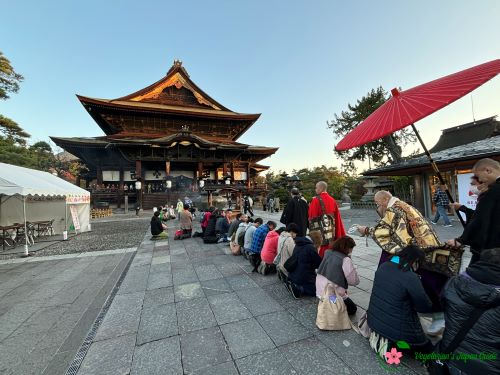
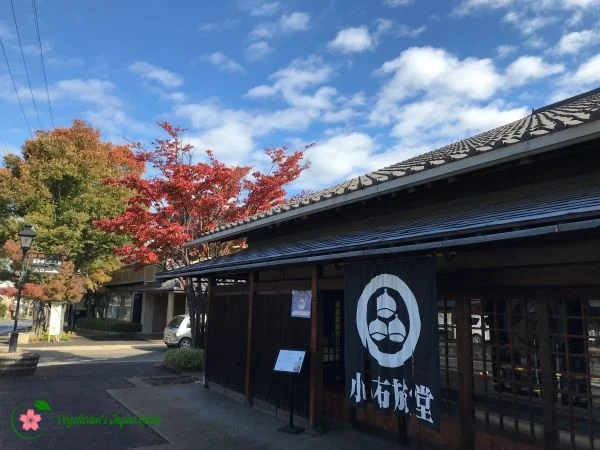
Before you arrive at Jigokudani Monkey Park, you will surely reach Nagano Station first. If you have time, we strongly recommend exploring the station’s attractions, especially around Zenkōji Temple.
For more information, refer to our article on Zenkōji Temple!