In addition to the beckoning cat temple, Gōtokuji, there is another temple in Tokyo that is secluded from the capital’s hustle and bustle. Located west of Jiyūgaoka, Kuhonbutsu Jōshin-ji (九品仏淨眞寺) is an ancient temple with an enchanting dry landscape garden. It is a spot in the urban jungle that will make you feel like you are in Kyoto. The Pure Land Sect temple has a spacious ground filled with greeneries. Opposite the dry landscape garden is another garden with a pond. It is where tourists gather every autumn season.
About Kuhonbutsu Jōshin-ji
Kuhonbutsu Jōshin-ji was erected in 1678 by a monk called Kaseki (珂碩上人) after he was given the land from the 4th Shogun of the Tokugawa shogunate. The various buildings in the precinct are arranged according to the explanations in the Sutra on the Visualization of the Buddha of Immeasurable Life (観無量寿経), which is the sutra of the Pure Land sect.
Kuhonbutsu (九品仏) refers to the nine statues of Amida Buddha enshrined. But nowadays, it is also commonly used to refer to the temple. The nine statues represent the nine stages of rebirth in Pure Land Buddhism. The statues are further divided into three groups and enshrined at Jōbondō (上品堂) in the middle, Chūbondō (中品堂) in the north, and Gebondō (下品堂) at the south. Together, the three worship halls are known as Sanbutsudō (三仏堂).
Moreover, the mudras for all the Amida Buddha statues are different. The upper-grade Buddhas are in the meditation mudra of Amida Buddha (弥陀定印). The middle-grade Buddhas are in the preaching seal mudra (説法印), and the lower-grade Buddhas are in the reasoning mudra (Raigo-in, 来迎印).
Kuhonbutsu Jōshin-ji’s Approach
Like other temples with a long history, Jōshin-ji has a long and quant approach lined with tall trees. There is a stone monument near the starting point of the approach with the words Gun Hunting Prohibited Metropolitan Police Department (禁銃猟 警視庁) carved. It is probably the only temple with this gun prohibition sign (´▽`*). Most others would ban meat and alcohol (不許葷酒入山門) if there is such a sign. The stone monument was installed in 1899. At that time, the area was almost uninhabited and covered with scrub forests, making it perfect for hunting.

Enmadō Hall (閻魔堂)
After passing through the main gate, the Enmadō Hall is on your left. Although no water is flowing underneath, the small red bridge is crossing the River Styx (三途の川). The worship hall beyond the River Styx has Enma enshrined, the god who judges the sins of the dead. The banners on the sides of the gate have words inscribed that sound like something Enma would say: “Don’t lie!” and “Don’t do bad things!”
If you put a coin into the donation box, you can hear a message from Enma!
The Niomon Gate (仁王門) and the Bell Tower (鐘楼堂)
The massive Niomon Gate was built in 1793. Like the Zenkoji Temple in Nagano, it has two stories. Jōshin-ji’s Niomon Gate has Amida Buddha and 25 Bodhisattva statues enshrined on the second floor and the guardian deities on the lower part of the gate.
On the left side of the Niomon Gate is the bell tower, completed in 1708. The zodiac signs are engraved around the four sides of the tower. While many temple bells were lost during WWII due to metal donations, the one at Jōshin-ji was exempt because its striking base has a chrysanthemum petal pattern, the family crest of Japan’s imperial family.
Jōshin-ji’s Main Worship Hall (本堂)
The main hall was completed in 1698. In addition to the principal image, Gautama Buddha, many other Buddhas are enshrined here. The main worship hall was named Ryūgoden (龍護殿), which means a worship hall protected by dragons. It is said that two dragon gods have protected the temple since its construction.
Furthermore, you will notice a red monk statue in the worship hall. He is Buddha’s disciple, Piṇḍola Bhāradvāja. It is said that your physical illness will be cured by touching his body. And if you stroke his head, you will become smarter! So don’t be surprised to see someone touching the statue from head to toe (´▽`*).
In front of the worship hall are two statues of white herons. They are where you can tie your fortune slips if you have drawn a bad one. Moreover, there is a stone with Buddha’s footprint on it.
Omenkaburi Ritual (お面かぶり)
The Omenkaburi is held once every four years. You can see participants wearing Bodhisattva masks walking across the bridge between the Main Worship Hall and the Sanbutsu Hall. The ritual is designated as an intangible folk cultural property of Tokyo.
The next Omenkaburi is planned to be held on the 5th of May, 2028.
Jōshin-ji’s Four Seasons
- If you visit Jōshin-ji between late July and early August, you will see the white flowers of the white egret flower blooming in the precinct.
- The temple’s autumn foliage season is from late November to early December.
Kuhonbutsu Jōshin-ji’s Opening Hours and Access Information
- Jōshin-ji is open from 6 am to 4:30 pm.
- The temple is a 15-minute walk from Tokyū Dentetsu’s Jiyūgaoka Station (自由が丘駅) or a 5-minute walk from Kuhombutsu Station (九品仏駅).
What Else Can You Do in Jiyūgaoka
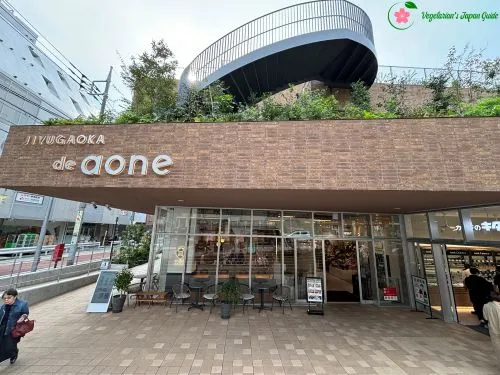
Besides cultural and historical spots, Jiyūgaoka has much more to offer. The neighborhood named Liberty Hill has many famous sweet shops, stylish cafes, and trendy boutique shops. From places perfect for taking a break during a date, to photogenic places, Jiyūgaoka is where you can have a taste of Japan’s capital without being pushed around!
For more information, refer to our article on What to Do and Where to Eat in Jiyūgaoka!