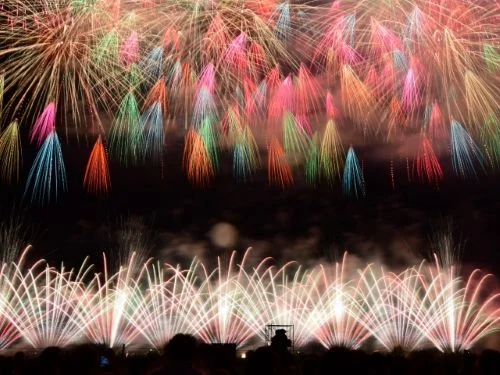
Every August, over one million visitors gather along the banks of the Shinano River (信濃川) in Niigata to witness one of Japan’s most spectacular displays: the Nagaoka Fireworks Festival (Nagaoka Hanabi, 長岡まつり大花火大会). Launching 20,000 fireworks over two unforgettable nights from 7:20 PM to 9:10 PM, this massive event is far more than a summer celebration. It began in 1946 as a solemn prayer for peace and rebirth following World War II. If you are keen to see one of Japan’s Top Three Fireworks Festival, careful planning is essential. In this ultimate guide, you will find everything you need to know about Nagaoka Hanabi’s history, ticketing strategies, accommodation, logistics, and expert tips to ensure a seamless show-day experience.
In This Guide: Nagaoka Fireworks Festival Planning & Strategy
- The Moving History Behind the Flames
- Nagaoka Fireworks Festival Iconic Signature Shells & Their Meanings
- How to Score Your Tickets to the Reserved Area Seats: A Step-by-Step Strategy
- Insider Tip: Alternative Nagaoka Fireworks Viewing Spots Without a Ticket
- Accommodation Tactics: Where to Stay When Nagaoka Sells Out
- Getting to the Nagaoka Fireworks: Access, Parking & Transit Survival Guide
- Essential Packing Checklist & Event Rules
- Game Plan for the Day: What to Expect
- The Return Journey: Managing the Post-Show Exodus
- What to Wear: Balancing Comfort and Tradition
- Taking Elderly Parents and Family Members to Nagaoka Fireworks: A Real-World Survival Guide
- Bonus Experience: Don’t Miss the Nagaoka Peace Festival on August 1st!
- Conclusion: Is It Worth the Effort?
The Moving History Behind the Flames
To understand why the Nagaoka Fireworks Festival holds such an important status in Japan, you must realize that it is not a casual summer party. It is an act of communal remembrance, resilience, and prayer. While many fireworks displays around the world focus purely on spectacle and entertainment, every burst of light above Nagaoka’s Shinano River carries a deeply emotional story.
Rebirth from the Ashes of World War II
The origins of the Nagaoka Fireworks Festival are rooted in one of the darkest nights in Nagaoka’s history. On August 1, 1945, at 10:30 PM, B-29 bombers launched a devastating air raid on the city, destroying over 80% of the urban area and claiming the lives of nearly 1,500 people.
Exactly one year later, on August 1, 1946, local citizens organized the Nagaoka Reconstruction Festival. The goal was simple yet profound: mourn those who were lost, express gratitude to the survivors rebuilding the city, and offer a prayer for lasting world peace. That spirit of recovery remains the core foundation of the festival today.

Nagaoka Fireworks Festival Iconic Signature Shells & Their Meanings
Rather than just a continuous stream of random pyrotechnics, Nagaoka’s display features symbolic fireworks designed to tell a story and evoke deep reverence from the crowd.
Tip: Refer to the official Nagaoka Fireworks website for the fireworks schedule.
Shiragiku (White Chrysanthemum, 白菊): A Silent Prayer
Every year on August 2nd and 3rd, the main event opens at 7:20 PM with three pure white fireworks launched in complete silence. Known as Shiragiku (White Chrysanthemum), these simple, elegant shells bloom quietly in the night sky as a tribute to the victims of the 1945 air raid. The crowd falls silent, taking a collective moment to honor the lives lost before the main show begins.
The Phoenix (Fukko Kinen Hanabi, 復興祈願花火フェニックス): Defying Disaster
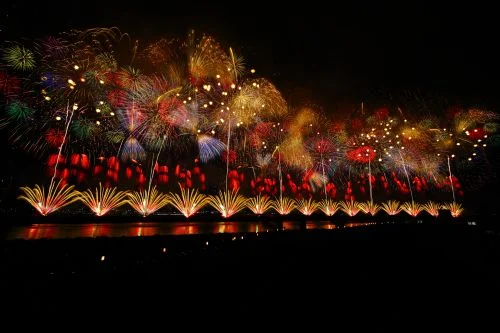
The absolute pinnacle and emotional highlight of the Nagaoka Fireworks Festival is the Phoenix (復興祈願花火フェニックス), a program that holds a revered, incomparable place in the hearts of the locals.
History & Significance
- Born from Resilience: In October 2004, Niigata Prefecture suffered immense devastation from the powerful Chuetsu Earthquake (中越地震). In 2005, local pyrotechnicians and organizers created the Phoenix display to honor those lost, offer prayers for recovery, and encourage survivors.
- A Symbol of Hope Beyond Nagaoka: While initially a symbol of Nagaoka’s own revival, the display has evolved into a message of solidarity and hope for communities affected by natural disasters across all of Japan.
The Display Experience
- A Two-Kilometer Horizon of Light: Spanning an incredible 2 kilometers along the Shinano Riverbank, the display launches simultaneously across the entire length of the venue, completely filling the night sky with fireworks.
- Set to “Jupiter”: The display is choreographed to Ayaka Hirahara’s soaring ballad Jupiter, a song that served as an iconic anthem of comfort and healing during the earthquake recovery.
- The Golden Phoenix: Golden, shimmering trails of light stretch across the horizon, creating the vivid image of an immortal phoenix spreading its fiery wings, symbolizing the courage to rise again no matter how deep the destruction.
2026 Schedule Update: Please note that for the 2026 festival, the launch time for the Phoenix display has been updated to 20:45.
Shosanjakudama (正三尺玉): Redefining Pyrotechnics
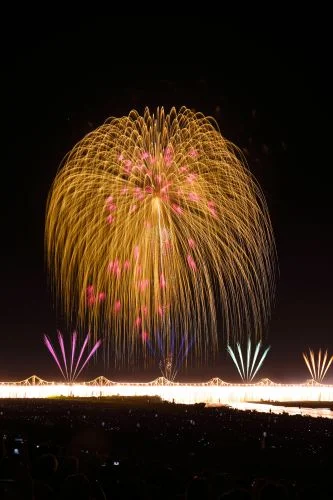
The Shosanjakudama is a monumental display that redefines the traditional limits of pyrotechnics. In 1990, the festival achieved a historic milestone by launching the Shosanjakudama simultaneously alongside the massive Niagara waterfall display.
The Experience
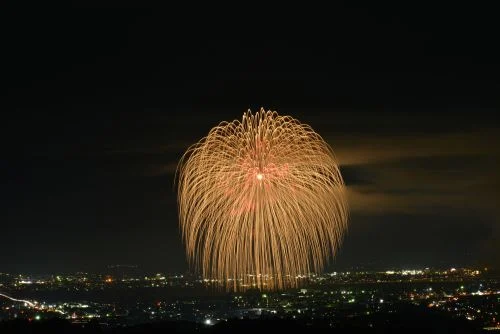
- A Baptism of Sound: The moment the shell bursts, the very air around the riverbank violently vibrates.
- Felt, Not Just Heard: Watching the Shosanjakudama is not merely a visual or auditory event. You don’t just “listen to the sound,” you feel the shockwave pass straight through your body. Experiencing that full-body sonic impact is truly best described as a “baptism of roar.”
Key Specifications
| Shosanjakudama Specification | Measurement / Details |
| Shell Diameter | Approx. 90 cm (36 inches) |
| Shell Weight | Approx. 300 kg (660 lbs) |
| Burst Diameter | Approx. 650 m (over 2,100 feet across) |
The Niagara (ナイアガラ): A Grand Waterfall of Light Across the River
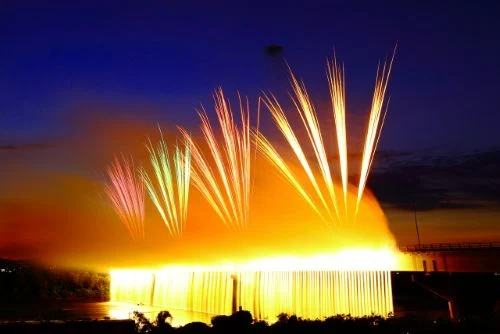
The Niagara (ナイアガラ) is an iconic curtain of fire that transforms the Shinano River into a sweeping, dazzling waterfall of pure light. Sparking embers stream continuously down from Chosei Bridge (長生橋) and Ote Bridge (大手大橋), a 650-meter-wide grand waterfall of light cascades directly toward the river below.
The climax occurs when the Niagara display on Chosei Bridge ignites simultaneously with the launch of the massive Shosanjakudama (正三尺玉) overhead. As a 650-meter burst lights up the night sky directly above a 650-meter wall of fire spanning the bridge, your entire field of vision becomes engulfed in shimmering gold, a breathtaking moment of scale unique to Nagaoka.
How to Score Your Tickets to the Reserved Area Seats: A Step-by-Step Strategy
Securing tickets to the reserved area seats for the Nagaoka Fireworks Festival requires advance planning, patience, and a clear understanding of the ticketing calendar. With over one million people attending across two nights, obtaining a ticket is the single most critical step in your trip planning.
1. Understanding the Paid Seating System
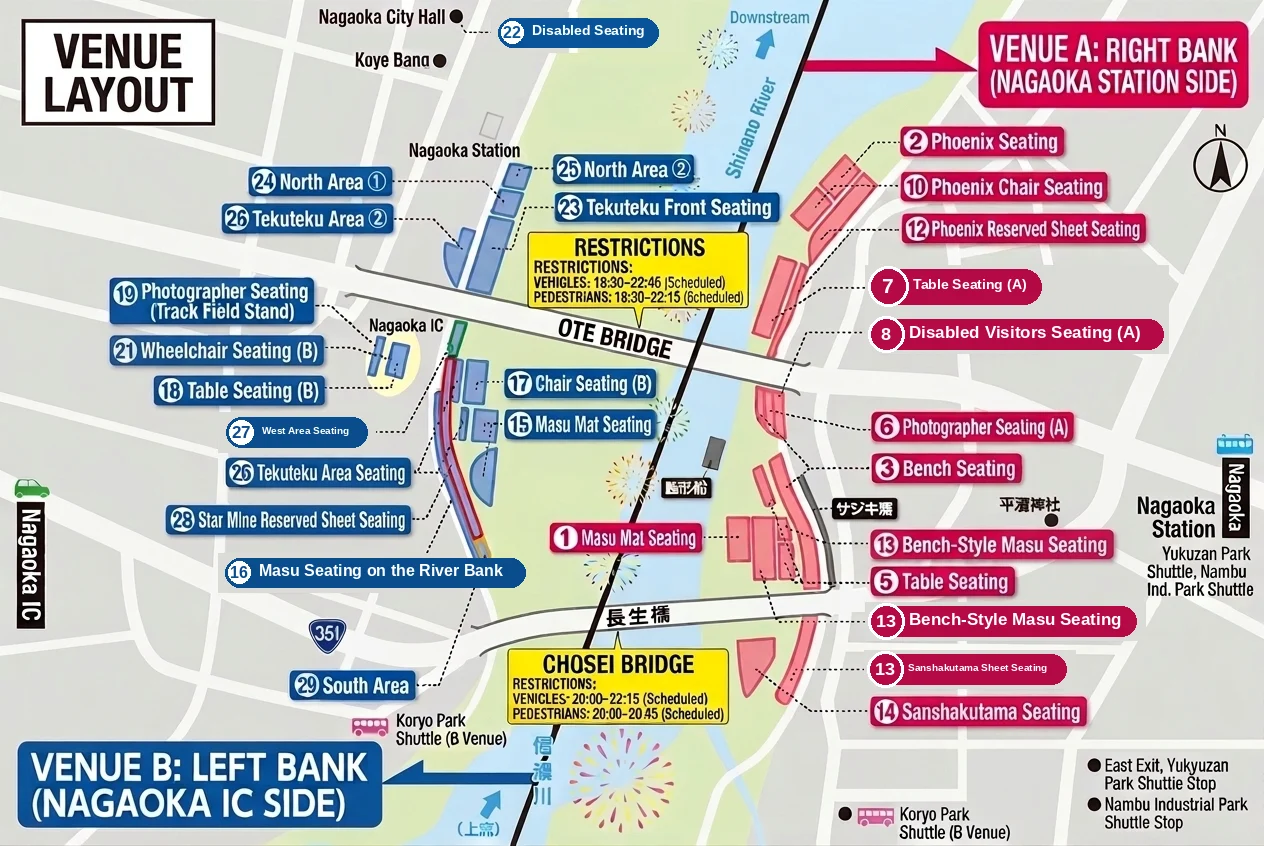
In recent years, organizers have transitioned the Nagaoka Fireworks Festival to an entirely paid reserved seating model along the Shinano Riverbanks. There are no official free viewing areas anywhere near the primary show zones. Viewing options are split across two main sides of the river, each catering to different travel strategies, parking locations, and viewing preferences.
| Venue Area | Location Side | Recommended Transit & Parking Strategy | Phoenix Display View | Key Advantages | Key Parking Candidates |
| A-Side (Right Bank) | Nagaoka Station Side (長岡駅側) | Best for Train & Shinkansen Travelers or drivers using eastern parking lots | Direct, head-on view | 20–30 min walk to station; captures stunning reflections off the river surface | Yukyuzan Park (悠久山公園), Nambu Industrial Park (南部工業団地), Koshiji Branch Office (越路支所), Koshiji Gymnasium (越路体育館), Kashiwazaki City Cultural Hall Artfore (柏崎市文化会館アルフォーレ) |
| B-Side (Left Bank) | Nagaoka IC Side (長岡インター側) | Best for Drivers & Shuttle Users utilizing western parking hubs | Slightly angled panoramic view | Closer proximity to launch pads for intense, high-impact visuals | Nagaoka Institute of Design (長岡造形大学), Lirick Hall (リリックホール), Nagaoka Kita Smart Logistics Park (長岡北スマート流通産業団地), Echigo Hillside Park (国営越後丘陵公園) |
Venue Breakdown & Parking Strategy
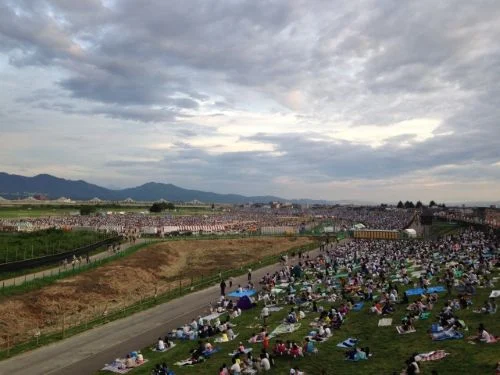
A-Side (Right Bank / Nagaoka Station Side)
Located a convenient 20-to-30-minute walk from JR Nagaoka Station, A-Side is the premier choice for public transit travelers. If you are driving, select parking lots on the east side that allow easy access to the station area.
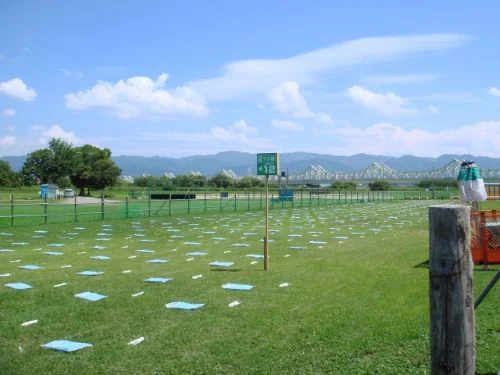
Seating options include blue floor mat blocks (masu), folding chairs, and group benches. Beyond easy transit access, spectators here enjoy a direct, head-on perspective of the fireworks, complete with mesmerizing reflections dancing across the river’s surface.
B-Side (Left Bank / Nagaoka IC Side)
Situated across the river near the Nagaoka Interchange, B-Side is ideally suited for drivers and shuttle bus users. It requires a 40-to-50-minute walk from the station, so drivers should reserve parking lots on the left bank that connect directly to local shuttle bus services. Because the main launch pads are located on this side of the riverbank, seats here put you significantly closer to the bursts for an exceptionally loud, high-impact experience.
2. Official Lottery & Overseas Ticketing
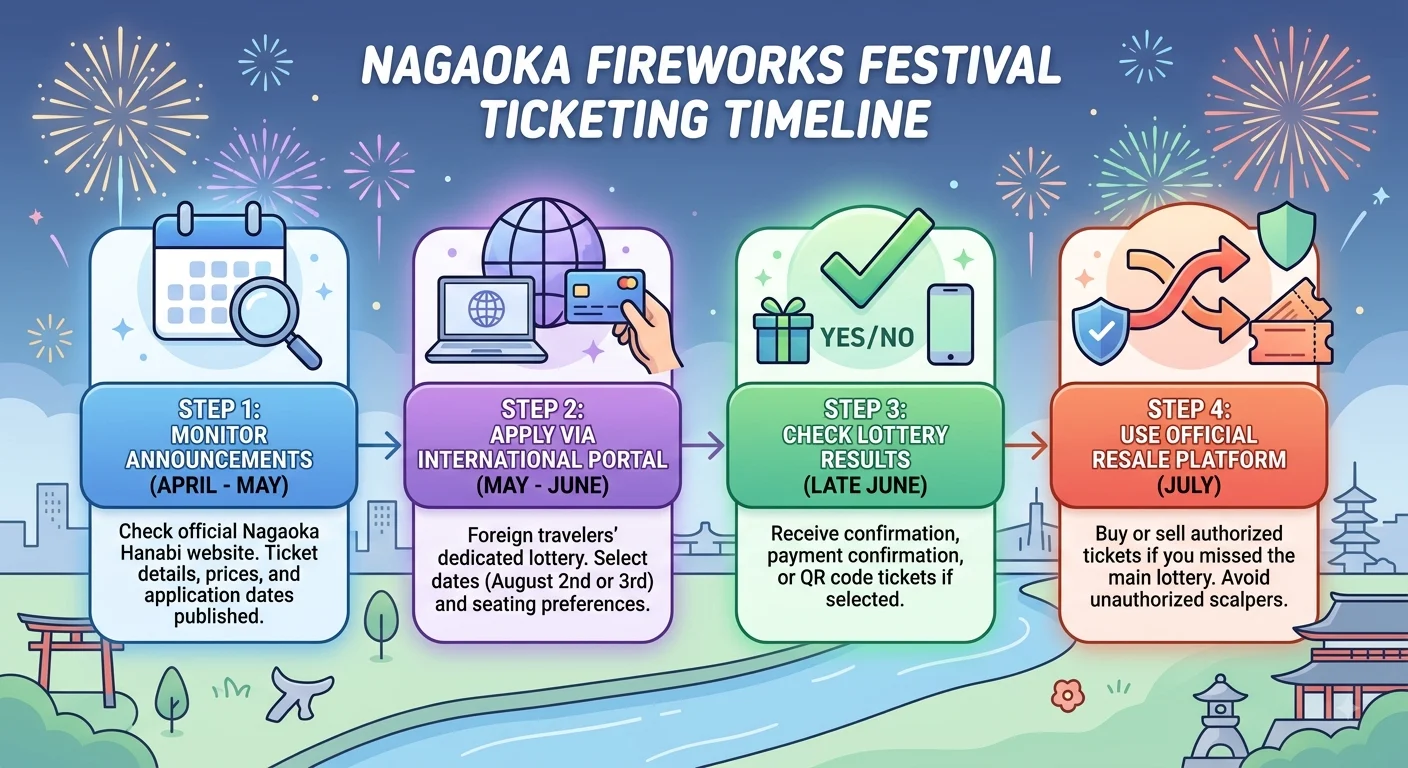
Tickets for the Nagaoka Fireworks Festival are distributed through a structured, multi-stage lottery system rather than a simple first-come, first-served sale. Understanding each phase helps maximize your chances of securing a spot.
Foreign travelers can enter a designated lottery system that accepts international credit cards and does not require a Japanese phone number. Select your preferred date (August 2 or August 3) and seating preference (e.g., Masu-seki floor mats or chair seating).

- If you win the draw, your credit card will be charged, and you will receive a confirmation code or QR ticket for entry on show day.
- If you miss out during the main lottery, use the official secondary resale platform hosted on the event’s partner site. Avoid purchasing from unauthorized third-party scalpers, as tickets are strictly verified at gate checkpoints.
Important Note for Readers: The specific dates and deadlines for the official lottery change every year. Always verify current information directly on the official Nagaoka Hanabi international visitors’ portal and official Japanese channels starting in mid-Spring.
| Phase | Target Audience | Application Period | Application Method | Results & Notes |
| 1. Local Resident Lottery | Nagaoka Residents Only | April 10 – April 28 | Dedicated postcard (Mailed with April City News) | Results by May 26 (Payment due June 1). A significant portion of total seats is allocated here. |
| 2. General Sales (1st Lottery) | Open to All (Domestic & Overseas) | May 25 (12:00 PM) – June 8 (5:00 PM) | Internet Only | Results on June 17 via email. This is the primary window for non-residents. |
| 3. General Sales (2nd Lottery) | Open to All (If remaining seats exist) | June 18 – June 22 | Internet Only | Subject to availability after the 1st round; do not rely solely on this step. |
| 4. Official Resale Platform | Open to All | Starts July 6 | Internet Only | Offers canceled or returned tickets. Check frequently; no venue desk or same-day sales exist. |
Pricing Note: Ticket prices differ between the local resident presale and the general sales periods, with prices generally ranging from several thousand yen up to ¥10,000+ per ticket depending on the seating category. Always verify current rates on the official Nagaoka Fireworks Ticket Center site.
Choosing the Right Seat: Top Recommendations
Nagaoka offers a wide array of seating options, but certain zones deliver a dramatically better experience depending on your group size and priorities.
- ★★★★★ First-Time Visitors: Phoenix Chair Seating (フェニックスイス席)
- If you only go once, spend a little extra for this. It places you directly opposite the 2 km Phoenix fireworks show with a reserved chair, guaranteeing an unforgettable view.
- ★★★★★ Families & Groups: Masu Mat Seating (マス席)
- Ideal for spreading out, sharing bentos, and enjoying a traditional blue-tarp floor mat experience together.
- ★★★★★ Couples: Table Seating (テーブル席)
- Offers individual seats and a dedicated table, allowing you to enjoy food and drinks comfortably without crowding.
- ★★★★☆ Value Seekers: Phoenix Area Seating (フェニックスエリア席)
- Provides high-impact views of the Phoenix display at a more budget-friendly price point.
- ★★★★☆ Photographers: Photographer Seating (カメラマン席)
- Specifically designated for setting up tripods and capturing uninterrupted long-exposure shots of the displays.
3. The Tour Package Backup Plan
If you miss both the primary lottery and the official resale window, booking an organized tour package is your most reliable alternative.
- What’s Included: Major travel agencies (such as JR East Tours and Klook) buy ticket blocks in bulk and package them with round-trip transportation (Shinkansen or private charter bus) and guaranteed lodging.
- Why It Works: While tour packages are more expensive than buying standalone tickets, they completely solve the nightmare of sourcing both reserved viewing seats and hotel rooms during peak season.
Insider Tip: Alternative Nagaoka Fireworks Viewing Spots Without a Ticket
If you were unable to secure a paid reserved ticket for the Nagaoka Fireworks Festival, you can still experience the show from several alternative locations across the city. Sound systems will not reach these non-venue spots, but you can stream official YouTube live streams using your smartphone and earphones to hear the live commentary and music.
Master Comparison Table of Non-Ticketed Locations
| Spot Name | Rating | View Quality | Facilities & Access | Best For / Key Features |
| Riverbank between Ōte & Nagaoka Bridges (大手大橋〜長岡大橋間の河川敷) | ★★★★★ | ◎ Excellent: Full, wide views of large-scale displays like the Phoenix and Sanshakudama. | ⚠️ Limited: Dedicated toilets are not guaranteed; unpaved gravel and slopes are tough on seniors. | Maximum Impact: Close to launch sites; expect heavy afternoon crowds and dark footpaths. |
| Shinano River Right Bank (信濃川右岸河川敷) | ★★★★☆ | ◎ Excellent: Unobstructed wide-angle view across the full 2 km Phoenix display. | ○ Moderate: Dense crowd congestion, especially near main venue borders. | Phoenix Enthusiasts: Offers the full, wide-scale display of the iconic Phoenix fireworks. |
| Nagaoka Bridge Area (長岡大橋周辺) | ★★★★★ | ◎ Excellent: Beautiful perspective of fireworks reflecting directly off the river surface. | ○ Moderate: Moderate-to-high local crowd density on surrounding footpaths. | Photographers: Highly recommended for scenic photos of the bridge, river, and fireworks. |
| Hanabi no Eki / Nagaoka Hanabi World Yu (花火の駅・長岡花火ワールド悠) | ★★★★☆ | ○ Good: Elevated vantage point overlooking the entire cityscape display. | ○ Moderate: Located on high ground away from the immediate riverbanks. | Panoramic Views: Elevated area ideal for capturing the full scale of the Phoenix display. |
| Suido Park (水道公園) | ★★★☆☆ | △ Partial: High-altitude shells visible; lower bursts blocked by trees and structures. | ◎ Good: 2 restrooms (1 barrier-free), gazebos, and benches. Reasonable walk from the station. | Station Proximity: Easy walk from JR Nagaoka Station; popular with locals, so expect moderate crowds. |
| Senshu ga Hara Furusato no Mori (千秋が原ふるさとの森) | ★★★☆☆ | △ Partial: High shells visible; low-level fireworks obstructed by trees and buildings. | ○ Moderate: Park amenities and playgrounds available; check night facility hours. | Left-Bank Lawn Seeking: Great grassy open area on the B-Side, though overlapping Venue B pedestrian flows pass through. |
| Nagaoka Civic Disaster Prevention Park (長岡市民防災公園) | ★★★☆☆ | △ Partial: High bursts visible; low shells hidden by urban buildings. | ○ Moderate: Flat, fully paved ground; confirm night restroom availability. | Comfort & Accessibility: Flat terrain makes walking easy compared to riverbank slopes; subject to street traffic controls. |
| Yukyuzan Park (悠久山公園) | ★★★★☆ | ○ Distant View: High-burst fireworks viewed clearly from a distance. | ◎ Excellent: 7 restroom facilities (4 barrier-free), plazas, and gazebos. | Families & Low Stress: Calm, relaxed atmosphere avoiding central venue chaos; mind internal park slopes and stairs. |
| AEON Nagaoka Area (イオン長岡周辺) | ★★★★☆ | ○ Good: Wide, open parking area view; lower bursts may be obstructed. | ◎ Excellent: Direct access to indoor shopping, food, and restrooms. | Convenience & Dining: Great for grabbing food and air conditioning, though standing continuously gets tiring and roads freeze post-show. |
| Zaobashi Bridge Area (蔵王橋周辺) | ★★★☆☆ | ○ Distant View: Clear view of high bursts from downstream. | ○ Moderate: Less congested bridge area further from the center. | Quiet Viewing: A relaxed spot away from central crowds. |
| Heiwa-no-Mori Park (平和の森公園) | ★★★☆☆ | ○ Distant View: Viewable from a quiet residential neighborhood park. | ○ Moderate: Basic neighborhood park amenities. | Easy Transit Return: Just a 15-minute walk to JR Nagaoka Station, saving hours on post-show transit back toward Niigata Station. |
| Saiwai Plaza & Upstream/Downstream Residential Areas (さいわいプラザ・信濃川上下流) | ★★★☆☆ | ○ Distant View: Overlooks the skyline silhouette from a distance. | ⚠️ Limited: Residential streets require standing; limited facilities. | Local Hidden Spots: Quiet areas where locals gather away from main traffic routes. |
| Higashiyama Fureai Agricultural Park (東山ふれあい農業公園) | ★★☆☆☆ | ○ Distant View: Distant view from agricultural park grounds. | ⚠️ Restricted: Vehicle access to surrounding facilities is strictly prohibited. | Avoid Vehicles: Only suitable if accessing on foot without private vehicle transportation. |
Quick Selection Guide
- For Maximum Scale & Impact: Riverbank between Ōte and Nagaoka Bridges, or the Shinano River Right Bank.
- Be there early. The number of people securing viewing spots starts to increase in the afternoon.
- For Photography: Nagaoka Bridge Area.
- For Walkability & Restroom Access: Suido Park (closer to station) or Yukyuzan Park (7 restrooms available).
- For Grassy Open Lawn (Left Bank): Senshu ga Hara Furusato no Mori.
- For Flat, Easy-Walking Terrain: Nagaoka Civic Disaster Prevention Park.
- For Families with Young Children: Yukyuzan Park or AEON Nagaoka Area (arrive early to secure space).
- For the Fastest Post-Show Departure: Heiwa-no-Mori Park.
Critical Rules for Viewing Outside Paid Venues
- Respect Private Property: Never trespass on private residential land, private parking, or agricultural fields.
- Traffic & Parking Restrictions: Do not park illegally along roadways or enter restricted vehicular zones.
- Trash Management: Pack out all of your own trash to keep local parks and streets clean.
Accommodation Tactics: Where to Stay When Nagaoka Sells Out
Finding a place to stay during the Nagaoka Fireworks Festival is often harder than getting viewing tickets. With over a million visitors descending on a city of roughly 260,000 residents, hotel rooms near Nagaoka Station sell out within minutes when they become bookable a year in advance.
To avoid getting stranded or paying extreme surge prices, you need a clear lodging strategy early in your planning process.
Klook.com1. The Reality of Booking in Nagaoka City
Securing a room in Nagaoka City during the festival dates (August 2nd and 3rd) is notoriously difficult, requiring extreme persistence and strategic timing.
- Instant Sell-Outs: Major hotel chains in Nagaoka release their rooms anywhere from 3 to 12 months in advance, and they are typically snapped up within minutes by travelers and tour operators.
- Price Spikes: The few local rooms that remain available independently often command sky-high rates during the festival dates (August 2nd and 3rd).
- When to Try: If you are set on staying directly in Nagaoka, check booking platforms daily for last-minute cancellations around 1 to 2 weeks before the festival, as tour groups and travelers finalize or release unneeded reservations.
Pro-Tip: Research the exact room-release dates for your target hotel and secure a fully refundable booking for August 2nd or 3rd the second reservations open. This locks in your spot risk-free while you work on securing your fireworks tickets later in the year.
Strategic Booking Opportunities & Key Dates
Missed out on securing a room early? Here is when you can still grab a last-minute hotel booking after the lottery results are announced.
- The Ultimate Target Window (the date when the lottery result is announced): The single best opportunity to secure a local room occurs on the date when when the official 1st general ticket lottery results are announced. Unsuccessful lottery applicants might cancel their tentative hotel reservations on this day, triggering a wave of room openings. If you win a viewing ticket, focus all your energy on locking in a hotel right at this moment.
- Daily Cancellation Checks: If you are set on staying directly in Nagaoka, check booking platforms and official hotel websites daily for last-minute availability. Persistent monitoring pays off as additional rooms or sporadic cancellations pop up.
- The 1 to 2 Week Buffer: Check platforms again roughly 1 to 2 weeks before the festival. This is when tour groups and individual travelers finalize their travel itineraries and release unneeded fallback reservations without penalty.
2. Best Alternative Base Cities (Shinkansen Corridor)
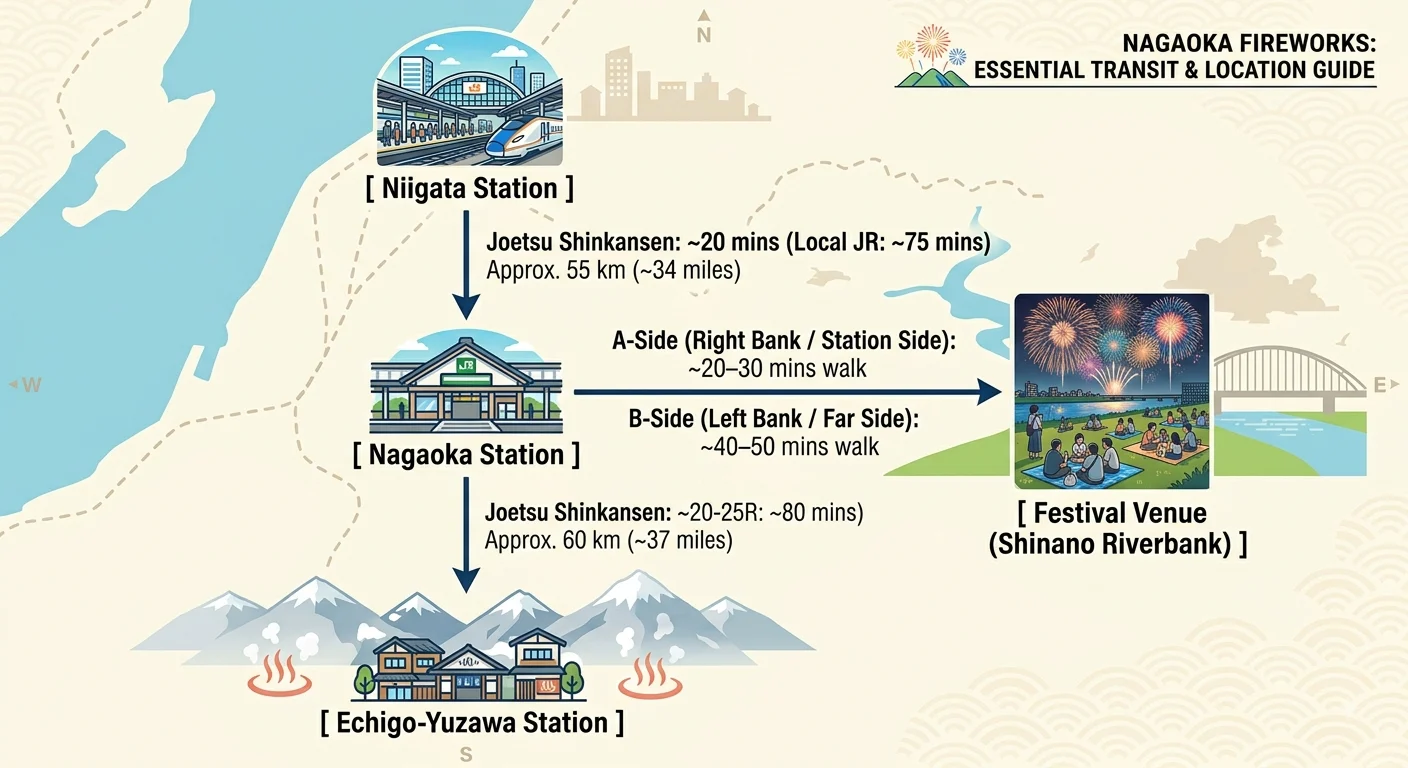
If local hotels in Nagaoka are fully booked, staying in neighboring cities along the JR Joetsu Shinkansen line is widely considered the smartest travel strategy. By taking a 20-minute bullet train after the show, you can escape the primary congestion zone, sleep comfortably, and return home smoothly the following morning.
Comparison of Nearby Accommodation Hubs
| Hub / Area | Travel Time from Nagaoka | Key Features & Atmosphere | Availability Level |
| Nagaoka City (長岡市) | 0 mins (30-min walk to venue) | Walk straight to your hotel post-show without taking transit | ✕ Hardest (Sold out almost instantly) |
| Niigata City (新潟市) | ~20 mins via Shinkansen (~75 mins via local JR) | Major metropolitan city with abundant hotels, lively nightlife, and late southbound/northbound transit options | ◎ Best Availability |
| Echigo-Yuzawa (越後湯沢) | ~20–25 mins via Shinkansen | Famous hot spring (onsen) resort town; perfect for combining fireworks with a relaxing thermal bath | ○ Moderate |
| Tsubame-Sanjo (燕三条) / Mitsuke (見附) | ~20–30 mins via Local JR or Shinkansen | Neighboring business hubs with high concentrations of modern corporate hotels | ○ Moderate |
Top Recommended Stay Strategies
1. The “Fireworks & Onsen” Package: Echigo-Yuzawa
For the ultimate trip upgrade, book a hot spring resort or traditional ryokan in Echigo-Yuzawa Onsen, located just 20 minutes south of Nagaoka by Shinkansen.
- The Routine: Arrive early, spend a relaxing afternoon soaking in the thermal waters to recharge and escape the midday summer heat, and take a quick Shinkansen ride straight to the festival in the evening. After the grand finale, return to Yuzawa to heal your tired feet in the hot springs.
- Booking Tip: Search booking platforms specifically for “Echigo-Yuzawa Onsen” around August 2nd–3rd well in advance.
- Travel Time: ~20–25 minutes south of Nagaoka by Shinkansen.
Pro-Tip (Midday Recharge): Spending the afternoon resting at your hot spring hotel in Echigo-Yuzawa is the ideal way to build up stamina and escape the midday heat before heading out to the venue in the evening.
2. The Stress-Free Option: Niigata City
As the prefectural capital, Niigata City offers the largest inventory of hotel rooms across all price points.
- Peace of Mind: The final extra Shinkansen trains heading north to Niigata City depart later than southbound trains toward Tokyo or Echigo-Yuzawa, giving you much more breathing room to leave the venue without fear of missing the last train.
- Travel Time: ~20 minutes from Nagaoka Station via Joetsu Shinkansen (or ~75 minutes on local JR lines).
- Post-Show Transit: Extra late-night Shinkansen trains operate specifically to transport festival-goers back to Niigata City after the show ends.
Pairing Your Stay with Local Sightseeing
Staying outside Nagaoka allows you to build a complete Niigata travel itinerary before or after the show:
- Echigo-Yuzawa Area (越後湯沢温泉): Visit Yuzawa Kogen Panorama Park (湯沢高原), Naeba (苗場), or sample sake at local breweries like Hakkaisan (八海山).
- Kiyotsu Gorge (清津峡): Located roughly 20 minutes by car from Echigo-Yuzawa, this is one of Japan’s Top Three Gorges, world-famous for its striking “Tunnel of Light” art installation.
- Niigata City: Explore Furumachi (古町), Bandai City (万代シテイ), or visit Ponshukan (ぽんしゅ館) at Niigata Station, a famous tasting hall where you can sample sake from every single brewery across Niigata Prefecture.
- Nagaoka Sightseeing: Isoroku Yamamoto Memorial Museum (山本五十六記念館), the historic brewing district of Settaya (摂田屋), or authentic Nagaoka Ginger-Soy Sauce Ramen (長岡生姜醤油ラーメン).
3. Day-Tripping vs. Overnighting: Is Tokyo Possible?
Attempting a same-night round trip from Tokyo to the Nagaoka Fireworks Festival is one of the biggest pitfalls for international travelers. Understanding the transit constraints is crucial for deciding whether to book a regional hotel or stick to a day-trip strategy.
The “Tokyo Day-Trip” Trap
While the Joetsu Shinkansen gets you from Tokyo to Nagaoka in roughly 1 hour 55 minutes to 2 hours 10 minutes, getting back on the same night is a major challenge.
- Tight Departure Margins: The last southbound Shinkansen returning toward Tokyo typically departs Nagaoka Station by 11:00 PM.
- Post-Show Bottlenecks: Exiting the crowded riverbank venue and shuffling through the massive pedestrian queues at Nagaoka Station can easily take 90 to 120 minutes.
- High Risk of Stranding: Missing that final southbound train means being stranded in Nagaoka with no available hotel rooms.
💡 The Verdict: Staying overnight at a regional hub (such as Niigata City or Echigo-Yuzawa) is strongly recommended over trying to race back to Tokyo. If you must return to Tokyo that same night, your safest option is booking an organized day-bus tour package, which provides guaranteed charter bus transportation directly after the show.
Klook.comTransit Comparison: Tokyo to Nagaoka
| Transport Method | Route / Path | Travel Time | Vital Festival Notes |
| Joetsu Shinkansen (Recommended) | Tokyo Station ➔ JR Nagaoka Station | Approx. 1h 55m – 2h 10m | JR East runs extra holiday Shinkansen services, but reserved seats sell out fast. Book 1 month early. |
| Expressway Driving | Tokyo ➔ Kan-Etsu Expressway ➔ Nagaoka IC | Approx. 2h 30m – 3h+ (Normal) | Not recommended. Severe traffic jams paralyze the Nagaoka IC area starting midday, lasting well into the night. |
Getting to the Nagaoka Fireworks: Access, Parking & Transit Survival Guide
Planning your transit strategy is one of the most critical parts of attending the Nagaoka Fireworks Festival (Nagaoka Matsuri Dai-Hanabi Taikai) held along the banks of the Shinano River. With hundreds of thousands of spectators descending on Nagaoka City, relying on a solid travel plan will make or break your festival experience.
1. The Golden Rule: Choose the Train Over Driving
⚠️ Pro-Tip from Experienced Attendees: Take the train. Driving to the festival is a recipe for extreme frustration. Traffic around the Nagaoka Interchange (I.C.) begins backing up as early as 11:00 AM on show day, and severe post-show congestion can leave you stuck for an hour just to cross a single intersection.
- Nearest Train Station: JR Nagaoka Station (served by the Joetsu Shinkansen and local JR lines).
- Walking to the Venue: The walk from JR Nagaoka Station to the riverbank venue takes approximately 30 minutes on foot. Directional signs and event staff line the routes to guide first-time visitors safely.
- Shinkansen Reservations: JR East operates extra Shinkansen services specifically for the festival. Reserved seats open for booking via eki-net exactly 1 month prior at 10:00 AM JST. You can also make a reservation overseas before exchanging your voucher for JR East Pass.
- Arrival Timing: Aim to arrive at the venue by 3:00 PM – 4:00 PM. After 6:00 PM, crowd density around ticketed viewing sections reaches hazardous levels.
How to Get to Nagaoka Station from Tokyo
| Route / Option | Departure Point | Travel Time | Cost Range | How to Reserve | Key Highlights & Tips |
| Joetsu Shinkansen (Recommended) | Tokyo or Ueno Station | ~1h 30m – 1h 45m | ¥8,800 – ¥13,190 (Covered by JR East Pass) | JR-WEST / JR-EAST Train Reservation Website (or ticket vending machines/offices at major JR stations). Opens 30 days prior at 10:00 AM JST. | Fastest & Most Direct: Drops you off inside JR Nagaoka Station. Book reserved seats (Shitei-seki) as soon as the 1-month window opens, as trains sell out completely for festival dates. |
| Expressway Bus (Budget Option) | Shinjuku (Busta Shinjuku) or Ikebukuro | ~4h 30m – 6h+ | ¥3,500 – ¥10,000 (Price surges on festival days) | Japan Bus Ticket, or Highwaybus.com. Reservations typically open 1 to 2 months prior. | Cheapest Alternative: Direct highway service to Nagaoka Station’s West Exit. Overnight buses are available, but daytime buses face heavy traffic delays near Nagaoka. |
2. Vehicle Access & Parking Rules (Strictly Pre-Booked)
If you plan to drive to the festival, keep in mind that there is no on-the-spot parking available near the venue. Unauthorized street parking or idling around the venue is strictly forbidden, as it worsens severe gridlock and causes major disruptions for local residents.
All official festival parking lots, such as Echigo Hillside Park (国営越後丘陵公園), Koshiji Branch Office (越路支所), Koshiji Gymnasium (越路体育館), Nambu Industrial Park (南部工業団地), and Yukyuzan Park (悠久山公園), are operated on a paid, advance reservation lottery system reserved exclusively for paid viewing ticket holders.
Important Application Rules
- Ticket Code Required: You can only apply using the unique application code issued with your official viewing ticket.
- Match Dates & Riverbank Sides: Your parking reservation date must match your viewing ticket date. Select parking on the same side of the river as your venue area, A-Side (Right Bank / Station Side) or B-Side (Left Bank / IC Side).
- Not First-Come, First-Served: The official lottery is not time-sensitive; applications are drawn at random after the window closes.
- Non-Refundable: Once purchased, official parking passes cannot be canceled. Unneeded passes must be listed on the official resale platform.
| Viewing Ticket (観覧チケット) | Location Area (場所の目安) | Parking Selection Strategy (駐車場選びの基本) | Key Candidates (主な候補) |
| Venue A (A会場) | Right Bank / Nagaoka Station Side (右岸・長岡駅側) | Choose a parking lot with easy access toward Nagaoka Station | Yukyuzan Park (悠久山公園), Nambu Industrial Park (南部工業団地), Koshiji Branch Office (越路支所), Koshiji Gymnasium (越路体育館), Kashiwazaki City Cultural Hall Artfore (柏崎市文化会館アルフォーレ), etc. |
| Venue B (B会場) | Left Bank / Nagaoka IC Side (左岸・長岡IC側) | Choose a parking lot on the left bank that utilizes a shuttle bus | Nagaoka Institute of Design (長岡造形大学), Lirick Hall (リリックホール), Nagaoka Kita Smart Logistics Park (長岡北スマート流通産業団地), Echigo Hillside Park (国営越後丘陵公園), etc. |
Parking Lottery Schedule
| Stage | Dates / Times | Key Details |
| 1st Lottery Window | June 19 (Fri) 11:00 AM – June 24 (Wed) 23:59 | Select your 1st to 3rd choice parking preferences on Ticket Pass. |
| 1st Lottery Results | July 1 (Wed) 14:00 onwards | Results sent via email or checked on your Ticket Pass My Page. |
| 2nd Lottery Window | July 2 (Thu) 11:00 AM – July 8 (Wed) 23:59 | For those who missed or lost the 1st lottery. |
| 2nd Lottery Results | July 9 (Thu) 14:00 onwards | Register your vehicle details promptly after winning. |
| Ticket Printing Starts | July 21 (Tue) 11:00 AM onwards | Print your parking pass. Note: Once printed, vehicle details cannot be changed and passes cannot be resold. |
Step-by-Step Guide: From Winning to Event Day
- Register Vehicle Information: Enter your license plate details on Ticket Pass after winning. If using a rental car, wait until your vehicle is finalized before registering.
- Print Your Parking Pass: Print your physical parking pass in A4 color prior to departure.
- Check Routes & Entry Times: Check official traffic regulation maps beforehand rather than relying solely on GPS, as local roads may be blocked. Avoid arriving too far ahead of the parking lot opening time to prevent idling on public roads.
- Display Pass Upon Entry: Place your printed pass clearly on your dashboard so staff can verify it from outside.
- Post-Show Departure: Expect significant delays when exiting due to simultaneous departures. Because the Nagaoka Interchange (IC) becomes heavily congested, consider using alternative expressway interchanges or local highways.
🚫 Important Usage Restrictions: Overnight sleeping inside vehicles is strictly prohibited in all official parking lots. If you need overnight accommodation, you must book separate hotel facilities. Do not leave valuable items inside your vehicle.
Alternative Options: Private Parking & Bicycle Parking
- Private Parking (Nokisaki PARKING / 軒先PARKING): If you miss out on the official lottery, you can attempt to book private parking spots through the Nokisaki PARKING platform. Reservations open on a first-come, first-served basis starting 1 month prior to the festival date.
- Shuttle Buses: Dedicated shuttle services operate from select distant parking hubs straight to the venue area.
- Bicycle Parking Lots (自転車専用駐輪場): For visitors arriving by bicycle or motorcycle, designated bike parking areas are available on both sides of the river:
- A-Side (Right Bank): Taishi Park (太子公園), Suido Park Bicycle Lot (水道公園駐輪場), and Senju Community Center (千手コミュニティーセンター).
- B-Side (Left Bank): Midorimachi Children’s Park (緑町児童遊園), Greenbelt Area in front of Athletics Stadium (陸上競技場前緑地帯), South Side of AEON Nagaoka (イオン長岡店 南側), and Kosodate no Eki Senshu Tekuteku (子育ての駅千秋てくてく).
3. Essential Arrival & Departure Checklist
- Check Traffic Restrictions Early: Review the festival’s official traffic regulation maps beforehand, as major roads close completely to vehicle traffic in stages throughout the afternoon.
- Buy Return Transit Tickets & Snacks in Advance: Buy all train tickets, beverages, and meals before arriving at Nagaoka Station to avoid exhausting multi-hour station lines later in the evening.
- Plan an Exit Buffer: Returning to JR Nagaoka Station after the show normally takes 30 minutes, but post-event pedestrian bottlenecks can extend travel times to 3 to 4 times longer. Consider leaving slightly early or hanging back near your seat to let the main crowd dissipate.
Essential Packing Checklist & Event Rules
Japanese summer nights are notoriously hot and humid, and riverbank amenities are limited. Packing the right essentials ensures you stay cool, clean, and prepared.
- Viewing Tickets & Cash: Essential for venue access. Carry plenty of physical Japanese Yen (cash and coins), as heavy network congestion renders digital mobile payments unreliable.
- Power Bank: Heavy camera usage rapidly drains battery life. Additionally, venue cell networks experience heavy traffic, so keep your phone charged for navigation and emergency updates.
- Smartphone + Earphones (FM Radio Audio): An insider tip: Tune into local radio broadcasts via smartphone and earphones during the show. Real-time commentary on the backstory of each shell, especially the emotional narrative behind the Phoenix display, dramatically enhances the viewing experience.
- Comfort Seating (Mat, Tape & Seat Cushion): Bring a cushioned picnic mat or a portable seat cushion to sit comfortably on the ground for hours. Secure your mat with painter’s/duct tape; do not use rocks to hold down mats, as they pose a hazard to walking crowds.
- Drinks & Cooling Gear: Hydration is key to preventing heatstroke. Convenience stores and stalls face hour-long queues, so carry plenty of water or electrolyte drinks. Handheld fans, cooling wipes, and a sun hat are highly recommended for the afternoon wait.
- Rain Poncho (No Umbrellas): Summer rainstorms can hit unexpectedly. Open umbrellas are strictly prohibited inside the viewing areas because they block views and create safety hazards in dense crowds. Always pack a compact rain poncho.
- Wet Wipes & Small Plastic Bags: Food stalls rarely have handwashing stations nearby, making wet wipes essential. Bring several plastic bags to manage your own trash, cover your items from damp grass, or protect valuables in sudden rain.
- Insect Repellent & Towels: Riverbank locations near the Shinano River attract mosquitoes at night. A small towel works for wiping sweat, covering your neck from the sun, or drying off spills.
Game Plan for the Day: What to Expect
Attending the Nagaoka Fireworks Festival is an exhilarating experience. However, navigating the massive crowds and intense summer heat requires a well-structured ground strategy. Follow this step-by-step game plan to ensure a smooth, comfortable, and memorable show day.
Daily Crowd Forecast & Timeline
Crowd density ramps up significantly throughout the afternoon, peaking just before kickoff and immediately following the grand finale.
| Time Window | Crowd Level | Expected Conditions & Strategy |
| 12:00 – 14:00 | ★★☆☆☆ | Relatively Smooth: Ideal for early arrivals, checking into nearby accommodations, or browsing early setup. |
| 15:00 – 16:00 *Recommended Arrival Window | ★★★☆☆ | Crowds Build Rapidly: Spectator numbers surge. Highly recommended arrival window to stroll the grounds comfortably. |
| 16:00 – 18:30 | ★★★★☆ | High Congestion: Nagaoka Station, venue access roads, and food stall areas become heavily packed. |
| 18:30 – 19:20 | ★★★★★ | Peak Entry Congestion: Movement slows to a crawl at ticket checkpoints and venue entrances. |
| 21:10 Onwards | ★★★★★ | Extreme Exit Rush: Mass exodus creates heavy bottlenecks at Nagaoka Station and surrounding highways. |
- Arrive in Nagaoka by 3:00 PM – 4:00 PM: Although the fireworks display begins around 7:20 PM, arriving late guarantees severe bottlenecks at the station and long queues at ticket checkpoints. Arriving early gives you ample time to locate nearby restrooms, grab food, and settle into your area comfortably.
- Station to Riverbank Walk: The walk from Nagaoka Station to the viewing grounds takes roughly 20–30 minutes for A-Side (Right Bank) and 40–50 minutes for B-Side (Left Bank). Dedicated festival stewards and directional signage guide crowd traffic along designated pedestrian routes.
💡Key Fueling Survival Tips
- Load Up Early: Sit-down restaurant meals are nearly impossible to schedule on festival day. Eat a hearty breakfast, purchase ekiben (station bento boxes) to eat during your train ride, and keep quick snacks on hand.
- Buy Drinks and Food Before Arrival: Convenience stores around Nagaoka Station and along the walking routes run out of ice, meals, and cold drinks early in the afternoon. Pick up supplies before boarding your train to Nagaoka.
- Enjoy Local Stalls (Yatai): Traditional festival stalls line the primary access roads, serving classic Japanese summer treats like yakisoba, takoyaki, and shaved ice. Be sure to use wet wipes before eating and keep cash handy for fast transactions.
Attending the Nagaoka Fireworks Festival is an exhilarating experience, but given the immense crowds and summer heat, navigating the day successfully requires a solid ground strategy. Here is your step-by-step game plan for show day.
Lively Food Stalls Along the Route from Nagaoka Station
Every year, the main walking routes extending from JR Nagaoka Station toward the Shinano Riverbanks are lined with an abundance of traditional festival stalls (yatai) and modern food trucks. This creates a vibrant, festive atmosphere packed with eager spectators long before the show begins.
- Key Food Hub: The area surrounding Aore Nagaoka (アオーレ長岡) is particularly famous as a primary food and beverage zone.
- Operating Hours: Most stalls generally begin operating around 3:00 PM and remain open through the end of the fireworks display.
Local Specialties & Classic Festival Eats
Beyond standard Japanese festival staples, the event is a fantastic opportunity to sample Niigata’s unique local street food:
| Food Item | Highlights & Features |
| Poppo-yaki (ポッポ焼き) | Niigata Local Specialty! A famous steamed bread stick flavored with brown sugar, featuring a warm, delightfully chewy texture. |
| Yakisoba (焼きそば) | Traditional event favorites like savory stir-fried Yakisoba noodles. Just note the sauce usually contain meat extract and the ingredients might not be entirely plant-based. |
| Summer Sweets (かき氷・チョコバナナ) | Refreshing shaved ice (Kakigori), chocolate-dipped bananas, and candied apples. |
| Cold Drinks & Beer (冷たいドリンク・ビール) | Chilled draft beer and soft drinks to help beat the summer evening heat. |
Pro-Tips for Enjoying the Food Stalls
- Buy Your Food by 4:00 PM: Popular stalls develop long lines as showtime approaches, and signature items often sell out early. Aim to wrap up your food purchases by 4:00 PM to avoid waiting in multi-hour lines.
- Combine Food & Restroom Runs: As the 7:20 PM kickoff approaches, congestion builds rapidly at both food stalls and temporary restroom units. Getting your food early leaves you plenty of time to use the facilities before settling into your seat.
The Return Journey: Managing the Post-Show Exodus
While the fireworks conclude around 9:10 PM, the festival experience is far from over. Transporting hundreds of thousands of spectators away from the Shinano River simultaneously creates one of the most intense transit bottlenecks in Japan. Navigating the return journey successfully requires strategy, patience, and realistic expectations.
Navigating Nagaoka Station Crowds
- Station Entry Restrictions: Immediately following the grand finale, local police and marshals implement strict crowd control. Entry into JR Nagaoka Station is heavily throttled, ushering spectators into slow-moving, serpentine queueing lines. Expect to wait 30 to 60+ minutes just to enter the station building and board the train.
- Extended Walk Times: What is normally a brisk 20-to-30-minute walk from the riverbank can easily stretch to 60 to 120 minutes or longer due to dense pedestrian gridlock and controlled street crossings.
Pro-Tips for a Stress-Free Departure
Book Reserved Seats Weeks in Advance
Book Shinkansen Reserved Seats Weeks in Advance: If you plan to travel back toward Niigata City, Echigo-Yuzawa, or Tokyo via the Joetsu Shinkansen, secure reserved seats (Shitei-seki) as early as possible, ideally 30 days prior. Passengers holding pre-booked reserved tickets are often directed into dedicated, faster station access lanes.
You have a couple of options to reserve your Shinkansne ticket, including the official JR East website, eki-net and klook. Reservation is open one month in advance.
Option 1: The “Hang Back” Strategy
Rather than joining the suffocating surge right at 9:10 PM, remain at your viewing area or a nearby open space for 45 to 60 minutes. Rest, drink water, and let the initial wave of day-trippers clear out before you start walking.
Option 2: The “Early Exit” Compromise (A Test of Willpower)
If you must catch a tight return train, you can start walking back around 8:45 PM to allows yourself to bypass the worst of the post-show gridlock. However, be warned: as you walk, the sky behind you will light up with the breathtaking grand finale. Many travelers who attempt to beat the rush find it nearly impossible to keep moving, ending up spellbound on the roadside until the final shell falls!
- Priority on Phoenix View: Riverbank between Ōte & Nagaoka Bridges or Right Bank.
- Priority on Walkability & Restrooms: Suido Park (closer walk) or Yukyuzan Park (most restrooms).
- Priority on Grassy Open Lawn (Left Bank): Senshu ga Hara Furusato no Mori.
- Priority on Flat, Easy Walking Ground: Nagaoka Civic Disaster Prevention Park.
- Priority on Easy Post-Show Transit: Heiwa-no-Mori Park.
What to Wear: Balancing Comfort and Tradition
Attending the Nagaoka Fireworks Festival is a quintessential Japanese summer experience, and choosing the right outfit ensures you enjoy the night comfortably in the heat.
Wearing a Yukata (Traditional Summer Kimono)
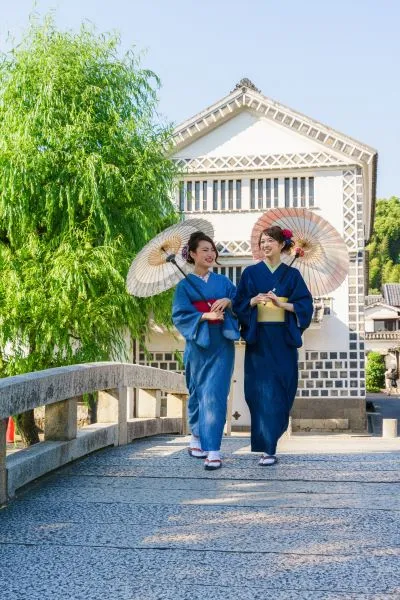
Wearing a Yukata (浴衣) is a popular way to embrace the festival atmosphere, creating unforgettable photos against the firework-lit night sky.
- Rental Services: You can easily take advantage of local yukata rental and fitting services, which handle both the dressing (kitsuke) and styling.
- Footwear Alternative (Sandal Hybrid): While traditional wooden clogs (geta) complete the look, walking from Nagaoka Station to the venue takes 20 to 50 minutes each way. A popular modern trend in Japan is pairing a yukata with comfortable sandals, flat shoes, or sport sandals worn with white tabi socks to keep your feet pain-free.
Practical Everyday Clothing Recommendations
If functionality and heat management are your top priorities, casual everyday wear is the most comfortable choice for navigating heavy crowds and long walks.
| Clothing Item | Recommended Specs | Strategic Reasons |
| Tops & Shirts | Breathable cotton, linen, or quick-dry athletic wear in darker colors | High humidity causes heavy sweating. Dark or patterned shirts prevent sweat marks and mask fine firework ash that occasionally drifts onto spectators sitting close to the launch sites. |
| Footwear | Worn-in sneakers (Highly Recommended) | Prioritize comfort over fashion. You will walk thousands of steps on pavement, dirt paths, and grass, making broken-in running shoes essential. |
| Light Layer | Thin cardigan or light long-sleeve shirt | August nights in Nagaoka stay warm (~25°C / 77°F), but a light layer protects against night breezes, insects, and air-conditioned transit cars. |
Taking Elderly Parents and Family Members to Nagaoka Fireworks: A Real-World Survival Guide
Many readers ask how to pull off what feels like a “mission impossible”, taking elderly parents or family members to experience the Nagaoka Fireworks safely and making sure everyone is happy. It will be challenging as they have less physical stamina. But seeing their eyes light up as they whisper, “Wow… that is so beautiful,” will make every ounce of stress and meticulous planning completely worth it.
If you are planning to take older relatives, keep three non-negotiable goals in mind: preserve their energy for the main event, prevent heatstroke, and eliminate potential points of failure. Here is the extreme play-by-play strategy to make it run smoothly:
1. Preserving Energy: Every Ounce of Stamina Counts
The exhaustion from a long festival day doesn’t hit right away. It catches up with older travelers right as the main show starts.
- Carry All the Weight: I carried all the heavy luggage myself, leaving my parents with only small, lightweight personal bags. I even quietly checked their bags before leaving the hotel to remove heavy, unnecessary items.
- The Power of the Midday Nap: Schedule very light mornings and head back indoors before the summer heat peaks. On show day, I specifically booked a private rental space (such as a local lounge or private room. A KTV/karaoke room is also an excellent fallback) so my parents could actually lie down and sleep for a few hours before heading to the riverbank.
- Ride Whenever Possible: Never make them walk if a vehicle is an option. For example, when visiting Zenkoji in Nagano earlier in the trip, we took a taxi directly to the main hall to save their walking energy for cooler, more comfortable hours. On festival day, I booked transport directly to the venue perimeter well before traffic restrictions started.
- Buy Food & Drinks in Advance: Do not rely on convenience stores at Nagaoka Station on show day. The queues can be demoralizingly long and exhaust your group before you even arrive at your seats. Buy all bento boxes, snacks, and water at your origin station before boarding the train to Nagaoka.
- Be Proactive About Rest & Restroom Breaks: Older parents often hesitate to say “I’m tired” or “I need a restroom” out of fear of slowing down the group. Watch their walking pace and body language closely. Instead of asking if they need a break, use white lies like: “I’m getting tired, let’s sit down for a bit” or “I need to use the restroom, let’s all go together.”
2. Beating the Heat: Active Cooling Strategy
Japanese summer heat is hot and humid. People lose water fast without realizing it until heat exhaustion sets in.
- Pack an Active Cooling Arsenal: Carry a small insulated bag loaded with chilled sports drinks, cooling neck bands, menthol body wipes, instant ice packs (the type that activate when squeezed), and cold snacks that cool the body down while eating.
- Enforce Hydration: Keep reminding them to drink fluids regularly throughout the day, even if they don’t actively feel thirsty.
3. Preventing Mistakes & Navigating Crowds
When dealing with a crowd of over one million people, minor mistakes can quickly turn into major emergencies.
- Prep for Lost Cell Signals: Network coverage degrades rapidly as the venue fills up. Before setting off, walk your parents to a clear, easily identifiable meeting spot and have everyone take a photo of it on their phone.
- Prepare Emergency Translation Cards: Save simple dual-language phrases on their phones (e.g., “I am lost. Please help me get to this location: [Hotel/Station Name]”).
- Formation Walking: Position the strongest navigator at the front of your walking group, with another reliable adult bringing up the rear to ensure no one gets separated in dense crowds.
- The Difficult Decision: Leaving Before the End: Considering my parents’ walking pace, we made the tough choice to slip out slightly early, sacrificing the very last segment of the display. While it meant missing the final moments, the payoff was priceless: a smooth, calm exit from the venue without getting trapped in a crushing sea of people or pushing my parents past their physical limits.
Bonus Experience: Don’t Miss the Nagaoka Peace Festival on August 1st!
While the grand fireworks displays take center stage on August 2nd and 3rd, the celebration actually kicks off a day earlier with the Nagaoka Peace Festival (Nagaoka Matsuri Heiwa-sai) on August 1st.
Having attended the Peace Festival firsthand, it proved to be an unexpected highlight of the trip. Here is why adding this extra day gives you the complete festival experience:
- Incredible Variety in One Place: You get to experience everything classic Japanese summer festivals are famous for, from energetic Taiko drum performances and massive traditional folk dance parades (Minyo Odori) to lively food stalls, spirited portable shrine (Mikoshi) processionals, and serene floating lantern ceremonies along the river.
- High Engagement & Interactive Fun: The festival is wonderfully welcoming. During the latter half of the folk dance parade, spectators are invited to join in and dance along. You can also watch the Mikoshi teams carrying the heavy portable shrines up close, putting you right in the middle of the action.
- Lively Without the Crushing Crowds: While the venue is energetic and well-attended, it never feels overwhelmingly packed. You can move around freely, sample local food vendor stalls, and easily find quiet nearby spots to rest whenever you need a break.
- The Perfect Warm-Up for the Fireworks: Attending on August 1st ties the whole story together. It deepens your understanding of why the Nagaoka Fireworks exist in the first place—as part of a broader community festival honoring peace—and builds immense excitement for the main spectacle launching the next evening.
Conclusion: Is It Worth the Effort?
Executing a trip to the Nagaoka Fireworks Festival takes substantial preparation—from entering lotteries months in advance and securing scarce regional lodging to braving high summer temperatures and post-show transit queues.
Yet, for everyone who stands on the banks of the Shinano River as thousands of golden Phoenix shells illuminate the night sky to the strains of Jupiter, the verdict is unanimous: it is entirely worth it. Nagaoka Hanabi is not merely an impressive pyrotechnic display; it is a profound cultural ritual where history, community resilience, and breathtaking artistry converge. With proper planning and the right expectations, witnessing Nagaoka’s sky full of prayers will easily become one of the most unforgettable memories of your travels in Japan.