Discover one of Japan’s most striking architectural wonders at Takkoku no Iwaya Bishamondō (達谷窟毘沙門堂), an ancient temple carved directly into a towering sandstone cliff in Iwate Prefecture. Located just a short distance from other UNESCO sites of Hiraizumi, this 1,200-year-old monastery was founded by the legendary Shogun Sakanoue no Tamuramaro to commemorate a victory over local tribes. The temple’s centerpiece is a brilliant vermillion hall that appears to emerge from the rock face. Moreover, the Ganmen Daibutsu, a giant Buddha etched into the cliff, gazes serenely over the grounds. Even if you aren’t interested in history or Buddhism, Takkoku no Iwaya is worth seeing.
What to See at Takkoku no Iwaya Bishamondō
- About Takkoku no Iwaya Bishamondō
- Dakkoku no Iwaya Bishamondō's Main Worship Hall
- Himemachi Fudōdō (姫待不動堂)
- Kondō Hall (金堂)
- Gamagaike Pond (蝦蟆ヶ池) and the Bentendō Hall (辯天堂)
- Ganmen Daibutsu (岩面大佛): The Giant Buddha Etched Into the Cliff
- How Much Time to Allocate to Takkoku no Iwaya Bishamondō
- What Is the Best Time to Visit Takkoku no Iwaya Bishamondō
- Takkoku no Iwaya's Opening Hours, Admission Fee, and Access Information
- Genbikei Gorge and the Fascinating Flying Dango Rice Cake
- Explore Other Astonishing Temples in Hiraizumi
Tip: You can spend a night at Hiraizumi. Hiraizumi Hotel Musashibou is a nice option. The hotel provides free pick-up and drop-off service.
About Takkoku no Iwaya Bishamondō
Takkoku no Iwaya Bishamondō was founded by the Shogun at the time, Sakanoue no Tamuramaro (坂上田村麻呂). He prayed to Bishamonten (毘沙門天) for his blessing to successfully suppress the bandits in the region where the temple was built. Upon completing the task entrusted by Emperor Kanmu (桓武天皇), he ordered that Takkoku no Iwaya Bishamondō be constructed. The temple was completed in 801 and has Bishamonten enshrined as the main image.

Apparently, 108 Bishamonten statues were enshrined at the origin of Takkoku no Iwaya Bishamondōally. Since its establishment, the temple has been supported by regional leaders, including the Fujiwara clan of Oshu, Minamoto no Yoriyoshi, and Date Masamune.
As repeated fires and wars destroyed the temple, the main building of Takkoku no Iwaya, completed in 1961, is the fifth reconstruction. The number of Bishamonten statues enshrined also reduced to 33.
In addition to the Bishamonten, Kisshōten (吉祥天) and Zennishi Dōji (善膩師童子) are enshrined in the small zushi cabinet. But they are only exhibited to the public once every 33 years. The next public viewing will be in 2042. Apparently, Bishamonten, Kisshōten, and Zennishi Dōji are families!
Currently, Dakkoku no Iwaya Bishamondō is administered by Takkoku Saikoji Temple (達谷窟毘沙門堂 別當達谷西光寺) founded in 802.
Dakkoku no Iwaya Bishamondō’s Main Worship Hall
You will be amazed by this temple, which is incredibly constructed, partially in the rock face of a cliff, when you get there. There aren’t many places in the world where you can find this unique architecture. Unlike other temples, the entrance isn’t located in the middle of the building. Instead, pilgrims enter the worship hall from the east entrance and exit from the west.
Moreover, do the pillars underneath the temple reminds you of the Kiyomizu-Dera Temple (清水寺) in Kyoto? Because that is the temple that Takkoku no Iwaya imitates!
What to pray to the Bishamonten? Here are a couple of things you can ask for his blessing.
- Success in sports competitions or exams
- Wearing off misfortune
- Luck on starting something new
- Success in running businesses and investments
Tip: It is said that making a wish after ringing the bell in front of the main hall will be more effective.
When you are inside the worship hall, don’t forget to look out. It is the best spot to admire the temple’s gorgeous garden!
Himemachi Fudōdō (姫待不動堂)

Before reaching Takkoku no Iwaya Bishamondō’s last Torii gate, the approach splits to the right to the Himemachi Fudōdō Hall. The temple was funded by Chishō Taishi (智證大師) and was initially constructed and rebuilt above the Himemachi Falls (姫待瀧). Over the years, the temple had deteriorated significantly, so it was reconstructed in its current location in 1789.
The Fudō statue enshrined was designated a prefectural treasure because it was carved from a single block of Katsura wood, dating back to the late Heian period.
Fudō is said to protect his pilgrims from fire and cure eye diseases. Apparently, many pilgrims have benefited from his blessings!
Kondō Hall (金堂)
The worship hall located at the rear right of Himemachi Fudōdō is the Kondō Hall. It was founded in 802 on the other side of the Takkoku River (達谷川), but was destroyed by fire in 1490. The current Kondō was completed in 1996. Traditional methods was used to pass on the construction techniques to future generations.
The main image in the Kondō Hall is a Healing Buddha carved from a holy pine tree from Mount Shinkyō (眞鏡山), the mountain behind Takkoku no Iwaya. The 120cm-tall Buddha is beneficial for people with worries and can help strengthen the body, heal illnesses, promote a long life, and fulfil various other wishes.
In front of the Kondō, a large Taxus tree, estimated to be 500 years old, spread its branches majestically.
Gamagaike Pond (蝦蟆ヶ池) and the Bentendō Hall (辯天堂)
In the temple’s front yard is the Gamagaike Pond. Whilst it seems like any other pond you might find in a Japanese garden, it is also of great historical value, with many plates from the Heian era discovered in the pond in 1985!
The small temple atop the small island in the center of the pond is the Bentendō Hall. The worship hall was rebuilt in 2013 and has the goddest, Benzaiten (弁財天), enshrined. It is said that the statue was made by Jikaku Daishi (慈覚大師) between 829 and 832.

The creatures that live in the pond are considered to be Benzaiten’s messengers. Among them, snakes are considered special creatures.
Nowadays, Benzaiten is worshipped by people seeking prosperity in business and financial success.
Important: The goddess can get jealous easily. So, don’t cross the red bridge to the Bentendō Hall with your partner!
Ganmen Daibutsu (岩面大佛): The Giant Buddha Etched Into the Cliff

On the west side of the temple, you will find this big Buddha face! Before his body collapsed during an earthquate in 1896, it was a 16.5-meter-tall Buddha statue. But at least we still have his 3.6-meter-long face and 9.9-meter-wide shoulder!
The Buddha was carved by Minamoto no Yoshiie (源 義家) with a bow while on horseback, to pray for those who had passed away in the wars that took place between 1051 and 1062 and between 1083 and 1087.
It is said that if various desires cloud your heart, the 930-year-old carving won’t look like an Amida Buddha to you. So, clear your mind before visiting Takkoku no Iwaya!
Furthermore, when you throw a coin into the donation box in front of the Ganmen Daibutsu, you should hear a loud bell sound. Be sure to try to listen!
How Much Time to Allocate to Takkoku no Iwaya Bishamondō
It is best to allocate 30 to 60 minutes to Takkoku no Iwaya Bishamondō.
What Is the Best Time to Visit Takkoku no Iwaya Bishamondō
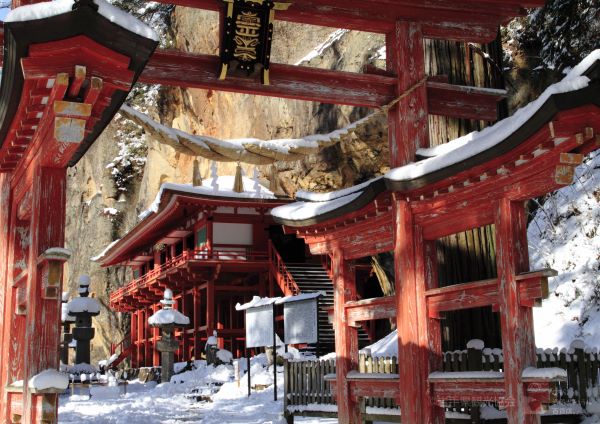
Takkoku no Iwaya Bishamondō is the most stunning during the cherry blossom and autumn foliage seasons. But the snow scenes in winter are also quite a view.
Takkoku no Iwaya’s Opening Hours, Admission Fee, and Access Information
- Takkoku no Iwaya is open from 8 am to 5 pm. It closes early at 4:30 pm from November 6 to February.
- The admission fee is
- 500 yen for adults
- 200 yen for high school students
- It is a 10-minute drive from JR Hiraizumi Station or Chūsonji Temple to Takkoku no Iwaya. If you take a taxi, it will cost around 2,500 yen one-way.
- If you plan to rent a bicycle to get there, it will take you approximately 30 minutes.
Tip: If you plan to take a taxi to Takkoku no Iwaya, check with the taxi driver to see if he can also take you back to Hiraizumi Station. Our driver waited for us at the car park while we explored the temple!
Genbikei Gorge and the Fascinating Flying Dango Rice Cake
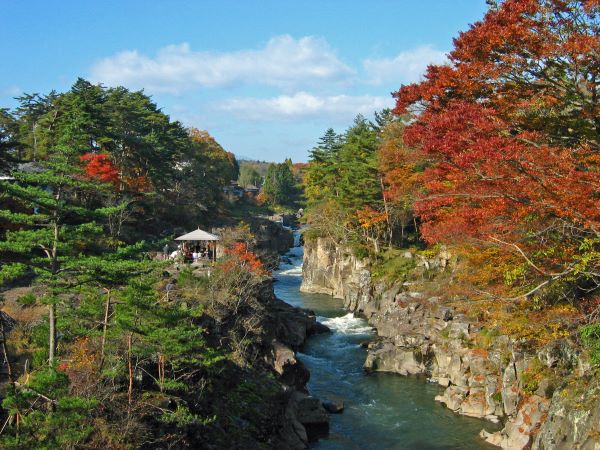
Just a 5-minute drive from Takkoku no Iwaya, Genbikei Gorge is a breathtaking scenic monument in Ichinoseki. Carved over millennia by the rushing waters of the Iwai River, this two-kilometer stretch of rugged rock formations, deep emerald pools, and cascading waterfalls is a must-visit destination in the Tohoku region. While the gorge is famed for its stunning seasonal shifts, it is perhaps best known for the quirky and delicious “Flying Dango” (Kakko Dango).
For more information, please refer to our article on Genbikei Gorge!
Explore Other Astonishing Temples in Hiraizumi
Discover why this tranquil town, easily accessible via the Tohoku Shinkansen, remains an essential stop for those seeking Japan’s hidden golden age. Established in the 12th century by the powerful Oshu Fujiwara clan, Hiraizumi was designed as a physical manifestation of the Buddhist Pure Land. In addition to Chusonji, be sure to visit other stunning attractions in the small town!
To find out about other great attractions in the town, refer to our article on Hiraizumi!