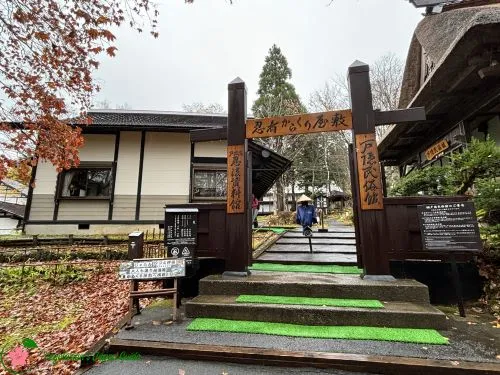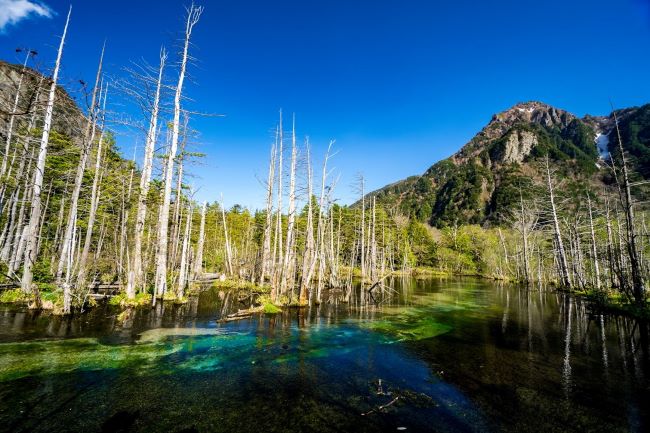
Deep in the forested highlands of Nagano, Togakushi Shrine (Togakushi Jinja, 戸隠神社) is a sacred destination where ancient Japanese mythology meets breathtaking natural beauty. Comprising five distinct shrines, Hokosha, Hinomikosha, Chusha, Kuzuryusha, and Okusha, this spiritual complex is legendary for its association with the “Amano-Iwato” myth, where the sun goddess Amaterasu was lured from a cave to restore light to the world. The undeniable highlight is the majestic Cedar Avenue leading to the Upper Shrine (Okusha), a 2-kilometer path lined with over 300 towering cryptomeria trees, some nearly 900 years old. Whether you are trekking the Togakushi Kodo pilgrimage trail or tasting the region’s world-famous soba noodles, our guide provides essential tips on bus access from Nagano Station and the best seasonal times to visit this mystical mountain retreat.
The Must-Sees and Must-Dos at Togakushi Jinja
- How to Get to Togakushi Shrine by Bus
- Togakushi Shrine’s History
- Togakushi Kodō (戸隠古道)
- Ichi no Torii (一の鳥居)
- Togakushi View Point/Soba View Point (戸隠展望苑/蕎麦展望苑)
- Yunomine Yūhitenbōen Observatory (湯之嶺夕日展望苑)
- Double-body Taoist God (双体道祖神)
- Yūkonshahi Monument (幽魂社碑)
- Jizō-dō (地蔵堂)
- Togakushi Hōkō-sha (戸隠神社 宝光社)
- Hinomiko-sha (火之御子社)
- Togakushi Chū-sha (中社)
- Shukubō Gokui (宿坊極意)
- The Ruins of Nyonin-dō (Nyonin-dō-ato, 女人堂跡)
- Bikuni-ishi Stone (比丘尼石)
- Chigo’s Pagoda (Chigo no Tō, 稚児の塔)
- Togakushi Shrine Oku-sha Approach (戸隠神社 奥社参道)
- Togakushi Cedar Path (杉並木)
- Zuijinmon Gate (随神門)
- Togakushi Oku-sha (奥社)
- Kuzuryū-sha (九頭龍社)
- Upper Togakushi Shrine: Togakushi Oku-sha (奥社)
- Nenbetsu-ike Pond (念仏池)
- The Five Shrines of Togakushi Shrine
- Chōishi Stone (丁石)
- The 30 Folios of Rubbings Along the Togakushi Kodō
- What to Wear and What to Bring to Trek the Togakushi Kodō
You can refer to THIS MAP for the locations of the above attractions.
Tip: Refer to the LIVE CAMERA for the current scenery at Togakushi.
Explore the Togakushi With a Guided Tour
If you prefer to be guided when visiting Togakushi or want to join one of the interesting activities, consider joining one of the tours below.
Here are a few options to consider:
- 1-Day Togakushi Tour: Soba making, Ninja Town, and Hidden Shrines
- Professional guided tours offered by Shinano Discovery.
How to Get From Nagano to Togakushi Shrine by Bus
To travel from Tokyo to Togakushi Shrine, take the bullet train to Nagano Station.
To get from Nagano Station to Togakushi Shrine by bus, take Alpico Bus’s route 70 or 73 from Nagano Station or Zenkoji Temple. The bus stop at Nagano Station is in front of the Alpico Kōtsu Nagano Station Information Center.
Important: Boarding a bus to Togakushi with suitcases isn’t a good idea. The buses that serve the area don’t have a luggage trunk. As the buses are usually packed, you won’t have space in the bus to store your suitcases.
- For those who are starting the journey from Ichi no Torii (一の鳥居), please only take route 70 and get off at Mt. Iizuna Trailhead (飯綱登山口). This bus stop is closer to the car park and the toilet.
- If you want to go straight to Togakushi Shrine, both bus routes stop at Togakushi Hōkō-sha (戸隠神社 宝光社).
- Refer to HERE for the timetable and bus fare.
- The timetable is abbreviated. Mt. Iizuna Trailhead is 3 stops before Soba Museum.
- For a complete timetable for Route 70 and Route 73, please refer to HERE.
- “平日” means weekday
- “土日祝” means weekends and public holidays.
Tip: If you plan to explore other attractions in Nagano Prefecture, such as Zenkoji, Kamikōchi, Norikura, and Matsumoto, there are various discounted transportation passes you can consider. Refer to Alpico’s Website for more information!
Togakushi Shrine’s History
Centuries ago, Togakushi was a thriving centre of mountain worship and the training ground of Shūgendō (修験道), where spiritual power was cultivated through ascetic practices on holy mountains. It may come as a surprise to some, but Togakushi Shrine was initially established as Togakushiyama Kenkōji Temple (戸隠山 顕光寺) approximately 2,000 years ago.
In the Kamakura period, along with Mt. Hiei and Kōyasan, Mt. Togakushi was known as Sanzenbō Sanzan (三千坊三山), which was used to describe the enormous number of practitioners and worshipers that were once gathered at Togakushi.
During the Edo period (1603-1867), Togakushi also received support from the Tokugawa Clan, with many small temples built around Togakushi Shrine Chūsha and Hōkōsha to accommodate pilgrims from around the country.
Even after Buddhism was separated from Shintoism during the Meiji Restoration in the late 19th century, traces of the past property of Togakushi, where many monks of Shūgendō trained, can still be seen.
For more information about the Shugendō, please refer to our article on Mt. Yoshino.
Togakushi Kodō (戸隠古道)
Nowadays, the most popular way to explore Togakushi Shrine is to start from Togakushi Hōkō-sha. However, for a pilgrimage, the proper way to get to Togakushi Shrine is by trekking the 12.5 km long Togakushi Kodō to Oku-sha. It is an old road that starts from Ichi no Torii (一の鳥居), which many pilgrims took in the past. Although it may seem arduous, the entire trail is almost flat, so as long as you can walk for a long distance, it shouldn’t be a problem for inexperienced hikers.
Time-wise, a one-way journey will take around 3 to 3.5 hours. Including sightseeing and breaks, it is better to allocate around 7 hours for the trek for a return trip.
For the English map, click HERE. You can also refer to the Japanese map HERE that has other trails marked.
The Five Shrines of Togakushi Shrine
Togakushi Shrine, established over 2,000 years ago, is largely divided into three areas: lower, middle, and upper shrine areas. Each is about 2 km apart. Within these areas, five sub-shrines of the Togakushi Shrine are scattered around. The best way to explore the entire Togakushi Shrine is by following the sequence below.
Togakushi Hōkōsha (宝光社) ⇒ Hinomikosha (火ノ御子社) ⇒ Togakushi Chūsha (中社) ⇒ Togakushi Okusha (奥社) ⇒ Kuzuryūsha (九頭龍社)
From Hōkō-sha to Kuzuryusha, it will be a 2 to 3-hour trek. If you don’t want to walk between the five shrines and can’t access a car, you can take a bus instead. It takes approximately an hour to travel from the car park and the closest bus stop to Okusha and Kuzuryusha.
Chōishi Stone (丁石)
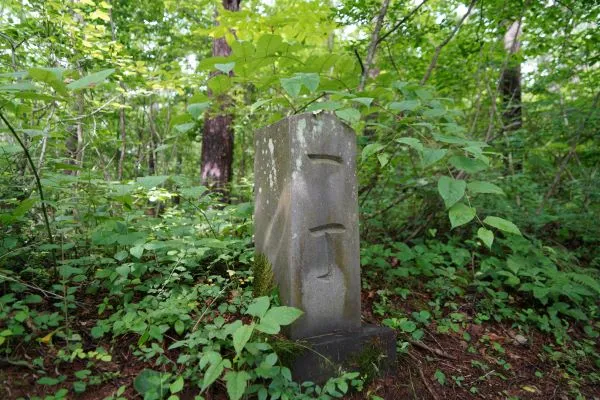
Along the Togakushi Kodō, if you pay attention to the side of the track, you will notice some stone indicators called Chōishi. Every time you see one of them, you have trekked another 109 meters.
Most of the Chōishi stones are still relatively new because hikers have taken some of them back as souvenirs.
So when you see the stones, let’s not increase the work of the mountain trail staff. Please leave them alone.
The 30 Folios of Rubbings Along the Togakushi Kodō
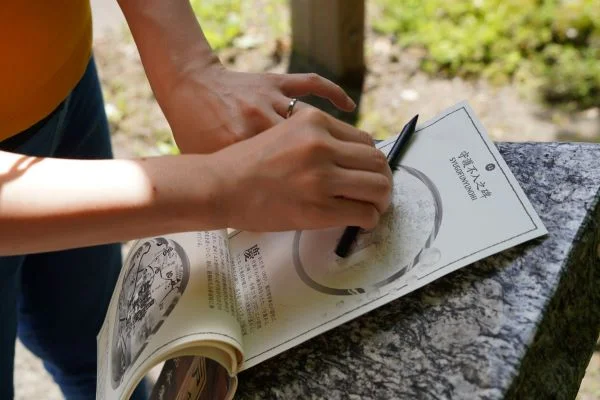
If you are up for a challenge, a fun thing that you can do is collect all 30 folios of rubbings along the mountain trail.
At each of the historic sites and scenic spots, a stone pillar is placed as a landmark. Atop the stone pillar, an image related to the spot is engraved for you to rub with a pencil.
You can get the Togakushi Kodō Walking Takumoto Collection Book (戸隠古道ウォーキング拓本集印) from Togakushi Tourist Information Centre (戸隠観光情報センター) around Chū-sha for this activity. Although the brief explanation of the spots in the book is only in Japanese, it will still make a great souvenir for you.
Refer HERE for more information.
What to Wear and What to Bring to Trek the Togakushi Kodō
- The Togakushi Kodō is a mountain trail that consists of mostly earthen roads. Hiking shoes won’t be necessary, but come prepared with comfortable shoes and clothing that allow for easy movement.
- The trail is situated at an elevation of approximately 1,300 meters. On average, the temperature is about 6 degrees lower than the city center, so come with enough warm clothes that can be easily taken off and put back on.
- Remember to bring enough water. Along Togakushi Kodō, there are almost no vending machines.
- In summer, don’t forget to bring insect repellent.
- No matter which season you visit Togakushi, having a bear bell with you will minimize the chance of running into a wild bear that lives in the area.
Ichi no Torii (一の鳥居)
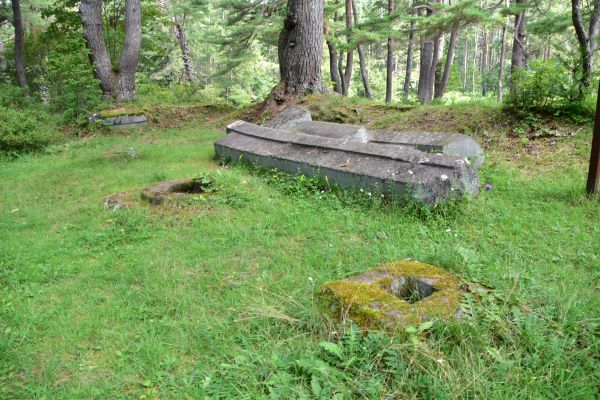
To avoid confusion, don’t expect a torii gate there when you get to Ichi no Torii. The stone torii gate that marked the precinct of Togakushi Shrine was knocked down during an earthquake of magnitude 7.4 in 1847.
As the gate wasn’t restored, only the foundation of the stone gate remains.
Togakushi View Point/Soba View Point (戸隠展望苑/蕎麦展望苑)
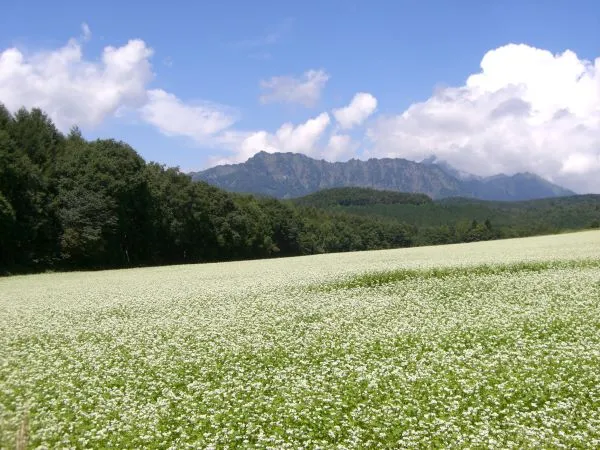
On the way to the first sub-shrine of Togakushi Shrine – Hōkō-sha, you will walk past a vast field of soba (buckwheat) with Mt. Togakushi (戸隠山) afar.
From early to mid-September, the white buckwheat flowers will bloom and begin to bear buckwheat seeds, which restaurants will grind in October for the delicious Togakushi soba noodles.
From mid to late October, the area will be decorated with vivid fall colors!
Refer to HERE for details on how to enjoy the soba-making activity held at Togakushi.
Yunomine Yūhitenbōen Observatory (湯之嶺夕日展望苑)
Trekking further toward Togakushi Shrine, the Yunomine Yūhitenbōen Observatory will give you a panoramic view of the surrounding mountain ranges.
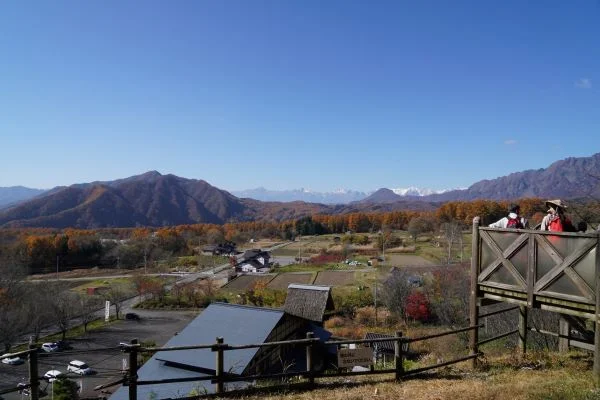
To the right, there is the Togakushi Mountain Range (戸隠連峰), extending to Niigata Prefecture. Then on the left, there is Mt. Arakura (荒倉山).
In the middle back, there are quite a few mountains, including Mt. Kashimayarigadake (鹿島槍ヶ岳), which is a part of the Mt. Tate Mountain Range stretching to Toyama Prefecture. Mount Shirouma (白馬岳) is also between Mt. Arakura and Togakushi Renpō.
In spring and summer, expect a resplendent sunset view from the observatory.
Double-body Taoist God (双体道祖神)
To reach the 5th attraction, Jizō-dō, as marked on the English map from Yunomine Yūhitenbōen Observatory, you will need to make a detour. Referring to the Japanese map HERE, at the intersection before Jizō-dō, there is a Togakushi Tourist Information Center (戸隠観光案内所).
Apart from grabbing some tourist pamphlets, you can also utilize their toilet facilities here.
Apart from grabbing some tourist pamphlets, you can utilize their toilet facility here.
From the information center to Hōkō-sha, it is only another 600-meter trek. On the way, you will see a graveyard, a few monuments, and a small stone pagoda.
In front of the graveyard is a small stone statue on the ground with an image of two people engraved. It is the statue of a Double-body Toaist God pronounced as Sōtai Dōsoshin. The god is said to be able to keep misfortune out of the border he is guarding.
You might notice the top of the statue is covered by black soot. It results from a fire ritual performed on January 15. It is believed that the fire will burn away all the misfortune accumulated over the past year.
Yūkonshahi Monument (幽魂社碑)
The Yukonshahi Monument is a large flat stone with a white rope wrapped around it, standing on one side of the track. It was built for the priests who passed away in other provinces as a result of a dispute known as the Sori Incident (雪舟事件) in 1780.
At the time, the priests of Hōkō-sha and Chū-sha were disputing the right to log and transport firewood. The dispute was eventually brought to the local government office for a decision. Unfortunately, Hōkōsha’s priests lost the trial and were banished from the province.
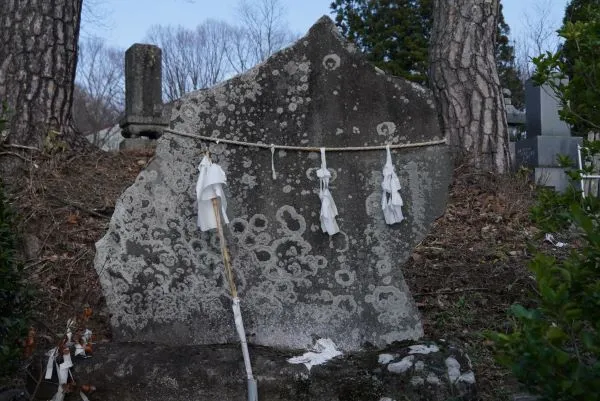
In 1881, the monument was constructed as a prayer site for a peaceful afterlife.
Next to the monument, you should see a small stone pagoda. Unlike other monuments in Japan, which are used to store Buddhist sutras, this one was used as a gravestone.
Jizō-dō (地蔵堂)
The Jizō-dō at Togakushi enshrined the Jizō Bodhisattva and the ten judges of hell. A couple of Buddha statues that lost their home when Buddhism was separated from Shintoism during the Meiji Restoration are also placed in the precinct.
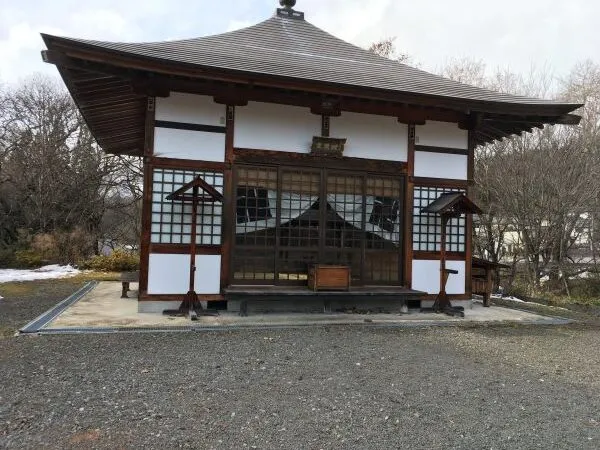
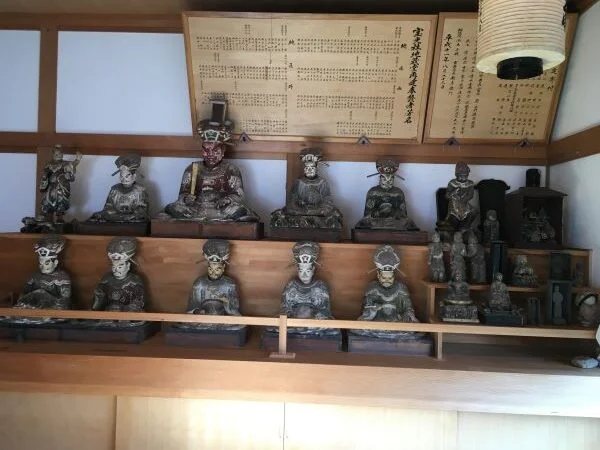
What is special about this Jizō-dō is that the statue of Jizō Bodhisattva is half-buried in the ground. It is said that the statue is slowly emerging from the ground. And when the entire statue is finally above ground, it is said a disaster will strike the world…Σ(゚Д゚)
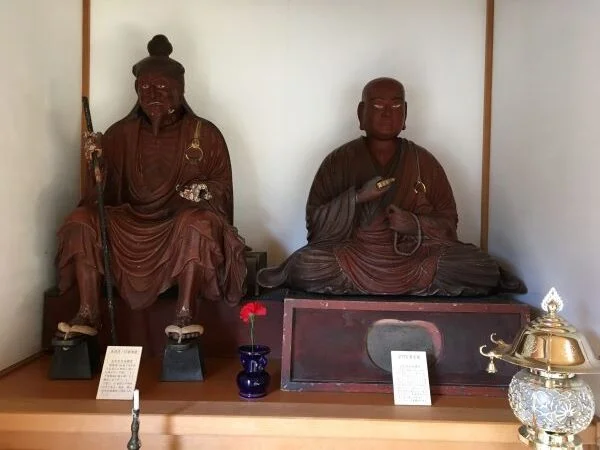
Next to the Jizō Bodhisattva statue, there are two other wooden statues. The one on the left is En no Gyōja (役の行者), who is the founder of Shugendō. The one on the right is Gakumon Gyōja (学問行者), the monk who founded Togakushi.
They were both originally enshrined in Togakushi Shrine. However, after the decree separating Buddhism and Shintoism was issued, they were relocated to Jizō-dō.
Togakushi Hōkō-sha (戸隠神社 宝光社)
Coming from the center of Nagano City, the first sub-shrine of the Togakushi Shrine you will encounter is the Hōkō-sha (戸隠神社 宝光社). Although the precinct of Hokosha is smaller than Togakushi Chusha Shrine, there are plenty of things to see at Togakushi Hokosha. Moreover, it might be the venue of the yearly Togakushi Soba Festival (戸隠そば祭り)!
For more information, refer to our Togakushi Hokosha article!
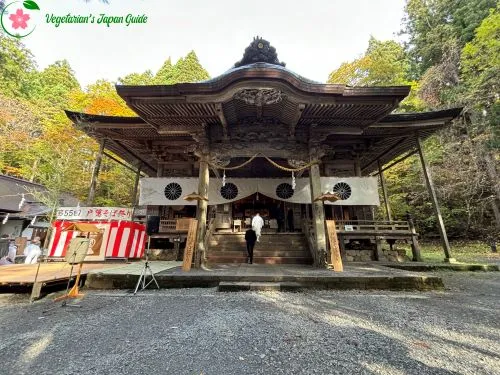
From Hōkō-sha to Hinomiko-sha
From the pilgrimage route to the right of Hōkō-sha, just 800 meters away, is where the Hinomiko-sha is located. Please look for the directory signs that say “(Kanmichi Iriguchi, 神道入口” or “(Kanmichi, 神道)”. The path is part of Togakushi Kodō (戸隠古道), which we introduced earlier.
Along the way, you will see a large cedar tree with a white rope tied around its bark. The place is Fushiogami-dokoro (伏拝所), the prostration for the Oku-sha.
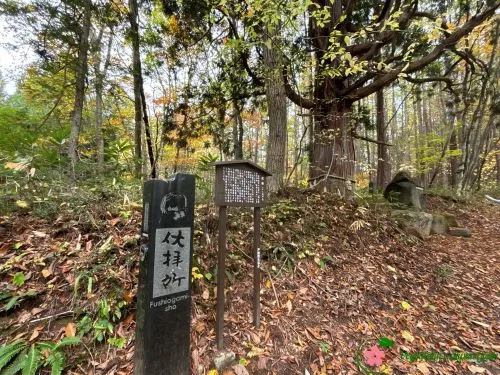
Passing the Fushiogami-dokoro, the road will split. If you go straight, you will be bypassing Hinomiko-sha and arrive at Chū-sha. So remember to head to the smaller road on the right. A directory board will be there to remind you.
Before you reach Hinomiko-sha, the road will split again. Follow the directional sign and turn left this time.
Tip: If you are driving and visiting Togakushi Shrine on weekends and public holidays, park your car in Hōkōsha or Chūsha’s car park. Hinomiko-sha’s car park can easily be filled.
Hinomiko-sha (火之御子社)
Hinomiko-sha is the only shrine at Togakushi that has always been a shrine since its establishment. The other four were previously temples of Shugendō.
Togakushi Shrine was established based on the legend: Amano-Iwato (天岩戸). Assuming you have read through the story in the Wikipedia link, the goddess, Ameno Uzumeno Mikoto (天鈿女命), who danced in front of the cavern where Amaterasu Ōkami (天照大神) was hidden, is enshrined as the main god in Hinomiko-sha.
Thanks to her dancing, the sun is shining in the sky again. And to avoid Amaterasu Ōkami, the goddess of the sun, hiding in that cavern again, the cavern was thrown far, far away and became the Mt. Togakushi that you will be visiting (´▽`*).
This is how the mountain got its name as well, with “To” meaning the cavern and “Kakushi” meaning hidden.
The Benefit of Worshipping the Gods at Hinomiko-sha
So, if you have wishes related to the performance arts, remember to ask for God’s help at Hinomiko-sha!
And because when she was dancing, the fire was lit, it is said that worshipping the gods here will protect you from fire hazards.
The last benefit of paying respect to the gods at Hinomiko-sha is finding a great romantic relationship. Since Ameno Uzumeno Mikoto met her husband while dancing in front of the cavern, she is also at the shrine, helping pilgrims seek a good life partner.
Hinomiko-sha’s Worship Hall
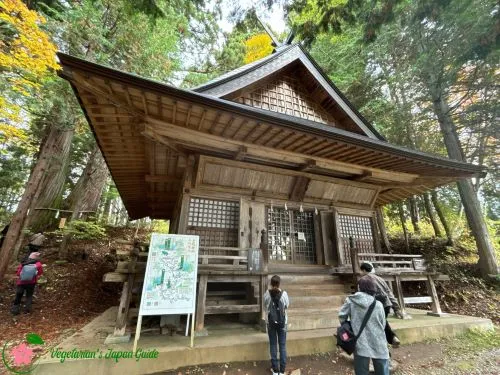
The current worship hall of Hinomiko-sha was reconstructed in 1884 due to major wear and tear. On the back-left of the hall, you will find two giant cedar trees sharing the same bark.
The two trees are said to be more than 500 years old and are another reason people head to Hinomiko-sha for relationship-related wishes. The two trees merging into one remind you of marriage, don’t they? So don’t forget to check them out when you visit the shrine!
As Hinomiko-sha doesn’t have its own shrine office, after you visit the Hinomiko-sha Shrine, you can ask for the Goshuin (御朱印), which is the seal stamp of the shrine from either Chū-sha or Hōkō-sha’s shrine office.
In winter, where Hōkō-sha and Hinomiko-sha Shrines are closed, you can get the Goshuin of both shrines from Chū-sha.
From Hinomiko-sha to Chū-sha
To get to Chū-sha, the promenade continues from the left back of the worship hall.
➡ When the road splits to the right, just stay on the original road.
➡ Along the way, you will walk past another graveyard. The end is when the road splits again. But again, stay on the road you are on, which should lead to the right.
➡ There is another intersection just before a residential area. Please ignore the road to the right and proceed straight ahead.
➡ Inside the residential area, you can either go straight or right at the intersection. Both will lead to Chūsha. But going straight is the shortcut.
⤴ + ➡ After climbing up a slope, head left and then straight at the following 2 intersections.
And then, if you keep walking on the road, you will soon see the large torii gate of Chū-sha. This is where another tourist information center is situated.
Togakushi Shrine Chūsha (戸隠 中社)
Among the five shrines of Togakushi, the area around Togakushi Shrine Chusha is the most lively. Along the Togakushi hiking trail, many restaurants and ryokans are located near Togakushi Shrine Chusha. Togakushi Tourist Information Center (戸隠観光情報センター) is also situated near the Chusha shrine. If you plan to hike in Togakushi, we highly recommend visiting the Togakushi Tourist Information Center first for the most up-to-date information on hiking trail conditions.
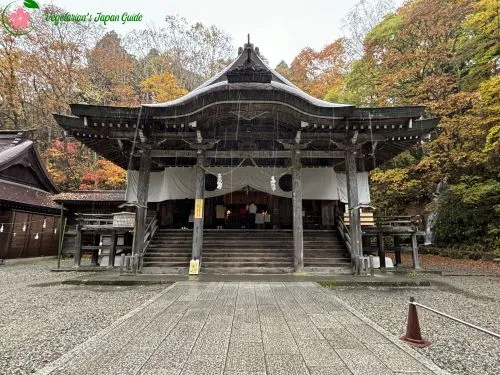
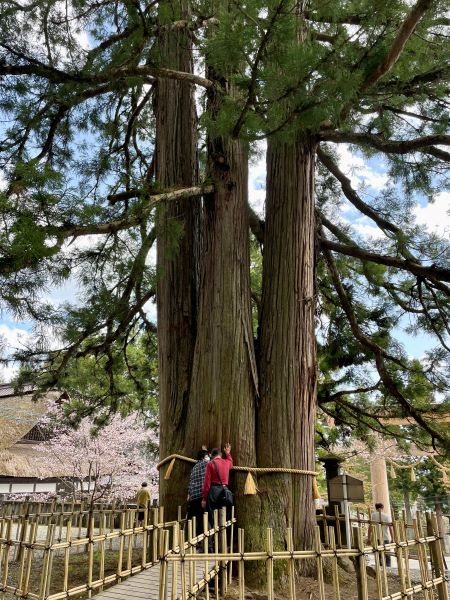
For more information, refer to our article on Togakushi Shrine Chū-sha!
Shukubō Gokui (宿坊極意)
Exploring the entire Togakushi area will take more than a day to complete. Instead of returning to Nagano’s city center, you can choose to stay locally. A good choice is Shukubō Gokui, which has its buildings registered as a national cultural property.
Unlike the Shukubō experience at other Japanese temples, the six rooms here in its thatched-roof house are equipped with air conditioners and TVs. Aside from the futon bed, which may be a bit harder to sleep on, it is just like a traditional Japanese ryokan!
And just like staying overnight at a Japanese temple, you get to participate in the morning ritual. Instead of Buddhist chanting, it will be the Shinto service led by the priest of Togakushi Shrine.
Interested? Make a booking now HERE!
Important: They currently can’t cater to special dietary requests. However, you can check if they have accommodation plans that exclude dinner and breakfast.
If you don’t plan to stay overnight at Togakushi, you can still come in for lunch.
From Togakushi Shrine Chū-sha (中社) to Togakushi Shrine Oku-sha Approach (戸隠神社 奥社参道)
From Chū-sha to Oku-sha and Kuzuryusha, it is around a 30 to 40-minute walk to get to the 2 km Togakushi Shrine Oku-sha Approach.
If you don’t want to walk, take a bus from Chū-sha and get off at Togakushi Okusha (戸隠奥社入口). There are also a couple of car parks around the bus stop for you to park if you are driving.
If you are trekking through the Togakushi Kodō, there are a few small attractions between Chū-sha and Oku-sha. Each of them is marked by a black stone pillar, allowing you to obtain a Folio of Rubbings.
The Ruins of Nyonin-dō (Nyonin-dō-ato, 女人堂跡)
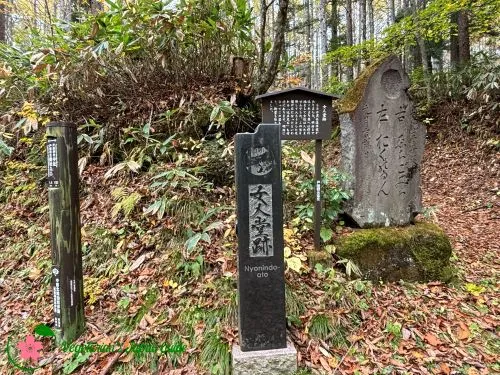
Back when women were forbidden to visit Togakushiyama Kenkōji Temple (戸隠山 顕光寺), a worship hall was established for women to worship the Buddha/gods from afar, which is why it was named Nyonin-dō.
Although the hall no longer exists, it remains deeply connected to the next attraction.
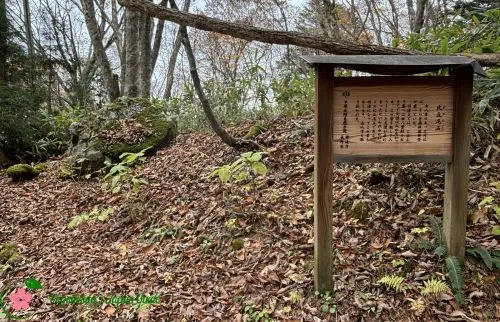
Bikuni-ishi Stone (比丘尼石)
The large stone close to Nyonin-dō has a somewhat sad story.
Back then, when women were strictly prohibited from entering the Togakushiyama Kenkōji Temple precinct, those rules also applied to nuns. One day, a nun broke the rule and went past Nyonin-dō. Although stopped by her attendant, she was really determined to reach Togakushiyama Kenkōji Temple.
But without being able to proceed too far, she collapsed on the spot, and before her attendant realized what had happened, the nun had become a stone.
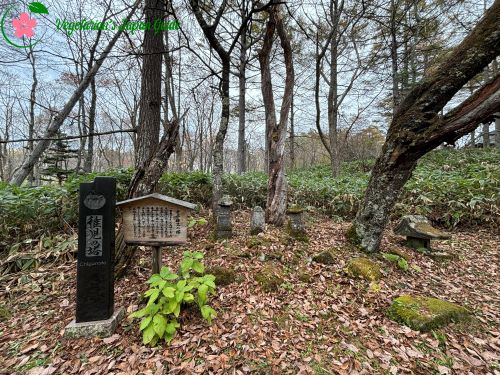
Chigo’s Pagoda (Chigo no Tō, 稚児の塔)
This pagoda has a more realistic story about the filial piety of a boy.
Back in the samurai era, there was a man named Tadayoshi (忠清). He was great at martial arts, but couldn’t read. While he was away trying to accomplish a mission assigned by his lord, his second wife was having an affair. After Tadayoshi came home, he sensed something was off and started doubting his wife.
When his wife was away, a love letter from the man she was seeing arrived. Unable to read, Tadayoshi asked his son to read it for him. With the hope of maintaining the relationship between his father and stepmother, the son changed the letter’s content to a letter of greeting.
Tadayoshi was consequently ashamed of himself for doubting his wife. He decided to repent his “mistake” by devoting himself to Buddhism. And his second wife, regretting committing infidelity, chose the same road and became a nun.
As to the son, although with good intentions, deceiving his father is a disobedience to Buddha’s teachings. So he chose to become a monk as well.
Knowing the story, the locals built this pagoda for him in 1400, praying for a peaceful afterlife for him.
Togakushi Shrine Okusha Approach (戸隠神社 奥社参道)
At the entrance of the approach, there is a large rectangular stone with “下馬” engraved on it. It is called Gebahi (下馬碑).
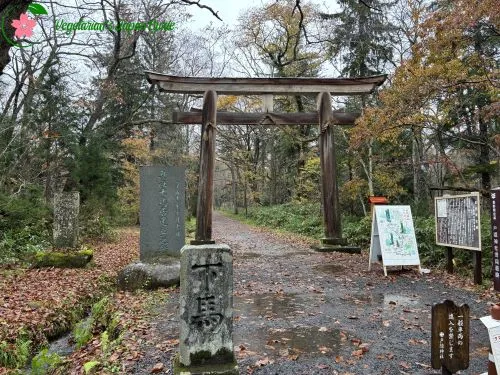
When horses were the primary mode of transportation, the stone was placed there to remind people to dismount from their horses from this point forward. Additionally, please note that pets are not permitted beyond the stone as well.
From the entrance of the approach to where Togakushi Okusha (奥社) and Kuzuryusha (九頭龍社) are located, it is around a 60-minute walk through the long approach in a cedar forest. The promenade is mostly flat for the first 1.5 km, with the last 500 meters consisting of some steep slopes and staircases.
Toilet Facility at Togakushi Okusha
The only public toilet facility in the area is close to Oku-sha’s torii gate and the bus stop. Remember to finish your private business before you proceed further.
Tip: We highly recommend visiting Togakushi Ninja Museum・Ninja Trick Mansion near Togakushi Okusha’s bus stop. The Ninja Mansion is a spot that both adults and children would enjoy.
Togakushi Jinja Zuijinmon Gate (随神門)
Around the middle of the 2 km approach to Oku-sha, this red thatched-roof gate is there to guard the precinct against evil spirits. You might notice that the statues (the 3rd and 4th photos in the IG post) on either side of the gate look different from the Niō statues you typically see at Buddhist temples in Japan. They look a lot more human-like. And you are right!
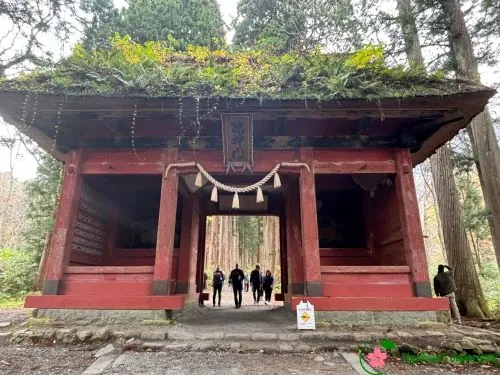
Before Buddhism was separated from Shintoism in the late 19th century, the Zuijinmon Gate was originally the Niōmon Gate of Togakushi. After the separation decree was issued, the Niō Statues were relocated to Kankeiji Temple (寛慶寺), located next to Zenkoji Temple (善光寺) in the city center of Nagano.
Replacing the Niō Statues, two Zuijin Gods’ statues were placed in the now Zuijinmon.
After passing the Zuijinmon Gate, you will see the remains of the twelve houses that were once the monks’ residences in Togakushi before Buddhism was separated from Shintoism during the Meiji Restoration.
Togakushi Cedar Path (杉並木)
The cedar path, consisting of approximately 80 trees that line the approach to Togakushi Shrine on both sides, is the spot that best represents Togakushi Shrine. Many of Togakushi’s promotional materials for tourists feature a photo of the cedar forest.
These trees are more than 400 years old. They were planted in the early Edo period to increase the dignity of the Togakushi Shrine.
These trees have most certainly achieved their purpose. Together, they created this solemn atmosphere, making you forget the hustle and bustle in your life and focus on the pilgrimage in process.
Another thing worth mentioning is that these trees are actually from the cutting of the Sanbonsugi cedar trees at Chūsha.
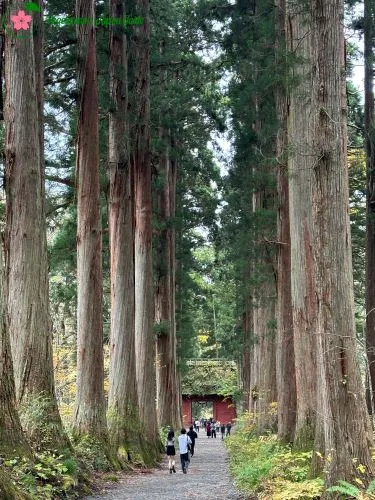
Important: For those who plan to visit Togakushi Shrine from early January to late April, please note Togakushi cedar avenue isn’t accessible. You won’t be able to go beyond Zuijinmon Gate, unfortunately.
Togakushi Jinja Kuzuryūsha (九頭龍社)
Togakushi Kuzuryusha is somewhat different from the other four sub-shrines of Togakushi Shrine, in that it enshrines the guardian deity of the Togakushi region. The founding of this shrine preceded that of Togakushi Okusha.
According to the shrine’s documentation, the legend started with a monk chanting the Lotus Sutra (法華経) while travelling to Mt. Togakushi in 849.
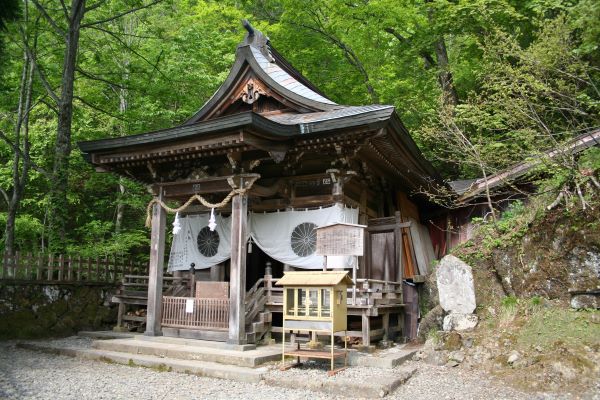
Suddenly, a nine-headed dragon appeared before him and said, “I was the head monk of the temple in the area. But I was transformed into a nine-headed dragon because I treated Buddha without respect and neglected my duties. Many monks traveled to Mt. Togakushi while chanting other sutras before you. But they died from the poison coming out of me.
Today, getting the benefit of listening to your chanting of the Lotus Sutra, I was released from this monster form.”
The dragon then transformed into a guardian deity and promised to look after Togakushi.
The Benefits of Worshipping the God of Kuzuryū-sha
Because dragons are revered as gods who control the water supply, locals have worshipped the dragon god here for proper rainfall since ancient times. Furthermore, because water is essential for us to live and for breeding new lives, it is said that the God of Kuzuryusha also grants good relationships to its pilgrims.
Also, if you are troubled by tooth-related issues, you can offer the dragon god’s favorite food – pears. The Japanese word for toothless is “Hanashi (歯なし),” and pear is pronounced as “Nashi (梨)”. So taking away the “Nashi” from “Hanashi” leaves you with “Ha (歯)”, which means tooth. This is why the Japanese offer pear to the dragon god when they want to pray for the health of their teeth (´▽`*).
Upper Togakushi Shrine: Togakushi Okusha (奥社)
The main God of Okusha is Ameno Tajikarao no Mikoto (天手力雄命). In the legend, he is the one who pulled the God of the sun out of the cavern when she opened the cavern where she was hidden.
The benefits you will get from worshipping him are better fortune and the fulfilment of your wishes. He also looks after prosperity and victory in sports competitions (since he was powerful enough to open up the cavern completely, where the God of the sun was hiding).
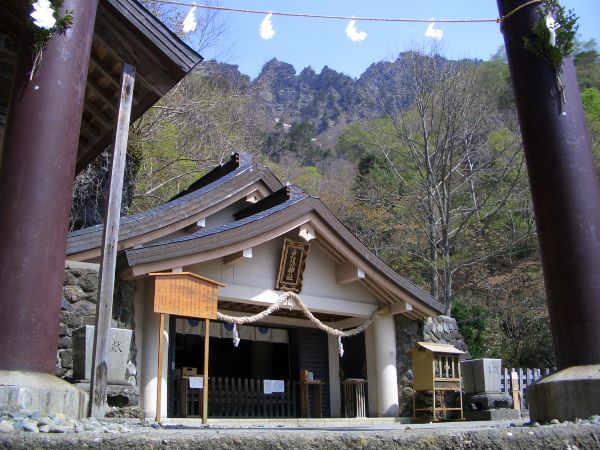
The worship hall of Oku-sha collapsed numerous times in the past due to an avalanche. The current one that we have today was restored in 1979. To prevent it from collapsing again, this time, the hall was built with concrete.
There is only one shrine office for both Oku-sha and Kuzuryusha, which is in front of Kuzuryusha.
Important: This shrine office will remain closed from the Chinkasai Festival (鎮火祭), held on January 7 each year, to mid-April.
The Scenic Route Between Togakushi Chū-sha to Oku-sha
On the way back from Oku-sha, instead of going through the 2 km approach again, you can head back to Chū-sha by detouring to the stunning Togakushi Forest Botanical Garden, Kagami-ike Pond, and Kotoriga-ike Pond.

When you reach Suijinmon Gate again, instead of going straight, turn right to access the Togakushi Forest Botanical Garden. Following the promenade, you will be led to Kagami-ike Pond, then Kotoriga-ike Pond, and lastly, Togakushi Chū-sha.
For more information, please read our article on the Scenic Route between Togakushi Chū-sha to Oku-sha!
You can also follow the same direction described in the article and go through this route from Chū-sha to Oku-sha.
Nenbetsu-ike Pond (念仏池)
Beyond Oku-sha, if you are heading to Togakushi Campsite or Togakushi Pasture, you will likely walk past a small pond called Nenbetsu-ike. The pond’s story is associated with a monk named Shinran Shōnin (親鸞上人).
According to legend, the pond was created by Shinran when he struck his khakkhara into the ground while chanting the name of Amida Buddha. Even up until now, the water is still springing out!
Other Interesting Attractions in Togakushi
The mountain range of Togakushi is renowned for its breathtaking scenery reminiscent of Chinese ink paintings. Food-wise, Togakushi is known for Togakushi Soba Noodles. There is also a large campsite, a ski resort, and a Togakushi ninja school!
So, check out our article on Togakushi to discover the best restaurants for mouthwatering soba noodles, the scenic spots in the area, and more (=゚ω゚)ノ.