Coming from the center of Nagano City, the first sub-shrine of the Togakushi Shrine you will encounter is the Hōkō-sha (戸隠神社 宝光社). Although the precinct of Hokosha is smaller than Togakushi Chusha Shrine, there are plenty of things to see at Togakushi Hokosha. Moreover, it might be the venue of the yearly Togakushi Soba Festival (戸隠そば祭り)!
The current worship hall was rebuilt in 1861 and is the oldest hall in Togakushi Shrine. The god enshrined here is Ameno Uwaharu no Mikoto (天表春命), who is the son of the god enshrined in Togakushi Chusha, which can be reached via the pilgrimage route on the right side of the worship hall.
Ameno Uwaharu no Mikoto is the god of practical arts and sewing. He is also known as the god of smooth delivery and is the guardian deity of women and children.
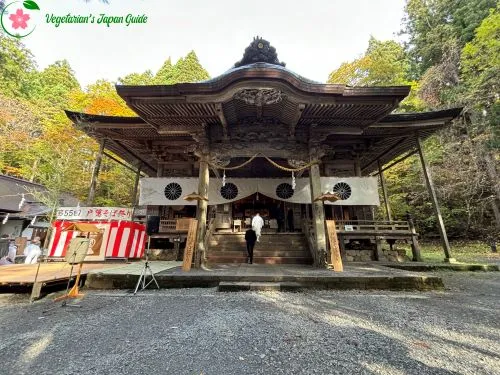
The shrine’s approach is formed by the 270 staircases mostly in the cedar forest beyond the torii gate. Among the five sub-shrines of Togakushi Shrine, the Hōkō-sha has the most staircases.
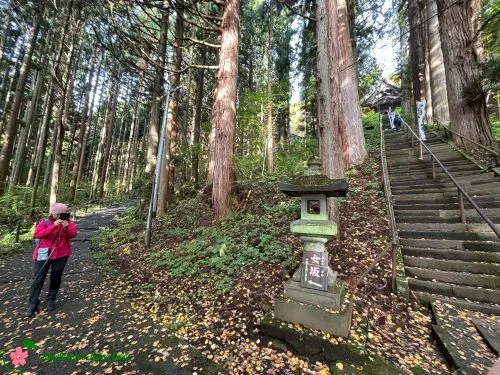
Tip: If you aren’t confident climbing up all the 270 staircases, a gentle slope called Onnazaka (女坂) stretches to the left from the middle of the long staircases. The path leads to the worship hall as well.
Hōkō-sha’s Founding Myth
Togakushi was once a training ground for Shugendō, which has a profound connection to Buddhism. So the myth of why Hokosha was built isn’t related to the legend of Amano-Iwato (天岩戸). Instead, it is a story of Jizō Bodhisattva.
In 1058, locals discovered something shiny atop a large tree where Hokosha is located today. After taking a closer look, people realized it was the mirror of the Togakushi Shrine, which was treated as an object of worship. Instead of reflecting those who were around, the mirror exhibited the image of the Jizō Bodhisattva.
At the time, a young girl in the crowd suddenly collapsed to the ground. After catching everyone’s attention and putting everyone in a panic, she slowly said, “I am the Jizō Bodhisattva who looks after the precinct. Because there is a barrier forbidding women from entering the precinct, please build a temple here and enshrine me in the temple. This way, women can also worship the gods and Buddhas here”.
Of course, people weren’t just going to believe what she said. So they replied, “If you are truly the Jizō Bodhisattva, please move into someone’s sleeve”. Hearing the request, the mirror flew into the sleeve of a monk there and transformed into a statue of Jizō Bodhisattva.
Upon seeing the scene, a temple was immediately built, and the Jizō Bodhisattva statue was enshrined within it. The temple is then treated as a branch of Oku-sha.
For more information about the Shugendō, please refer to our article on Mt. Yoshino.
Hōkō-sha’s Shrine Office and Shinyo
The shrine’s office, located to the left of the worship hall, is open from 9 am to 5 pm.
To the right of the worship hall, there is another small building housing the portable shrines (Shinyo, 神輿). The one on the right was made in 1804. While all sub-shrines of Togakushi Jinja, excluding Hinomiko-sha, received one of the portable shrines at the time, the other three no longer exist.
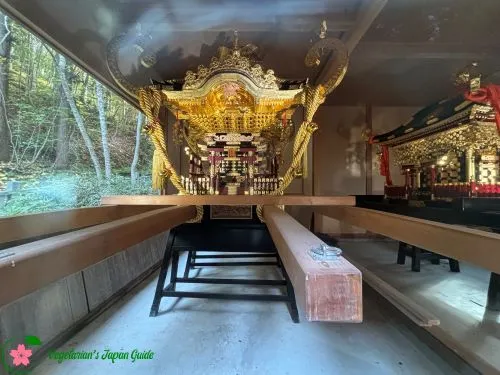
The portable shrine was used to carry the object of worship for the god, allowing the god to travel through Japan, where pilgrims could worship and gather believers. Due to wear and tear, a new portable shrine was installed in 1991, replacing the old one (pictured above).
Discover Other Interesting Attractions in Togakushi
The mountain range of Togakushi is renowned for its breathtaking scenery reminiscent of Chinese ink paintings. Food-wise, Togakushi is known for Togakushi Soba Noodles. There is also a large campsite, a ski resort, and a Togakushi ninja school!
So, check out our article on Togakushi to discover the best restaurants for mouthwatering soba noodles, the scenic spots in the area, and more (=゚ω゚)ノ.