Among the five shrines of Togakushi, the area around Togakushi Shrine Chusha (戸隠 中社) is the most lively. Along the Togakushi hiking trail, numerous restaurants and ryokans are situated near Togakushi Shrine Chusha. Togakushi Tourist Information Center (戸隠観光情報センター) is also situated near the Chusha shrine. If you plan to hike in Togakushi, we highly recommend heading to the Togakushi Tourist Information Center first for the most up-to-date hiking trail conditions.
About Togakushi Shrine Chusha
According to Togakushi Shrine’s documentation, Oku-sha is its first shrine. Hokō-sha was later established. In 1087, the head priest of Togakushi Shrine had a dream where he was told that Togakushi Shrine should consist of three sub-shrines. So in the middle of Oku-sha and Hokō-sha, Togakushi Shrine Chusha was built. This is why the shrine is named “Chū”.
Whether the dream was true or not, after the Togakushi Shrine Chusha was founded, it certainly improved the lives of the priests at Togakushi Shrine. During winter, when Oku-sha became too cold to live in, Chū-sha was where they would temporarily migrate.
The main god of Chū-sha is Ameno Ygakoro Omoikane no Mikoto (天八意思兼命). He is the god who had the idea of how to lure the sun goddess, Amaterasu Ōkami (天照大神), out of the cavern. Known as the god of wisdom, many come here to pray for academic excellence and prosperity for their businesses.
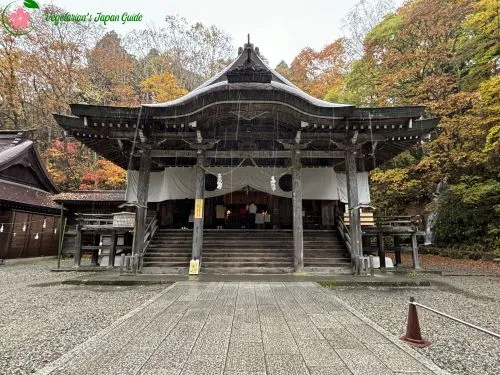
The worship hall of Togakushi Shrine Chusha had gone through several restorations since it was first built. The most recent reconstruction was in 1956.
On the right of the main worship hall is the Seiryū-den Hall (青龍殿). It is where the treasure hall of Chū-sha is located.
If interested, you can pay to explore it between 9 am and 4:30 pm (closing early at 4 pm in winter).
In the precinct of Togakushi Shrine Chusha, there are a lot of smaller worship halls and Buddha statues for you to visit.
Similar to Hokō-sha, beyond the torii gate, there is also a set of long staircases for visitors to climb up to where the worship hall is. And again, if you prefer a more gentle slope, the Onnazaka (女坂) is just on the stairs’ left. Note in winter, Onnazaka is the only way to access the worship hall.
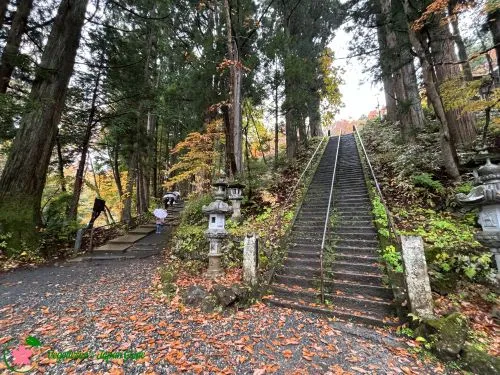
Sanbonsugi Cedar Trees (三本杉)
You will see three giant cedar trees scattered in Togakushi Shrine Chusha’s precinct. Two are close to each side of the shrine’s torii gate. The last one is in front of the worship hall. Each of them is said to be more than 800 years old!
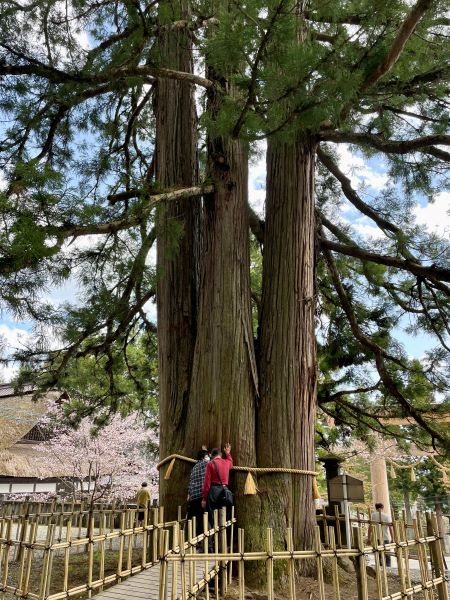
According to legend, the trees were planted by a fisherman who wanted to save his children after they had eaten the meat of the mermaid he had killed. Long story short, his children ate the meat out of hunger when he was away. As a result, scales began to appear on their skin.
Worrying so much about his children, the fisherman couldn’t sleep for days. Just when he finally fell asleep, he received a divine message asking him to become a monk and repent for his killing of the mermaid at Togakushi. He was also asked to plant three cedar trees as a sign of his determination.
Following the message, he became a monk at Togakushi, and his children were said to have passed away peacefully without further suffering.
Discover Other Interesting Attractions in Togakushi
The mountain range of Togakushi is renowned for its breathtaking scenery reminiscent of Chinese ink paintings. Food-wise, Togakushi is known for Togakushi Soba Noodles. There is also a large campsite, a ski resort, and a Togakushi ninja school!
So, check out our article on Togakushi to discover the best restaurants for mouthwatering soba noodles, the scenic spots in the area, and more (=゚ω゚)ノ.