

Whether you are a regular visitor or are discovering Minoh Park (箕面公園) in Minoh City in Osaka for the first time, the Takimichi Hiking Course (滝道ハイキングコース) should be on your itinerary. Completed in 1886, this well-maintained 2.7 km course (which takes around 40 – 50 minutes) starts at Hankyū Minoh Station (阪急箕面駅) and ends at the spectacular Minoo Falls (箕面大滝). This is a great hiking course for the family, with lots of great photo opportunities, shops, and restaurants to enjoy along the way. Best of all – there are no steep slopes!
What to Do in Minoh Park
- The Trailhead and Maple Leaf Tempura
- YUZUYA Cafe and YUZUYA a Table Ukita
- Minoh Park Insect Museum (箕面公園昆虫館)
- Ryūanji Temple (瀧安寺)
- Tojinmodoriiwa Rock (唐人戻岩)
- Minoo Falls (箕面大滝)
- Tracks Leading to Other Areas in the Park
- Saikouji Temple (西江寺)
- The Best Time to Visit Minoh Park
Refer to HERE for the Minoh Park map, including Minoo Falls and the hiking trail to Katsuo-ji Temple.
Explore the Minoh Park With a Guided Tour
If you prefer to be guided when you visit Minoo Park, consider booking the tours below. This way, you can explore the park and the popular attractions in the area without extensive planning!
- Minoh Waterfall and nature walk through the Minoh Park
- Minoo Park Adventure: Nature, Temples, and Coffee Bliss
How to Get to Minoh Park from Osaka City Center
You can get to Minoh Park from Osaka by taking either a train or a bus.
- From Osaka Station/Umeda Station, take Hankyu’s Takarazuka Line to get to Ishihashi Handai-mae Station (石橋阪大前). From there, take the Minoh Line (箕面線) and get off at Minoh Station (箕面駅).
- You can also take Hankyu Bus Route 21 or 36 from Minoh-Kayano Station (箕面萱野駅) to Minoh Station (箕面駅前).
You can use one of Japan’s Transport Apps to plan your visit.
The Trailhead and Maple Leaf Tempura
The starting point for the Takimichi Hiking Course is just in front of Hankyu Minoh Station. On the other side of the pedestrian crossing, there are many cute souvenir shops and restaurants. Be sure to stock up on local snacks for your hike. One specialty of the area is Momiji Tempura (紅葉天ぷら). Momiji Tempura is a deep-fried, battered snack seasoned with sugar and sesame. It is shaped like a maple leaf because it actually contains a pickled maple leaf!
Something as special as this is definitely worth giving it a go! We promise that you at least won’t hate it. We guarantee that the leaf you eat didn’t touch the ground and won’t taste like the leaves from a maple tree in your back garden. It is unusual to eat a revered cultural icon as an autumn snack, but it is proper food (´▽`*).
The hiking course was built along the Minoo River (箕面川), and a large portion of the track is lined with trees on both sides. This not only makes the whole course more colorful in different seasons, but it also provides cool shade in summer. When you are tired, there are a couple of rest areas and benches along the track to take a break while you enjoy the alluring nature!
YUZUYA Cafe and YUZUYA a Table Ukita
Around a 5-minute walk from Minoh Station, there will be a bridge that you need to cross. The bridge serves as the entrance to Minoo Park!
On the far side of the bridge is a wooden building called Hashimoto Tei (橋本亭). It originally opened in 1910 as a ryokan guest house. Despite the second level being renovated into a restaurant that serves a Western-style menu, the building’s exterior retains the charming wooden structure of 100 years ago.
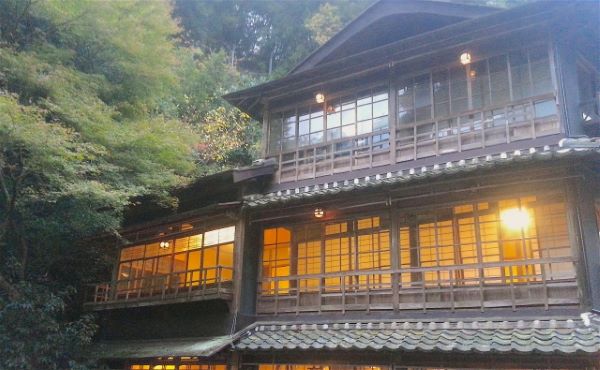
Note that a reservation is required if you want to dine at YUZUYA a Table Ukita.
The Hashimoto Tei you will encounter now is a replica of the one in the photo. The old building in the photo was destroyed due to a natural disaster in 2016.
So when you get to Hashimoto Tei, the restaurant on the second floor is called YUZUYA A TABLE UKITA, which serves a Western-style non-vegetarian lunch and dinner menu. On the ground floor, there is a fusion sweets shop, YUZUYA.
Whether it is on the way to the waterfall or on the way back, we highly recommend that you at least get one of their signature sweets – Little Treasure!
Yuzu is a type of small citrus fruit with a unique lemon/lime taste. You will find a lot of yuzu-related products in Japan, and it is becoming more popular around the world. We bet you haven’t encountered any dessert as exotic as “Little Treasure”. It is yuzu wrapped in white chocolate and gyūhi (a rice cake made from glutinous rice flour and sweetened white bean paste)!
YUZUYA Cafe and YUZUYA a Table Ukita’s Business Hours and Access Information
- YUZUYA Cafe is open from 11 am.
- YUZUYA a Table Ukita is open from 12 pm for lunch and 6 pm for dinner.
- YUZUYA is closed on Mondays and Tuesdays. If Monday or Tuesday is a public holiday, it will close on the next business day.
- From Hankyū Minoh Station (阪急箕面駅), it is around a 5-minute walk.
Minoh Park Insect Museum (箕面公園昆虫館)
Continuing on the track, just before the third bridge, you will see the Minoh Park Insect Museum on your left. This spot probably won’t appeal to those who aren’t particularly interested in insects, especially since it isn’t an English-speaker-friendly attraction.
Nevertheless, the museum’s opening hours are from 10 am to 5 pm (the last admission is at 4:30 pm) daily except Tuesday and from December 29 to January 3. Note that the museum will be closed on the next business day instead if Tuesday is a public holiday.
Admission to the Insectarium is 280 yen per person for anyone 16 years old and above (free for children 15 years old and under).
Ryūanji Temple (瀧安寺)
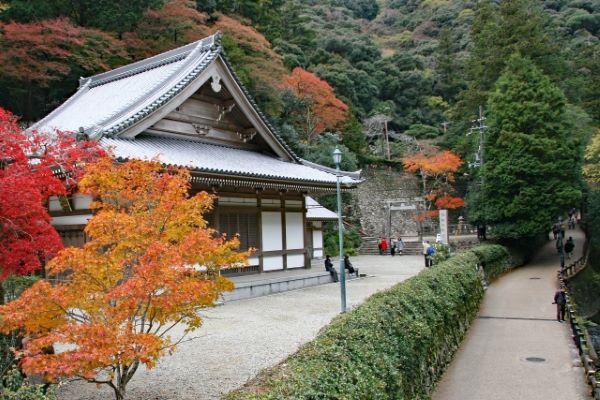
Leaving the Insectarium behind and continuing trekking, you will come across this red bridge called Zuiun Bridge (瑞雲橋). It connects you to one of Japan’s oldest mountaineering asceticism temples, Ryuanji Temple.
This is the temple of Benzaiten, the god of wealth and artistic improvement, and is where lotteries originated in Japan. It is no surprise that many people visit this temple to pray for good luck and a prosperous lifestyle.
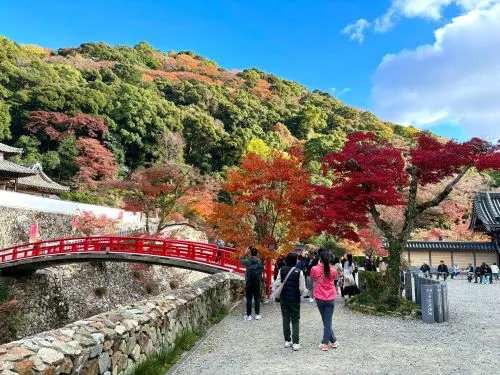
Albeit a little scarce in number, the cherry blossom trees around the temple bloom from late March to early April. Rather than during the springtime, it is the fall foliage that makes these photos so stunning (=゚ω゚)ノ.
Watch Out for Those Cheeky Monkeys
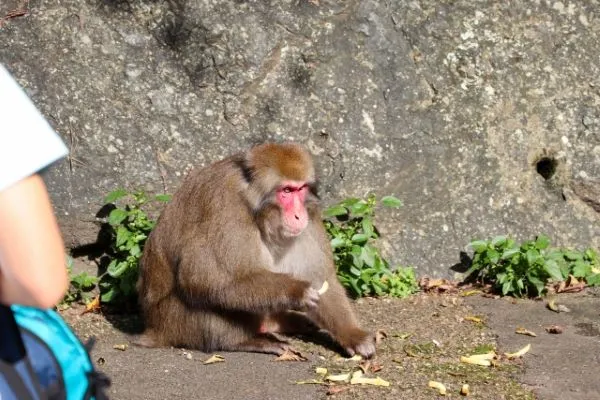
If you like to eat while walking, watch out! Otherwise, you might lose your food to the monkeys in Minoh Park (´▽`*).
Due to efforts to return the monkeys in Minoo Park to their original natural habitat, encountering them might become rare. However, if you do see a monkey, do not feed it! Feeding monkeys is against Minoh City rules and carries a fine of 10,000 yen.
Tojinmodoriiwa (唐人戻岩)
Before you get to the magnificent Minoo Falls, you have to pass through this gigantic Tojinmodoriiwa rock.
Legend has it that the imposing height of 7.5 meters of Tojinmodoriiwa scared off a messenger sent from China during the Tang Dynasty. The messenger returned to China, sadly, without seeing Minoh Falls.
We reckon it was the rock’s resemblance to a human face, rather than its imposing size, that scared the messenger away (´▽`*).
Minoo Falls (箕面大滝)
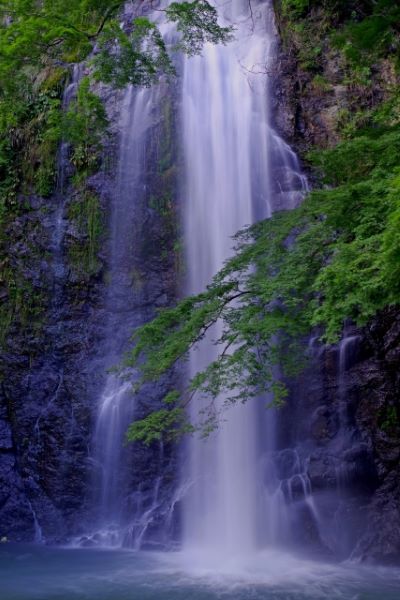
If you manage to get past the Tojinmodoriiwa, the Minoo Falls that runs down from a quay with a height of 33 meters is just behind the final red bridge in the course.
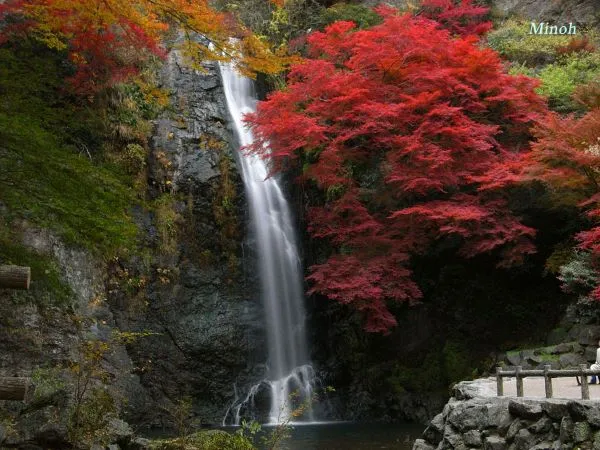
The waterfall is particularly stunning during the fresh green and autumn foliage seasons, which attract many tourists to Minoh Park!
If the light is right, you could even snap a photo of the waterfall with a rainbow (=゚ω゚)ノ.
Saikouji Temple (西江寺)
If you didn’t drop by Saikouji Temple on the way to Minoo Falls, remember to pay it a visit on the way back to the station.
Saikouji Temple is a unique place that combines a Shinto shrine and a Buddhist temple. The Shinto god enshrined here – Taiseikangiten (大聖歓喜天) – is also a guardian god of Buddhism, so you will find both Taiseikangiten and Kannon Bodhisattva (観音菩薩) in Saikouji Temple.
Another special thing about the temple is the Kesoufumi (懸想文), which was a love letter in the good old days. Nowadays, the Kesoufumi available from Saikouji is an amulet designed to fulfil your wishes for marriage, business prosperity, and family safety.
While the beauty of the autumn leaves is exceptional, the area is also known as a camellia viewing spot from December to May, when the autumn foliage season ends.
Tip: There is a small track that leads to the Seiten Observation Deck (聖天展望台), which gives you a complete view of Minoh city. Please note that the slope is steeper than the waterfall hiking track.
Festivals at Saikouji Temple
- Mushikuyō (蟲供養): a ritual performed at the temple on the first weekend in October. The ritual originated 1350 years ago when Gyoki Bodhisattva (行基菩薩) collected the remains of insects from the grounds and held services praying for them. The insects here are really a metaphor for all living things in the universe.
- In addition to the ritual, there are tea ceremonies, flower arrangements, Japanese traditional music, parties, and banquets during the 2-days event schedule
- Tengu Festival (天狗まつり): held annually on October 15 and 16.
- Tengu is a long‐nosed goblin from Japanese folklore. During the festival, the tengu (who are performed by volunteers from the local fire brigade) will chase children and gently smack them. It sounds brutal. However, this is to exterminate evil spirits and dispel demons, so be happy, not horrified, if a tengu smacks your kids!
The Best Time to Visit Minoh Park
Minoh Park Fresh Green Carnival (新緑カーニバル)
The Minoh Park Fresh Green Carnival is held throughout the park from mid-April to the end of May.
During the festival period, activities and events mostly happen on weekends. One of the most exciting activities is deep-frying your own Momiji Tempura. This is probably your only chance in your entire life to make a dish out of maple leaves!
In 2025, the festival will be held from April 15 to June 1.
Kawadoko Cuisine at Minoh Park
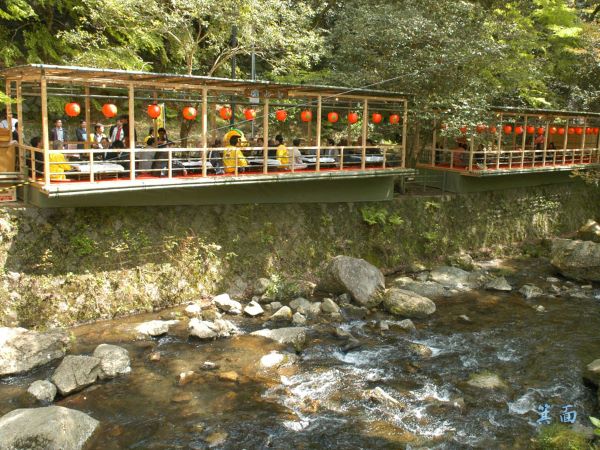
When the Japanese think of valleys, cool streams, and the summertime, they are likely thinking of Kawadoko (川床) dining. Kawadoko is a great way to escape the summer heat and chill out on a platform built by the nearby restaurant/ryokan whilst you enjoy delicious food served at a river terrace.
At Minoh Park, the Kawadoko is operated by two restaurants/ryokans from late April to late October each year. Booking is essential. You can either call to make a booking or utilize AutoReserve links provided below to make a reservation.
Important: We haven’t been able to confirm if they can cater to a special diet.
Minoh Festival (箕面まつり) and Minoh Park Candle Road
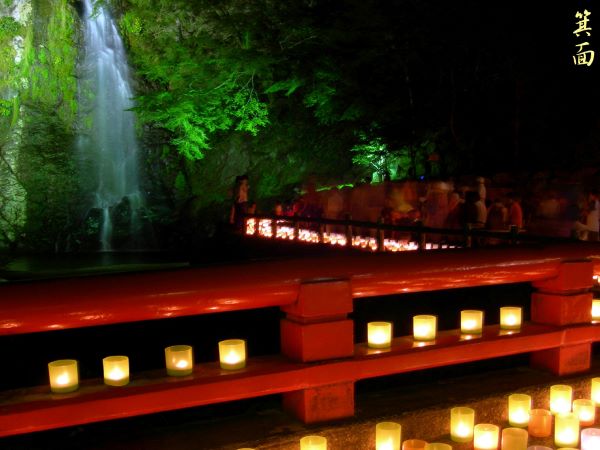
Minoh Festival (箕面まつり) usually takes place between the end of July and early August.
At night time during the festival, the hiking track to Minoo Falls is illuminated with thousands of candles. The candles last only two hours, so make sure you are there in time to experience this romantic summertime atmosphere!
In 2025, the Minoh Festival will be held on October 4 and 5.
Minoh Park’s Autumn Season
The fall foliage season starts in mid-November and finishes around early December.
Also, as the park is in a long valley, the progression of foliage colour changes varies throughout the park. You can refer to the park’s website HERE for a clearer update on the situation of the autumn leaves when the season starts.
Discover Other Close-by Attractions in Minoh City
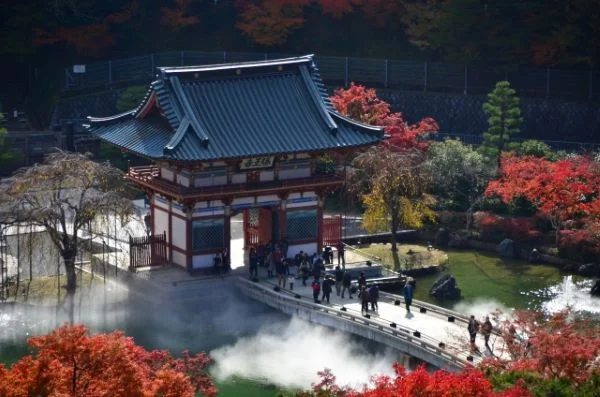
There are a couple more fascinating attractions in Minō City in Osaka that you can easily form a one-day itinerary.
For more information, please refer to our article on Minoh City.
Hi there! Very nice guide!! Do you think I can visit minoh park/falls early in the morning, around 7.30am? I saw in google that the park’s opening hours is from 10am..
Hi Mazy,
Thanks for the compliment. Just got a reply from Minoh Park. The park is open 24/7. But the insect museum opens at 10am.
Hope this helps and enjoy your trip!
Lily