Dominating the horizon of the Tsugaru Plain, Mount Iwaki (Iwaki-san, 岩木山) is the highest peak in Aomori and a sacred symbol of Northern Japan. Affectionately nicknamed the “Mt. Fuji of Tsugaru” for its near-perfect conical silhouette, this 1,625-meter stratovolcano offers some of the most spectacular panoramic views in the Tohoku region. Whether you are looking for a challenging day hike from the historic Iwakiyama Shrine, a scenic drive up the 69 hairpin turns of the Tsugaru Iwaki Skyline, or a relaxing soak in the nearby Dake Onsen, our guide to visiting Mount Iwaki covers everything from trail maps to seasonal festivals. Discover why this “100 Famous Japanese Mountain” is a must-visit for nature lovers and photographers alike.
All You Need to Know About Mount Iwaki Before Visiting
- About Mount Iwaki
- Iwakiyama Shrine (岩木山神社)
- So, How Do You Get to Mount Iwaki?
- Useful Information About the Bus Services to Mount Iwaki
- The Easiest Way to Reach the Summit of Mount Iwaki
- Mount Iwaki's Gondola Lift
- Mount Iwaki's Summit
- Iwakiyama Skyline
- Mountain Climbing at Mount Iwaki
- Things to Note Before You Climb Mount Iwaki
- Dake Onsen (嶽温泉)
- Iwaki Sanpo Kan (岩木さんぽ館)
- The World's Longest Cherry Blossom Road
- Discover the Hirosaki's City Center
About Mount Iwaki
We have all seen them, the fantastic views photographed from the mountaintops. Surely they must have been edited? Well, now you can find out in the laziest way possible with an easy mountain peak climb!
If you love climbing, five mountain trails will lead you to the top of Iwaki Mountain in 4 to 5 hours. But, if you want to take an easier route, then a bus trip from JR Hirosaki Station and a 10-minute gondola ride will bring you close to the summit (^_-)-☆.
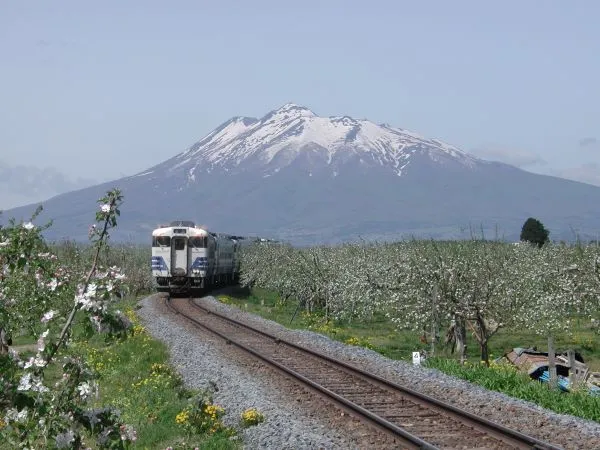
As the tallest mountain in the region, Mt. Iwaki will be the backdrop for all the photos you take anywhere in Hirosaki City (whether you like it or not!). The summit overlooks Ajigasawa (鰺ヶ沢), Hakkōda mountain range (八甲田連峰), Lake Jusanko (十三湖), and Tsugaru Peninsula (津軽半島). On a clear day, the summit’s panoramic view stretches as far as Hokkaido (*’▽’)!
Just like with other Japanese volcanoes (this one is dormant), hot springs are scattered around the Mt. Iwaki area for travelers to relax.
Iwakiyama Shrine (岩木山神社)
Your journey to the top of Mt. Iwaki CAN start from the mountain symbol, Iwakiyama Shrine. We say “can” because, during the warmer seasons, Kōnan Bus provides direct bus services to the gondola lift station, which does stop at the shrine. In this case, you might want to visit this beautiful shrine, known as “Oku no Nikko”!
For more information, please refer to our article on Iwakiyama Shrine.

So, How Do You Get to Mount Iwaki?
The only way to get to Mt. Iwaki by public transport is to get a bus from bus stop no. 6 in front of JR Hirosaki Station (弘前駅) or bus stop no. 3 at Hirosaki Bus Terminal (弘前バスタミナール). You will need to catch the bus bound for Karekitai (枯木平) operated by Kōnan Bus (弘南バス) and get off at Karekitai (枯木平), which is the Hachi Aime of Mt. Iwaki.
This trip should take about 70 minutes if traffic is clear. Refer to HERE and scroll down for bus services for Mt. Iwaki. Note that only the main bus stops are listed.
You can also use one of Japan’s Transport Apps to plan your visit.
Useful Information About the Bus Services to Mount Iwaki
As mentioned earlier, direct bus services will carry you all the way up to the 8th station of Mt. Iwaki. The special return bus ticket, Skyline Return Bus Ticket (スカイライン往復乗車券), costs only 2,550 yen. This ticket lasts for two days.
- A one-way ticket from JR Hirosaki Station to Dake Onsen at the bottom of Mt. Iwaki is 500 yen.
- From Date Onsen to Mt. Iwaki the 8th station, the fare is 1,200 yen.
- A one-way ticket from JR Hirosaki Station to Dake Onsen at the 8th station of Mt. Iwaki is 1,700 yen.
Tip: What is even better is that, with the Skyline Return Bus Ticket (スカイライン往復乗車券), the gondola lift to the 9th station, which usually costs 1,000 yen return, will be half price (remember to keep your bus ticket to show to the staff at the lift’s ticket office)!
Important: Please note that this ticket is only available between early May and mid-October each year, when the bus service operates between Karekitai (枯木平) and the 8th station (exact dates vary depending on snow conditions).
For more information, please refer to the official website HERE and translate it into English using Google Chrome’s translation feature at the top right of the address bar.
The Easiest Way to Reach the Summit of Mount Iwaki

Continue the bus trip from JR Hirosaki Station. If you don’t get off at Iwakiyama Shrine, the bus will terminate at the 8th Station, Iwakiyama Hachi Aime (岩木山八合目).
In autumn, trees growing on the part of the mountain below you will blend into a colorful carpet (we wish we were there between early and mid-October)!
Here, apart from the spacious car park for those who drove all the way up, there is also a viewing deck above the rest area building that you have to drop by for the spectacular view (such as the sunset in the photo)!
Tip: Make sure you finish your private business at the toilet here, as there is no toilet at the summit!

Mount Iwaki’s Gondola Lift
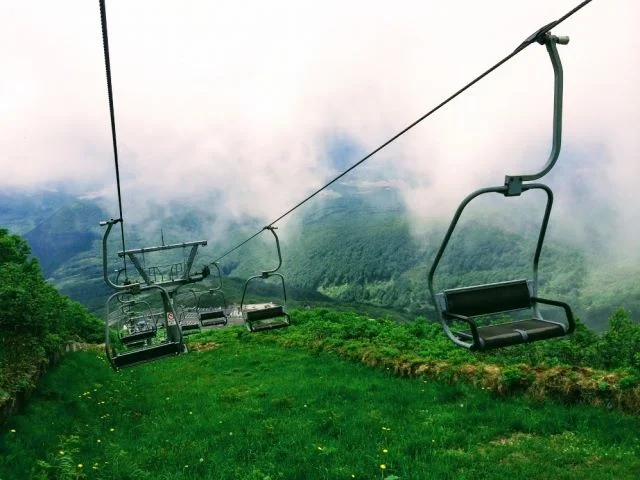
After you have had your fill of the scenery at Hachi Aime, head to the gondola lift station. The lift will bring you to the 9th Station – Iwakiyama Kyū Aime (岩木山九合目) in 10 minutes. The 500-meter sky journey offers a magnificent view of the Sea of Japan (and the surrounding mountain ranges, of course).
But please sit still. You really don’t want to fall off your seat…
Mount Iwaki’s Gondola Lift’s Operation Hours and Charges
- The lifts are operating as follows from late April to late October.
- From the 8th station to the 9th station: 9 am to 4 pm
- From the 9th station to the 8th station: 9 am to 4:20 pm
- The cost of boarding Iwaki Skyline:
- Adults: 1,000 yen for a return journey and 700 yen for a one-way journey
- High school students: 800 yen for a return journey and 550 yen for a one-way journey
- Elementary school students: 600 yen for a return journey and 450 yen for a one-way journey
Important: The lift is not in service on Wednesdays and on the 2nd and 4th Tuesdays of each month.
From the 9th Station to the Summit of Mount Iwaki
From Chōkai Funkakō Station (鳥海噴火口駅) at Kyū Aime to the summit of Mt. Iwaki, it is only a 30-minute climb. If you visit the 9th Station in June or July, you will have more fun around the station because a variety of primroses unique to Mt. Iwaki will be in full bloom!
This part of the track is more like “mountain climbing” than “hiking”. Please make sure you are well-prepared before departing the 9th Station, and climb carefully. It is best to have enough rest here.
Tip: Hiking shoes and thick cotton gloves are highly recommended to complete this part of the track. Don’t be that girl who challenged herself by wearing a skirt and heels. The thick cotton gloves protect your beautiful hands from injury when you need to push your body up!
That small shed is called Houmei Hutte Evacuation Shed (鳳鳴ヒュッテ). It was built after a tragic accident.
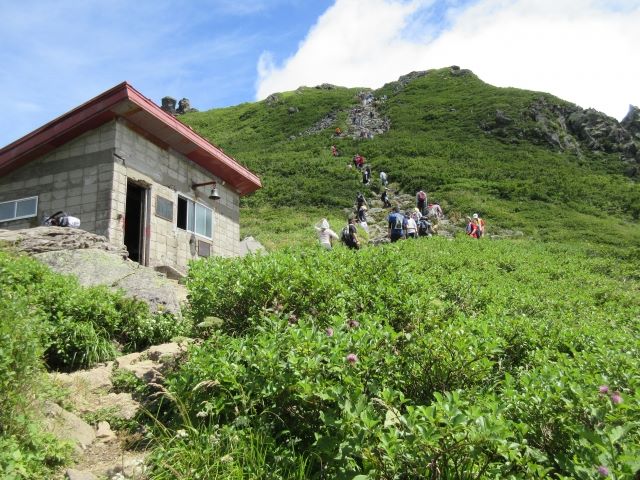
The closer you are to the peak, the more crowded and narrow the steep rocky track will be. So, here is the rule for all climbers – climb right and descend left!
Mount Iwaki’s Summit
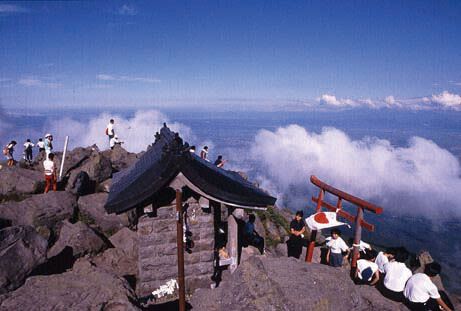
When you see this triangular monument with a cute bell attached, congratulations, you have reached the summit!
With a great sense of achievement, make sure you give that bell a ring (or even a few rings)!
Depending on the season, it might be super chilly up there. But, we believe the jaw-dropping 360-degree panorama view of all the famous mountains (such as the Hakkōda mountain range and Mt Shirakami) is majestic enough to forget the cold (^_-)-☆.
Tip: If it is unbearably cold for you, you can hide in the hut at the peak to try to warm up before you head back out again!
The inner shrine of Iwakiyama Shrine (岩木山神社の奥宮) is enshrined on the summit.
After ringing that bell of achievement, let’s join our hands and pay our respects to the god to show our gratitude for a safe trip up the mountain and to pray for another pleasant trip back down (and anything else you would like the god to help you accomplish!).
Iwakiyama Skyline
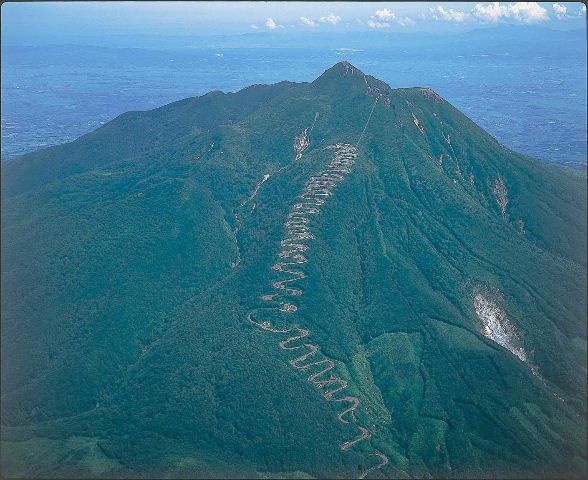
Instead of public transport, if you wish to drive up, your passengers might need a strong stomach…
As you can see in the photo (and we will count for you), the toll road, Iwakiyama Skyline (岩木山スカイライン), has a total length of 9.5 km and 69 curves Σ(゚Д゚). This is the only way the construction team found to minimize the impact on the valuable beech forest we can now drive through.
The Toll Charge and Road Opening Hours
The Iwakiyama Skyline is open from 8 am to 5 pm (the last entry at 4 pm) between late April/May and late October/beginning of November.
The toll charges below are payable once when you enter the Iwakiyama Skyline:
- Vehicles with two wheels: 1,200 yen
- Small/compact cars: 1,700 yen
- Normal-sized cars: 2,000 yen
- Small buses that fit from 11 to 29 passengers: 5,000 yen
- Anything bigger: 8,000 yen
Mountain Climbing at Mount Iwaki
Compared to other volcanoes in Japan, Mt. Iwaki is a newbie. Following the late-1800s eruptions, no coniferous forest is visible between the alpine and broad-leaved forest zones. Instead, a peculiar sight occurs at Mt. Iwaki. The birch forest is dwarfing gradually.
Apart from the stunning views that continue throughout the hiking trail, another benefit of climbing Mt. Iwaki is encountering a variety of alpine plants. A few species, such as the primroses around the 9th station, can only be found at Mt. Iwaki!
There are 5 mountain-climbing courses at Mt. Iwaki, each with varying difficulty. The starting points for the two below are accessible by the same bus that goes all the way to the 8th station.
- Dake Mountain Track (嶽登山道): A 4-hour course suitable for anyone
- Hyakuzawa Mountain Track (百沢登山道): A 5-hour course suitable for the experienced climber
Dake Mountain Track
Dake Mountain Track is the easiest and most popular hiking course. This course regularly appears on local schools’ excursions (‘ω’)ノ.
In the fall foliage season, the track is also among the most beautiful tracks you can find in the country!
It takes about 5.5 hours to reach the peak from Dake Onsen (嶽温泉) and back.

The Course Route and Approximate Time Required of Dake Mountain Track
Dake Onsen (嶽温泉) → 2 hours → Iwakiyama 8th Station (岩木山八合目) → 40 mins → Houmei Hutte Evacuation Shed (鳳鳴ヒュッテ) → 30 mins → Mt. Iwaki Summit (岩木山山頂) → 20 mins → Houmei Hutte Evacuation Shed (鳳鳴ヒュッテ) → 25 mins → Iwakiyama 8th Station (岩木山八合目) → 1.5 hours → Dake Onsen (嶽温泉)
To start your journey, you will need to find this red torii gate at the back of Dake Onsen Town. The gate is just next to a car park, and from the Dake Onsen’s bus stop, it is less than 100 meters away.
Important: It is also possible that you will meet a bear during this trip (though the likelihood isn’t high, as they tend to hide from us, too). According to the guide who has multiple bear encounters, if you see a bear, DON’T SCREAM! The best thing to do is try not to scare the bear and slowly back away.
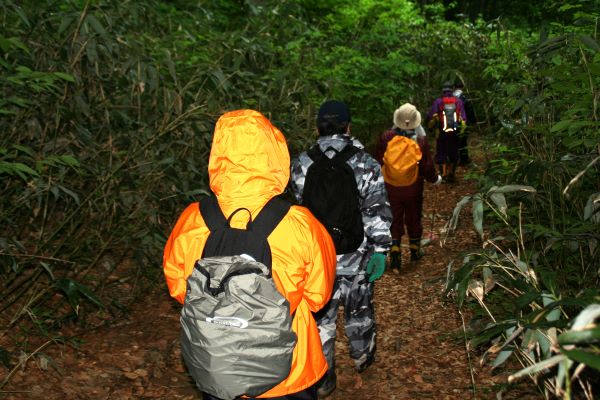
You will hike through the beech forest from this Torii gate to the 8th station. There aren’t going to be many views during this part of the journey, but instead, you can enjoy the fresh air and the birdsong (*´ω`).
In autumn, as you climb higher, the leaves’ colors change gradually, which makes the 2-hour forest hike to Iwakiyama 8th station even more enjoyable!
Hyakuzawa Mountain Track
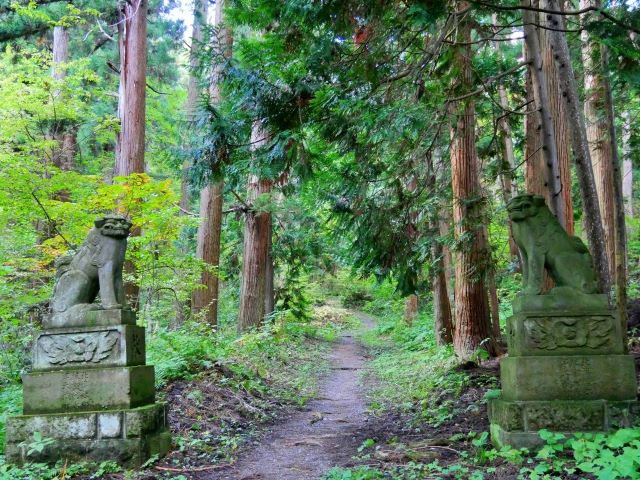
The Hyakuzawa Mountain Track is for those with at least a certain mountain climbing experience.
The starting point is at the back of the Iwakiyama Shrine. Before you head off, maybe make a quick prayer to the 2 Tamagaki Komainu for a safe trip (=゚ω゚)ノ.
This small path should lead you to Iwakiyama Sakurabayashi Park (岩木山桜林公園) within 30 minutes. In spring, it is another beautiful spot for cherry blossom viewing (^_-)-☆.
From the first photo in the tweet, go past the second photo on the top right-hand side, then the bottom left-hand side, and lastly the photo on the bottom right-hand side.
This is the first 90 minutes of your hike!
神苑桜林公園から百沢スキー場のゲレンデを入り登山道入口へ。百沢コースの始まり❗️七曲り、カラスの休み場、鼻コクリの急登、樹林帯が続き姥石に着きます。#岩木山#百沢コース pic.twitter.com/66qLPzeGxR
— jdtm (@jdtm31067733) September 6, 2020
From there, it is another 100-minute climb before you get to the Houmei Hutte Evacuation Shed (鳳鳴ヒュッテ) close to the 9th station.
Winter Mountain Hiking at Mount Iwaki
The above two mountain courses can also be accessed in winter. You will, however, need to bring your own equipment.
Things to Note Before You Climb Mount Iwaki
- Don’t forget to bring water, small snacks, and rain gear. A backpack is always recommended.
- Wear clothes that can be put on and taken off easily, as the temperature can change rapidly in the mountains. The best clothes are made of quick-drying materials.
- For footwear, hiking shoes that reach the ankle and thick socks are better.
- As there are branches from the main track, a map and compass are always useful. Dropping by the Iwaki Sanpo Kan (岩木さんぽ館) may be useful.
- You might want to consider mountain insurance just in case.
Dake Onsen (嶽温泉)
This onsen spot was discovered by a lumberjack about 350 years ago. While tracking the fox that stole his lunch, he spied a small onsen in the middle of the snowfield.
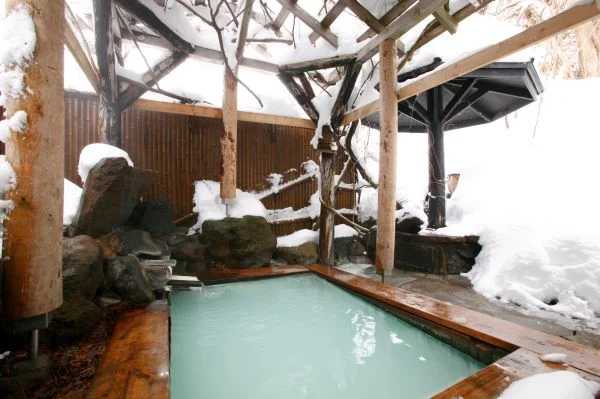
The onsen here has a strong smell of sulfur. It is said that water can cure skin diseases and mycoses.
As the starting point of the Dake Mountain Track is just at this onsen town, you can stay in one of the six onsen hotels before or after your Mt Iwaki journey!
Tip: Don’t forget to try one of their steamed corn. The locals call them “Dakekimi (嶽きみ)”. Freshly harvested from a nearby field, they are extremely delicious!
To get to Dake Onsen Town, get off the bus at Dake Onsen-mae (岳温泉前).
Iwaki Sanpo Kan (岩木さんぽ館)
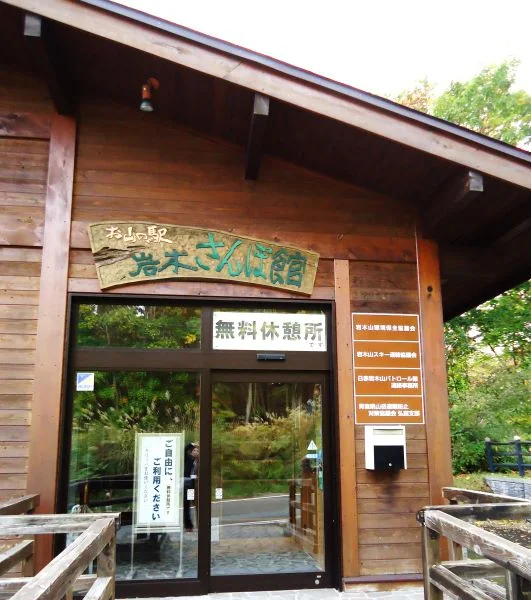
Close to the Dake onsen town, there is this small hut. It is basically a visitor centre that introduces tourist attractions in the Hirosaki and Tsugaru regions. You will also find information on Iwaki’s nature, history, and culture.

But most of the information is in Japanese, so if you don’t know the language, you might instead enjoy the stunning scenic photos and Mt. Iwaki’s Topographic model inside the hut.
Most people, however, like to hang around at the free foot spa in the outdoor area!
Iwaki Sanpo Kan’s Opening Hours and Access Information
- The opening hours are 9 am to 5 pm daily except Thursdays.
- If Thursday is a public holiday, it will close on the next business day.
- No admission fee will be charged upon entry.
The World’s Longest Cherry Blossom Road
From late April to early May, before you climb Mt. Iwaki, how about a slight detour to admire this 20 km long road full of cherry blossom trees (=゚ω゚)ノ?
This 20 km road is located at elevations of 200 to 450 meters. This means the blooming timing is a bit later than in Hirosaki City. Although it is harder to say when exactly the blooming peak occurs each year, the good thing is that, because the altitude of the road affects the bloom, you will have more than 10 days to enjoy these blossoms!
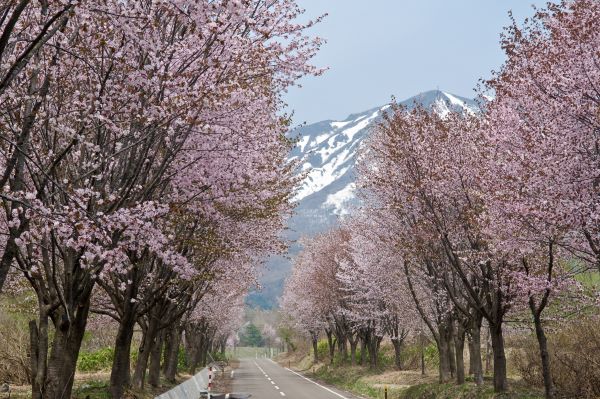
Tip: The best photo opportunity is in the morning. When the morning sun shines, the pink cherry blossoms and the green trees draw a beautiful contrast. Also, the lawn looks greener before sunrise, when the sky is bluish. It might be another great time for photos!
Lastly, the next day of a rainy day is a great day for stunning photos because the puddle on the ground will reflect the beautiful flowers on the tree (^_-)-☆.
The stunning road stretches from the Kareki and Hyakuzawa areas, with Kareki at a higher altitude.
You can take the same bus to the 8th station to reach both areas.
- Hyakuzawa area (the starting point of the road): please get off at Komoriyama Iriguci (小森山入口)
- Mt. Iwaki Synthesis Park (岩木山総合公園): Where most people get off the bus for the cherry blossoms
- Kareki area: please get off at Karekitai (枯木平)
For those who read Japanese, HERE is the entire map of the road.
Tip: Sightseeing taxis are available for you to reserve during the cherry blossom season. Please refer to HERE for more information. It is best if you understand basic Japanese to utilize the sightseeing taxis. However, your hotel concierge should be able to make a booking on your behalf if you don’t understand Japanese.
Discover the Hirosaki’s City Center
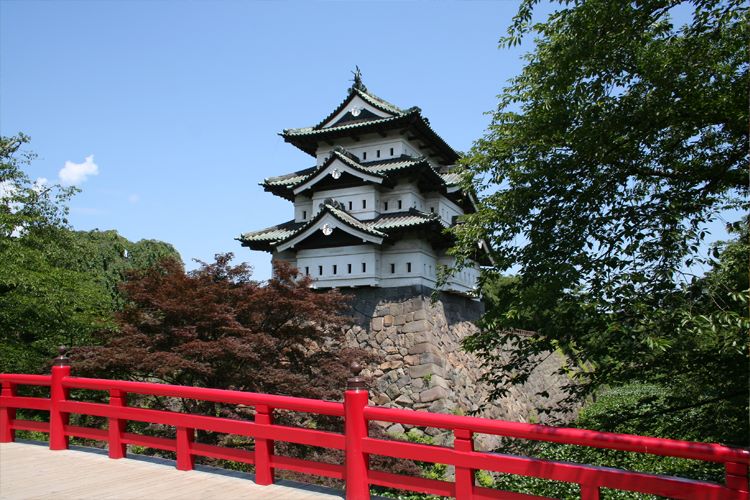
To get to Mt. Iwaki, you will surely arrive at Hirosaki’s city center first. It might also be where you will spend a night before departing for Mt. Iwaki.
As the cultural heart of Aomori Prefecture and Japan’s undisputed cherry blossom capital, this historic castle town offers a perfect blend of feudal history, stunning botanical gardens, and unique Western-style architecture.
Refer to our Hirosaki City article for all the attractions we recommend!