Perched precariously on the side of a jagged mountain in Yamagata Prefecture, Hojusan Risshakuji (宝珠山 立石寺), is one of Northern Japan’s most sacred sites. It is a place where nature and spirituality collide, immortalized by the haiku poet Matsuo Basho and preserved by over 1,100 years of Tendai Buddhist tradition. Popularly known as Yamadera (山寺), which literally “Mountain Temple”, this sacred complex is a masterpiece of spiritual architecture. Just a scenic 60-minute train ride from Sendai Station, Yamadera offers a dramatic contrast to the city: ancient cedar forests, jagged cliffs, and the legendary 1,015-step climb that promises to wash away your worldly cares. The temple that rises above the clouds is known for the panoramic views of the Yamagata valley, which feel like a scene from a traditional ink-wash painting.
What to See at Risshakuji Temple (Yamadera)
- Yamadera Travel Tips
- The Sacred History of Risshakuji
- The 1,015-Step Ascent: The Path of Purification Through the Forest
- Yamadera's Four Seasons
- Vegetarian Eats: What to Eat in Yamadera Village
- How to Get from Sendai to Yamadera
- Yamadera's Opening Hours and Admission Fee
- Yamadera FAQ
- Sendai: Your Vibrant Home Base for the Journey to Yamadera
Yamadera Travel Tips
- Early Bird Gets the View: Take the 8 am train from Sendai to beat the tour buses and enjoy the mountain in its natural silence.
- Lockers: There are lockers on the ground floor of Yamadera Station. A few shops near the station also offer luggage storage service. Don’t carry your heavy city bags up 1,015 steps!
- Seasonal Note: In winter, the stairs are icy. Rent “boots with spikes” from the shops near the entrance for a few hundred yen.
- Footwear: The steps can be slippery, especially in the rainy season or winter. Wear shoes with excellent grip.
- Hydration: There are no vending machines beyond the Sanmon Gate. Buy your water at the bottom!
- Vegetarian Food: After your descent, head to the village for Yamadera Chikara-Mochi (pounded rice cakes) or Itasoba. For a completely plant-based snack, look for the “Dashi” Tofu, a local Yamagata specialty featuring chilled tofu topped with a refreshing chopped vegetable relish.
Tip: Refer to our Top Three Best Walking Shoes for an Overseas Trip if you need a good pair for exploring Yamadera and Japan!
Important: There is no escalator or lift at Yamadera Station. Avoid bringing bulky luggage.
The Sacred History of Risshakuji
Founded in 860 AD by the high priest Jikaku Daishi Ennin (慈覚大師 円仁), Risshakuji was established under the order of Emperor Seiwa (清和天皇). The temple was intended to be a northern stronghold for the Tendai sect, a “borderland” sanctuary for spreading Buddhist teachings in the Tohoku region.
Ennin was a key figure in the Tendai sect who had traveled to Tang China to study Buddhism.
There are over 30 large and small temples and pagodas scattered throughout Yamadera’s vast precinct. Since ancient times, many people, including monks, have climbed this approach to the temple.
The temple’s most sacred treasure is the Eternal Flame ( 不滅の法灯), which Ennin brought from Enryakuji in Kyoto. Remarkably, this flame has burned continuously for over 1,100 years. When the original temple in Kyoto was destroyed in the 16th century by Oda Nobunaga, who envied Enryakuji, the flame was restored from Yamadera to Kyoto—a testament to this mountain’s enduring spiritual power.
The 1,015-Step Ascent: The Path of Purification Through the Forest
Yamadera has three main trailheads: the Nenbutsu-do (念佛堂), Hie Shrine (日枝神社), and Konpon Chudo. The route from the Konpon Chudo is the most complete, and therefore the most popular starting point.
The 1,015 steps were not built for convenience; they were designed as a meditative path. It is believed that with every step you climb, your worldly desires (bonno) are left behind, and your soul is cleansed by the time you reach the “Inner Sanctuary.”
While hiking 1,015 staircases sounds like an intense workout, the journey to the summit won’t be as boring and tiring as a gym session. Instead of a mere hike, think of the path to the summit as a gallery of mountain scenery! The climb takes approximately 30–50 minutes, depending on your pace.
Tip: There are benches and rest areas along the way, so you can take a break if your feet hurt or you get tired.
Konpon Chūdō (根本中堂)
Located at the foot of the mountain, Konpon Chudo is the oldest building at Yamadera. It was reconstructed in 1356 by Shiba Kaneyori, the lord of Yamagata Castle.
The building is primarily made of beechwood, which is rare in Japanese temple architecture because beech is difficult to preserve. So, Yamadera’s Konpon Chudo was designated as a National Important Cultural Property since it is Japan’s oldest beechwood building!

Inside the dim hall sits the Hōtō (Dharma Lamp), containing the “Eternal Flame.” The flame was brought from Enryakuji in Kyoto over 1,000 years ago and has never been extinguished. In fact, after the original Enryakuji in Kyoto was burned down by Oda Nobunaga in 1571, the flame was eventually restored to Kyoto from this very lamp in Yamadera!
The inner sanctuary houses a seated statue of Healing Buddha, a secret Buddhist principal image carved from a single piece of wood from the Heian period. This statue is only open to the public once every 50 years. The next time it will be open to the public will be in 2063.
Just a two-minute walk from the worship hall, you will find a statue of Matsumo Basho (松尾芭蕉) and his disciple Sora (曾良). In 1689, the legendary haiku master Matsuo Basho visited Yamadera. He was so struck by the profound stillness of the mountain that he composed his most famous haiku here, describing the sound of cicadas sinking into the rocks.

Tip Don’t forget to touch the statue of Hotei-son (招福布袋尊), also known as the Rubbing Buddha or the God of Happiness. He sits at the entrance to Konpon Chudo. Rub the part of the statue that corresponds to your own ailments to receive healing (e.g., rub his head to cure a headache).
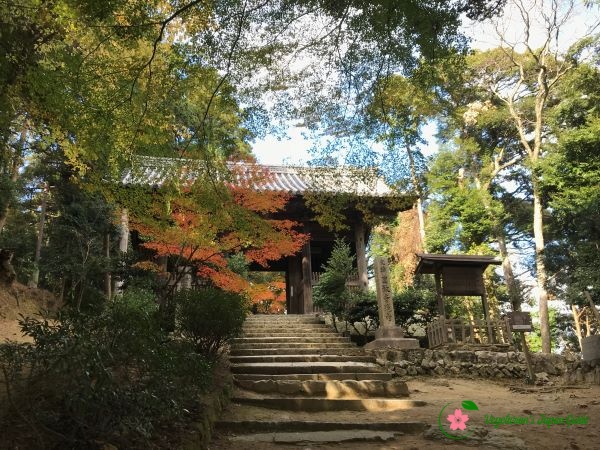
Sanmon Gate (山門)
The Sanmon Gate mark the starting point of the 1,015-step climb. It is where you pay the entrance fee. Built in the Kamakura period, it serves as the threshold between the secular world and the sacred mountain. From here, the path narrows, and the forest thickens.
The hike begins through a dense grove of towering, centuries-old cedars. The path is lined with moss-covered stone lanterns and small Buddha statues, creating an atmosphere of “Zen serenity” that cools the air even in the height of summer.

Ubadō (姥堂)
The small worship hall with garments hung inside is Ubadō, home to Datsuba (奪衣婆), the Clothes-Snatching Crone. The worship hall is the boundary between heaven and hell. Above Ubadō lies the Pure Land, so the worship hall is considered the entrance to this paradise.
Cleanse your body and mind in the clear water beside the rocks next to Ubadō, change into new clothes, and you are ready to step into the Pure Land. Your old clothes are offered to Datsuba.

Not far from Ubadō, you will realize the approach becomes very narrow. The narrowest point here is about 14 centimeters wide. So, this part of the approach was named Four-Inch Path (四寸道). It is the ascetic path.
Midahora Rock (弥陀洞)
As you ascend, you will encounter massive rock formations carved by centuries of wind and rain. At Midahora, look closely at the cliff face. It is said that those who can see the shape of the 4.8-meter-tall Amida Buddha in the natural rock will be blessed with lifelong good luck!
There were many coins stuck in the rock face. The coins were offered by pilgrims who came to worship. Thus, please don’t treat them as free money and start collecting them for yourself.

The Cicada Mound, Semizuka (せみ塚)
After a 15-minute hike, there is a stone monument on the side of the approach. Apparently, the spot where the famous haiku poet Matsuo Basho sat in 1689. Moved by the profound silence, he wrote: “In the utter silence / The cicada’s cry / Sinks into the rocks (閑さや 巌にしみ入る 蝉の声).”
In 1751, Basho’s disciples buried a scroll containing one of his poems beneath this rock to honor his visit. The stone is now a pilgrimage site for literature lovers.
Niomon Gate (仁王門)
The Niomon Gate marks the final stretch of your ascent. This grand is guarded by two fierce Nio Guardians (Agyo and Ungyo), who’s job is to prevent evil spirits from ascending to the upper reaches of the temple. It serves as the “gateway to the heavens.”
The two-story gate was reconstructed in 1848 using dark, aged Japanese zelkova. The craftsmanship of the woodwork here is among the finest on the mountain. Passing through here feels like entering another realm, the “Inner Sanctuary” of the mountain.

Framed by seasonal foliage, this intricately carved gate marks the transition into the upper temple grounds, where the views begin to open up over the valley.
Moreover, the Niomon is the halfway point. If you look back, you will see a panoramic view below. From here on, there will be a series of spectacular views.
After passing through the Niomon Gate, you will soon see the famous scenery of the Yamadera temple, the Kaisando and Nokyōdō Hall above a huge rock.
Okunoin & Daibutsuden (奥之院・大仏殿)
About a 15-minute walk from Niomon Gate, the hike ends at Okunoin, formally known as Nyohōdō (如法堂). The Inner Sanctuary, Okunoin, is the highest point accessible to tourists. It was a sutra-copying training center that was rebuilt in 1872. The worship hall houses a statue of Gautama Buddha and Prabhutaratna (多宝如来) brought from China by Ennin.

The particularly large bronze lantern near the stone steps of Nyohōdō Hall is one of the three largest lanterns in Japan. Take a look at the lantern’s detailed craftsmanship, including the dragon.
Next to it is the Daibutsuden Hall, which houses a 5-meter-tall golden Amida Buddha. This is where pilgrims complete their spiritual journey and offer their final prayers. The Buddha enshrined here is said to have the power to sever harmful relationships.


Tip: Don’t forget to check out Japan’s smallest three-story pagoda (三重の小塔) inside a stove cave near Daibutsuden. The pagoda has a Vairocana enshrined.
Kaisandō & Nōkyōdō (開山堂 & 納経堂)
Go down a little from Okunoin, then follow the path to the right. The Kaisandō Hall (Founder’s Hall) and the Nokyōdō Hall are built on a huge rock at the end of the road.
Kaisando is dedicated to the temple’s founder, Ennin. His wooden statue is enshrined in the hall. Rice and incense are offered for breakfast and dinner. Once a year, on January 14th, the anniversary of Daishi’s death, a memorial service is held, and the statue is open to the public. The remains of the Great Master are said to be buried in a natural cave below the cliff (入定窟).

To Kaisandō’s left is Nōkyōdō. It has the Lotus Sutra enshrined. The small, red-roofed sutra hall perched on a cliff is the oldest structure in the mountain. Against the backdrop of the blue mountain range, it is one of Japan’s most picturesque sights.
Godaidō (五大堂)
The crowning jewel of Risshakuji is Godaidō. It is where many Yamadera’s iconic photos were taken. Built like a traditional Noh stage, this wooden observation deck hangs over the cliff and appears to float in the sky. From here, the world below looks like a miniature toy set, with the train running on the JR Senzan Line crawling through the lush green valley. It is the ultimate “Healing Spot” to sit and breathe in the mountain air.

Godaidō was built to dedicated to the Five Great Wisdom Kings (五大明王) to pray for world peace. Because it juts out over the cliff, it offers a 180-degree view of the Tachiya River (立谷川) valley and the surrounding “Yamagata Alps.”
Yamadera’s Four Seasons
- Spring: Delicate cherry blossoms soften the rugged grey cliffs frame the lower temples in mid/late April.
- Summer: A deep, “vibrant green” forest filled with the meditative sound of cicadas.
- Autumn: The valley turns into a sea of fire from Late October to early November. The vivid oranges and reds are best viewed from the Godaido.
- Winter: The “Ink Wash” (Sumi-e) season. The temple rooftops are blanketed in thick white snow, creating a silent, fairytale landscape.
Tip: The Yamadera Light-up and Road of Light (山寺のライトアップ・光のロード) are held from late July to mid-August and late October to early November. You can see the beautiful temple standing out in the darkness of the mountains. Also, about 200 candles are lit on the approach to the temple from Yamadera Station to the Konpon Chudo Hall.
Vegetarian Eats: What to Eat in Yamadera Village
After your descent from Yamadera, you will be hungry. The village at the base is a haven for vegetarian-friendly local specialties. Yamagata is famous for its mountain vegetables (Sansai), making it a great spot for plant-based travelers.
- Tama-Konnyaku (玉こんにゃく): A Yamadera staple! These are balls of konjac simmered in a savory soy-based broth. They are naturally vegan, gluten-free, and sold on sticks at the base of the mountain for about 100 yen to 200 yen.
- The locals call it Chikara-Konnyaku (力こんにゃく). Eating it before visiting Yamadera will give you the necessary energy to hike.
- Yamagata Soba: This region is famous for its firm, flavorful buckwheat noodles. Order “Itasoba” (served on a wooden board) with a side of seasonal mountain vegetables (Sansai).
- Dashi Tofu: A refreshing local dish—chilled tofu topped with a crunchy, finely chopped mix of cucumber, eggplant, and ginger.
- Cherry Soft Serve: Yamagata produces 70% of Japan’s cherries. Don’t leave without trying the tart, refreshing cherry ice cream! You can also look for seasonal fruit parfaits or sorbets in the village shops.
Important: Please note the broth used for soba and tofu are likely to contain fish extract. Ask the restaurant to give you soy sauce or salt instead. The high quality soba noodles and vegetable tempura would still taste nice with salt!
How to Get from Sendai to Yamadera
Getting to Yamadera from Sendai is incredibly easy, making it the perfect day trip.
It takes about 60 minutes by train on the JR Senzan Line (仙山線) from JR Sendai Station to JR Yamadera Station (山寺駅). If you are based in Yamagata, it takes around 20 minutes by train on the JR Senzan Line. Risshakuji is then a 5 to 7-minute walk from Yamadera Station.
Important: The number of services is limited. You can use Japan Transit Planner‘s timetable function for the train schedule.

From the observation deck on Yamadera Station’s second floor, you can get a panoramic view of Yamadera Temple that you can’t see while climbing the stone steps.The view from the platform is also great. You will be surprised by the steepness of the hiking trail when you arrive at Yamadera Station, and on your way back, you can look back on the path you walked before passing the ticket gate.
The cost to get to Yamadera Station from Sendai is around 860 yen each way (fully covered by the JR Pass).
Tips:
☛ Sit on the left side of the train when departing Sendai for the best views as the train winds through the “Yamagata Alps.”
☛ Use the One-Day Sendai Area Pass or Two-Day Sendai Marugoto Pass (仙台まるごとパス」) to get to Yamadera if you don’t have a JR Pass.
During the warmer months, you can often see people taking a break on Tachiya River’s riverbank while waiting for the train. It is a great way to soothe the fatigue of your walk around Yamadera while admiring the clear stream.
Yamadera’s Opening Hours and Admission Fee
- Risshakuji opens from
- 8 am to 4 pm from April to November
- 8:30 am to 3 pm from December to March
- Pease note that closing times may be earlier depending on weather conditions in winter.
- The admission fee collected at the Sanmon Gate is
- 500 yen for adults
- 200 for children who are 4 years old or older
- It will cost 200 yen if you want to enter the inner sanctuary of the Konpon Chudo Hall.
- The admission fee to enter the Treasure Hall (宝物殿) is
- 200 yen for adults
- 100 for children who are 4 years old or older
Yamadera FAQ
How long will it take to get to the top of Yamadera?
The difference in elevation from the base to the summit is 159m. This elevation difference is climbed via 1,015 stone steps. It takes about 30 to 40 minutes for an adult to climb. There is also a slight descent from the summit to Godaido, so it takes about an hour.
If you are with children, it will take about 1.5 hours from the trailhead. This includes time to take a 10-minute break at rest areas along the way and to stop and enjoy the scenery here and there.
What about the smartphone signal at Yamadera?
There’s no need to worry about losing signals at Yamadera! You can still call your family and friends at Okunoin.
What should I wear to Yamadera?
You don’t generally need special clothing or gear to visit Yamadera Temple, except in winter. That said, you will sweat along the way as you hike. Thus, comfortable clothing and shoes are the best. We also recommend bringing a light jacket to protect yourself from the potential windy weather.
Please avoid wearing short skirts and high heels. There are narrow, uneven, and slippery surfaces along the approach.
When there is snow, the snow is cleared to a space large enough for one person to pass through. Crampons are highly recommended for the icy stairs. Winter trekking shoes, boots or rubber boots are also recommended.
Can elderly people and children visit Yamadera without difficulty?
The stone steps are low, so it is surprisingly easy to hike. You will see young children around 5 years old and elderly people climbing the mountain. Climbing at your own pace is fine; take your time, enjoy the scenery along the approach, and listen to the wind as you climb slowly.
The rest area, Tamakon (玉こん), is where you can take a longer break along the way.
Tip: Walking sticks are available for rent (free of charge) at the souvenir shop in front of the Sanmon Gate.
Sendai: Your Vibrant Home Base for the Journey to Yamadera
Before you begin your ascent into the clouds at Yamadera (Risshakuji), your journey most likely starts in the ‘City of Trees’, Sendai. As the largest hub in the Tohoku region, Sendai is far more than just a transit point. The city has several attractions that let you appreciate Japanese culture and scenery. Moreover, you will surely enjoy the unique zunda treats and mochi rice cakes!
For more information, check out our Complete Guide to Exploring Sendai.