When visiting Sendai, a must-see shrine is Osaki Hachimangu Shrine (大崎八幡宮). It is the only place in the Tohōku region that houses a National Treasure. The shrine was erected in 1607 as the guardian shrine of Sendai and carries Date Masamune’s (伊達政宗, the first lord of Sendai Domain) hope of bringing happiness to his subjects. Even today, the shrine still plays an essential role for Sendai’s citizens. Osaki Hachiman Shrine is also where athletes pray for victory before important matches. If you are a fan of the famous Japanese figure skater, Hanyu Yuzuru, or a Sendai-based Japanese sports team, Osaki Hachiman Shrine should be on your pilgrimage site list!
The Must-Sees at National Treasure Osaki Hachiman Shrine in Sendai
- Ōsaki Hachimangū's Origin
- Ōsaki Hachimangū Ichi no Torii (一之鳥居)
- Ōsaki Hachimangū Ni no Torii (二之鳥居)
- Ōsaki Hachimangū's Shrine Office and Auxiliary Shrines
- Othering Interesting Spots Along Ōsaki Hachimangū's Main Approach
- Nagatoko (長床)
- The Main Worship Hall – Goshaden (御社殿)
- Saigi-tō (祭儀棟)
- Heading Home from the North Approach: Kita Sandō (北参道)
- The Car Purification Site (自動車祓所)
- The Roosters at Ōsaki Hachimangū
- Matsutaki Matsuri (松焚祭)
- How to Get to National Treasure Osaki Hachiman Shrine
- Discover Other Fantastic Attractions in Sendai
Ōsaki Hachimangū’s Origin
The Osaki Hachimangu Shrine we see today was originally called Chinjufu Hachimangū (鎮守府八幡宮), established by a Shōgun named Sakanoue no Tamuramaro (坂上田村麻呂) during the Heian period (794 – 1185). At the time, Tamuramaro led an army to suppress the unrest in the Tōhoku region. To pray for a victory, he ceremonially transferred a divided Hachiman Daijin’s spirit from Usa Jingū (宇佐神宮) in Ōita Prefecture, the head shrine of all Hachimangū in Japan.
In the Muromachi period (1336 – 1576), the shrine was relocated to Ōsaki City by the head of the Ōsaki clan, who oversaw the region. The shrine was thus called Ōsaki Hachimangū.
After the Battle of Sekigahara (関ヶ原の戦い), Date Masamune returned to Sendai, which was when the Sendai Domain was formed. He then moved Osaki Hachiman Shrine to the northwest entrance of Sendai Castle’s castle town, where the shrine currently sits.
Tip: It takes around 30 minutes to explore National Treasure Osaki Hachiman Shrine.
Ōsaki Hachimangū Ichi no Torii (一之鳥居)
Assuming you visit Osaki Hachiman Shrine by taking public transportation, you will be welcomed by the gigantic torii gate on the side of the prefectural road. While splendid, the torii gate doesn’t quite blend in with the surrounding township, making it clear that behind the gate, something unique awaits!
If you pay close attention to the “Hachi (八)” of the Hachimangū on the plaque attached to the top of the gate, you will notice the word “eight” is formed by two doves!

The vicinity past this torii gate (called Ichi no Torii) is considered the grounds of Osaki Hachimangu, a place reputed to be filled with cultural properties and nature.
Ōsaki Hachimangū Ni no Torii (二之鳥居)

Ni no Torii, standing shortly after Ichi no Torii, is a stone torii gate completed in 1668 and was donated by Sendai Domain’s fourth lord, Date Tsunamura (伊達綱村). The gate was made from granite from Ichinoseki City, Iwate Prefecture (一関市), and is now a prefectural tangible cultural property.
Behind the Ni no Torii, you will cross the bridge built atop the small artificial river that is a part of the Yotsuya Irrigation (四ツ谷用水). The irrigation was constructed across Sendai at the order of Date Masamune and served as the locals’ essential water supply until the early 20th century.
Then, you will get to a staircase that is 100 steps tall. Whilst it may look ordinary, the stone staircase leading to the main worship hall is designated as a cultural property of Sendai City.
Once you are at the top of the staircase, the third and last torii gate of Osaki Hachiman Shrine awaits.
To the left of the approach is a space for horseback archery rituals and the venue of the Matsutaki Matsuri (松焚祭), a big festival held in January. You will also find the shrine office on the left of the horse riding grounds.

Ōsaki Hachimangū’s Shrine Office and Auxiliary Shrines
Buying Omamori amulets and drawing fortune tips won’t be something you do at the shrine’s office. Osaki Hachimangu’s shrine office is a place for architecture enthusiasts to explore, offering a detailed look at this designated national cultural property. There are also a couple of small shrines located next to the shrine’s office. Each of them has a different god enshrined. So don’t forget to pay them a visit for the following benefits!
- Suwa-sha (諏訪社): enshrining a god who protects water and controls birth and death
- Kashima-sha (鹿島社): enshrining a god of martial arts spirit and determination
Hokushin-sha (北辰社): enshrining the god who created the universe - Ryūjin-sha (龍神社): enshrining a dragon god who controls rainfall
- Daigen-sha (大元社): enshrining Daigensuimyōō (大元帥明王) or Āṭavaka in Hindi, who repels evil spirits and brings good fortune
Othering Interesting Spots Along Ōsaki Hachimangū’s Main Approach
Osaki Hachiman Shrine has a horse stable. The stable is also a designated national cultural property. Until the end of World War Two, the shrine’s horses were kept here. Next to the stable, there is a cafe space called Kura (鞍), a place to enjoy some delicious traditional Japanese sweets and matcha green tea.
With many types of cherry blossoms planted in Osaki Hachimangu’s precinct, the cherry blossom season at Osaki Hachiman Shrine is long. Usually, you can adore the beauty of the flowers from the end of March to early May!

Nagatoko (長床)

Just in front of the main worship hall, there is a building called Nagatoko. In Japanese, Nagatoko originated from Shugendō (修験道). It was where practitioners made their prayers. Now, it is an elongated temple or shrine building in front of the main hall.
Compared to the main hall, Osaki Hachimangu’s Nagatoko is rather plain. But it is one of two Nagatokos in Japan designated as important national cultural properties! The other one is at Kumano Shrine in Kitakata (喜多方市), Fukushima Prefecture.
While the exact construction date remains unclear, the building has existed since 1686, making it the oldest Nagatoko in the Miyagi Prefecture.
Shugendō (修験道) originated in Japan. It is derived from animistic beliefs and embraces Shintoism, Taoism, and Buddhism. It aims to cultivate spiritual power through ascetic practices on holy mountains.
At Nagatoko, you will find many ema plaques. Many of them were hung by sports players and athletes. As the god enshrined in Osaki Hachiman Shrine looks after victory, many professional sports teams based in Sendai pray at the shrine before the season starts.
Another thing that you will find at Nagatoko is Daruma Dolls. Unlike the Daruma Dolls made of wood you might have encountered, the ones at Osaki Hachimangu are all made of paper. This type of Daruma Doll is called Matsukawa Daruma (松川だるま).
The Daruma Dolls are a type of local handicraft, Sendai Hariko (仙台張子). The craftwork originated in the Edo period and was created by the samurai of the Sendai Domain. The dolls were created for the commoners to enjoy life. And because Daruma Dolls are auspicious items, they are one of the most popular Sendai Hariko.
You will also find Hanyu Yuzuru’s ema at Osaki Hachiman Shrine!
Before the 2017 Winter Olympics, the two-time Olympic gold medalist prayed for his victory at the shrine. Thus, you will find many ema plaques from Yuruzu’s fans filled with prayers for him.
But his ema plaque isn’t placed at Nagatoko. The shrine has moved it to the shrine’s reception building (Saigi-to, 祭儀棟) so it can be exhibited and protected by a glass wall.
Tip: The reception building is the building to the right beyond the Nagatoko.
The Main Worship Hall – Goshaden (御社殿)
There will be no doubt that the highlight of your visit to Osaki Hachiman Shrine is the Goshaden. The hall, constructed in the luxurious Gongen-tsukuri style (権現造り), is the only National Treasure in the region.
Completed before Tokugawa Ieyasu passed away, and thus the Nikkō Tōshō-gū (日光東照宮), it is the first Gongen-tsukuri style building and the oldest building in Japan from the Azuchi-Momoyama period (1568 – 1603).
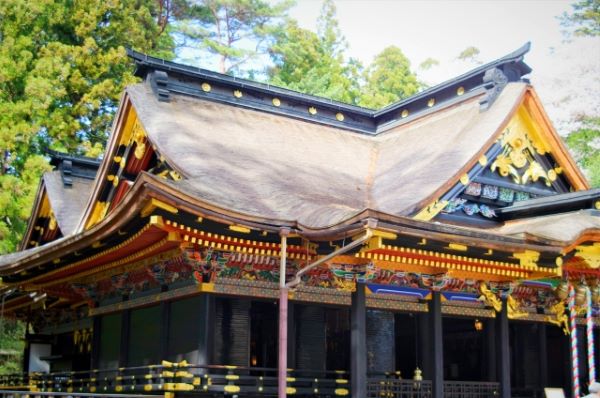
As you can imagine, building something of this scale requires a lot of time. In 1604, Date Masamune invited top-class artisans around the country, and it took them three years to complete the construction. Whether internal or external, the building is lacquered and decorated with colorful golden fittings!
Tip: If you want to examine the interior of the worship hall, apply for a private ritual or prayer session.
Saigi-tō (祭儀棟)
If you are after Omamori amulets, fortune slips, or even a Matsukawa Daruma, Saigi-tō, to the right of the Goshaden, is the next place you want to visit between 9 am and 5 pm. It is also where you apply for private ritual and praying sessions.
At the resting space, you can also learn more about how the shrine maintains the Goshaden by watching the documentary.
- Saigi-tō is open from 9 am to 5 pm.
- Applications for rituals are open from 9 am to 4 pm.
Heading Home from the North Approach: Kita Sandō (北参道)
In autumn, the part of the shrine with the most vivid scenery is the North Approach, parallel to the Goshaden. It is also the approach leading to the shrine’s free car park at the back of Goshaden.
What lines the approximately 150-meter approach are numerous maple trees that turn a bright color in the autumn.
The Kita Sandō Torii, which separates the shrine’s precinct from the parking lot, is said to be the largest torii gate in Miyagi Prefecture. The 8-meter-wide and 7-meter-tall torii gate was made from 300-year-old Hinoki trees from Aomori Prefecture.
Tip: The road elevation from the North Approach to the bus stop is much gentler than the steep staircases along the main approach.
The Car Purification Site (自動車祓所)

At the side of the shrine’s car park, you will encounter a Car Purification Site. The purification ritual was previously performed on the animals used to carry humans, including cows or horses. But since cars have become more common, the ritual was transformed into one suitable for performing on cars.
So if you live in Japan and want to be blessed with a year of road-traffic safety, apply at Saigi-tō. After the ritual, you will be given an Omamori (amulet) with your name, the date of the ritual, and your car plate number written.
After the shrine receives your application, the ritual will be performed within 30 minutes. But note that the ritual won’t be performed from the 1st to the 15th of January, or during festivals and events.
Important: The car park is closed at 6 pm.
The Roosters at Ōsaki Hachimangū
When you stroll around in Osaki Hachiman Shrine, you will most likely run into one of the shrine’s five roosters. Since the shrine brought them back, they became one of the highlights of the shrine!
While the roosters normally stay in the temple’s spacious vicinity, there were times when one of them was brought back by the local police (´▽`*). Because of these roosters, the connection between the shrine and the locals has deepened.
So why roosters? If you know some Japanese language, it won’t be hard to gather how chickens relate to shrines. The word torii originates from chickens perching atop a tree (according to one theory). So to shrines, chickens are treated as god’s messengers.
Another reason the roosters are kept in the precinct is that Osaki Hachimangu’s priest hopes that visitors to the shrine can feel at ease about coming into contact with living creatures.
Chicken and Ōsaki Hachimangū
According to the legend, there was a chicken with golden feathers that came to the railing of a bridge and cried every night. Annoyed by the chicken, the locals visit Hachimangū Shrine to complain to the god. This is when they saw this chicken walking into an ema plaque.
To stop the chicken from coming out at night, people put a mesh around the ema. However, just when the locals hoped they could finally have a good night’s sleep, the town was flooded by heavy rain that night. This was when they realized the chicken was trying to inform them of the natural disaster to come.
To commemorate the event, the bridge where the chicken cried was named Tori-hashi (鶏橋), which is close to Osaki Hachiman Shrine!
If you don’t know the story, the bridge might be just another one in Japan. But we are sure it has become a spot you want to visit after learning about the legend (=゚ω゚)ノ.
Tori-hashi Bridge is marked on Google Maps if you are interested in seeing it.
Matsutaki Matsuri (松焚祭)
While several major rituals and festivals are held at Osaki Hachimangu throughout the year, the biggest and most exciting is the Matsutaki Matsuri, held from the 14th to the early dawn of January 15. It is a ritual in which the shrine burns the prior year’s New Year’s pine decoration (松飾り), and old amulets are collected from pilgrims to pray for a disease-free year and prosperity for their businesses. Each year, around 100 thousand people participate in this magnificent event!
Matsutaki Matsuri is also known as the Donto Matsuri (どんと祭) from how the Japanese describe the raging fire. The flame is believed to serve as a medium through which people’s prayers reach the gods. In addition, the fire purifies the participants’ minds and bodies, bringing peace to the pilgrims and their families.
Moreover, the festival has some “naked” elements. As part of the ritual, thousands of men form a procession in the middle of winter, with their clothes off!
How to Get to National Treasure Osaki Hachiman Shrine
- From JR Kunimi Station (国見駅), a 15 to 20-minute walk.
- From JR Tohokufukushidai-Mae Station (東北福祉大前駅), a 10 to 15-minute walk.
- You can also take a bus from JR Sendai Station’s (仙台駅) bus stop no. 10 or no. 15 at the west exit. Many of the services stop at the bus stop, Osaki Hachimangu-mae (大崎八幡宮前), or a bus stop close to the shrine.
- Sendai Sightseeing City Loop Bus, Loople Sendai (るーぷる仙台), also stops at Osaki Hachimangu-mae.
- Refer to the official website HERE for the service’s timetable and bus fare.
Discover Other Fantastic Attractions in Sendai
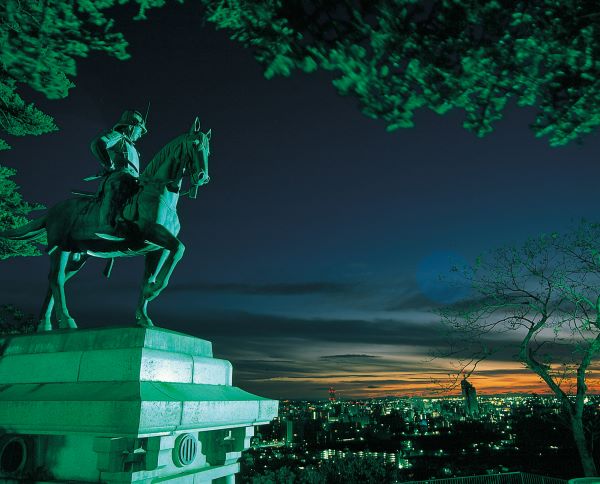
You might not be aware of it, but Sendai, the Tōhoku region‘s biggest city, receives more than 20 million tourists each year!
So if you want to find out how Sendai managed to attract so many visitors, refer to our article on Sendai, which is filled with historical, cultural, and natural attractions (=゚ω゚)ノ.