As Japan’s first UNESCO World Heritage Site and one of the country’s 12 remaining original keeps, Himeji Castle (姫路城), tops almost every traveler’s bucket list. Known as the “White Heron Castle Shirasagi-Jō (白鷺城)” for its brilliant white plaster walls and elegant, wing-like architecture, this 400-year-old masterpiece is the ultimate day trip from nearby Osaka or Kyoto. However, navigating the historic grounds and steep main keep can be physically demanding, and finding an authentic, plant-based meal afterwards in the surrounding city can be notoriously difficult. Whether you are looking for ticket prices, train directions, or a breakdown of the best vegetarian and vegan-friendly restaurants near the castle gates, this comprehensive guide has you covered for a perfect, hassle-free visit.
All You Need to Know Before Visiting Himeji Castle
- Booking an English-Guided Tour
- Why Himeji Castle is a Must-Visit in Japan
- Inside Himeji Castle: Exploring the Main Keep (Daitenshu) & What to Expect
- Tips for Visiting Himeji Castle
- Cherry Blossom at Himeji Castle
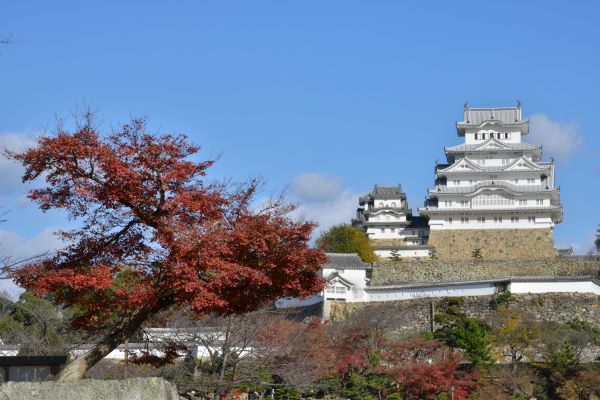
- Autumn Foliage at Himeji Castle
- Nighttime Light-up at Himeji Castle
- Festivals and the Best Time to Visit Himeji Castle
- Himeji Castle Opening Hours, Tickets & Prices
- How to Get to Himeji Castle from Osaka and Kyoto
| Feature | Himeji Castle (White Heron) | Osaka Castle / Nagoya Castle |
| Authenticity | Original Keep (Survived 400+ years) | Rebuilt concrete reconstruction |
| Design Style | Brilliant white plaster, wing-like rooflines | Green copper roofs, gold accents |
| UNESCO Status | Japan’s very first World Heritage Site | Regional Historic Site |
| Interior | Steep wooden stairs, historic defense traps | Modern museum with an elevator |
Fun fact: The reason that the castle can survive until now for over 400 years is not that the American army didn’t target Himeji Castle during WWII, but because the bomb that was dropped was faulty.
If you would like an English-speaking tour guide to introduce Himeji Castle and Kōkōen Garden, make a booking with one of the two tour guide groups.Tip: Remember to download the Himeji Castle Great Discovery App on your phone before visiting Himeji Castle. This app will be a great guide, providing historical and fun facts about different areas of the castle’s grounds!
Booking an English-Guided Tour
If you would like an English-speaking tour guide to introduce Himeji Castle and Kōkōen Garden to you, make a booking with one of the two tour guide groups.
In addition, here is a list of tours you can book to explore Himeji City, including Himeji Castle and Kōkōen Garden.
- Himeji Half-Day Private Tour with Government-Licensed Guide
- Himeji and Mt. Shosha Tour
- Himeji Full-Day Private Tour with Government-Licensed Guide
- Himeji Castle Easy Bike Tour: Samurai History, Garden & Matcha
- Himeji Castle and Traditional Sake Breweries Tour
- Walking Tour in Himeji Castle Garden and Aizome Indigo Dyeing
- Himeji: Private Guide Tour of the Castle from Osaka or Kyoto
Tours That Explore Both Himeji and Kobe!
Why Himeji Castle is a Must-Visit in Japan
As Japan’s first UNESCO World Heritage Site, a monument is placed at the entrance of the castle park. When you visit the castle, don’t forget to take a photo with this landmark in the photo!
Unlike many castles in Japan, the Himeji Castle that you see today is not a rebuild but the same original 400-year-old castle. This single fact is worth a visit already!

The History of the White Heron Castle (Shirasagi-jo)
Himeji Castle is widely considered the pinnacle of Japanese feudal architecture. Its nickname, Shirasagi-jo (White Heron Castle), stems from its brilliant white-plastered walls and the elegant, layered roofs, which resemble a massive white bird taking flight. Unlike reconstructed concrete landmarks like Osaka Castle, Himeji is completely authentic. It has stood for more than 400 years, miraculously surviving wars, earthquakes, fires, and political shifts that leveled nearly every other fortification in Japan.

Today, the White Heron Castle has 83 buildings. Exploring all of them can take a while. But the grounds of the castle back in the 16th century were even bigger! The model in the photo below illustrates the complete ground of the castle back then. The area up on the hill is the castle’s current ground.

The purpose of the white color of the castle wasn’t for an elegant presentation but to strengthen its defensive function. The color actually comes from the white plaster, which is used to fireproof the internal wooden structure.
With various openings for firing guns, arrows, and even boiling water (yes, boiling water was considered a weapon back then), the castle protected the people inside from their enemies.
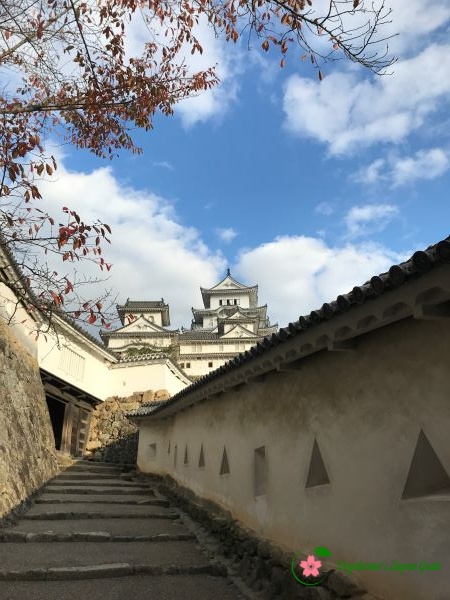
Check out the openings in the wall, in various shapes, in the photo. They weren’t opened up for the samurai to appreciate the nice view of the castle’s downtown areas, but for them to spot unwelcomed visitors!
Inside Himeji Castle: Exploring the Main Keep (Daitenshu) & What to Expect
- Collect your original shoulder bag: Prerequisite.
You cannot wear outdoor shoes inside the wood-preserved keep or the Hyakken Corridor. The castle has permanently discontinued standard plastic grocery bags.
Instead, you will be handed a complimentary, reusable, original Himeji Castle shoulder bag at the entrance to carry your shoes and personal belongings. If you are lucky, a special edition shoulder bag might be distributed during your visit!

2. Navigate the 6 structural stories: Physical Demand.
The castle interior is completely authentic wooden architecture with no elevators. Keeping your hands free is essential, which is why the city introduced the new shoulder bags. You will climb six floors of increasingly steep, narrow wooden stairs (some built at a sharp 45-degree angle).
⚠️ Accessibility Note: Because Himeji Castle is an un-altered, protected national treasure, it is entirely inaccessible to strollers, wheelchairs, or travelers with severe mobility limitations. There are no elevators, and the final staircases are practically vertical ladders angled at a sharp 45 degrees with narrow footholds.
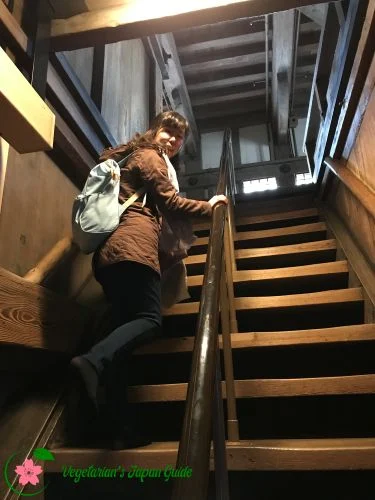
3. Spot the defensive architectural traps: What to look for.
As you safely navigate the stairs, keep an eye out for ishi-otoshi (stone-drop chutes tucked into the corners) and hidden weapon racks (wagu-bako) built directly into the ancient walls.
4. View the Himeji skyline from the top floor: The Reward.
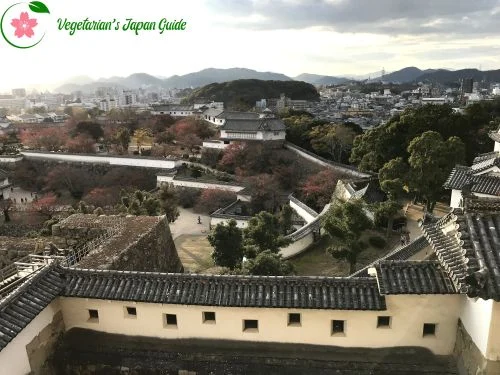
The topmost floor houses a small shrine (Osakabe-jinja) and offers panoramic views over the castle grounds and down the main boulevard directly to Himeji Station.
5. Take your shoulder bag home with you: Departure.
There are no collection bins or drop-off stations for the shoulder bags. Take it home as a unique, practical travel souvenir!
Tips for Visiting Himeji Castle
- Check out the Himeji Castle’s Website and click “Number of visitors to the Castle” for the congestion forecast to plan your visit.
- English-guided tours are held at 10 am and 1 pm, each lasting 1 hour and 45 minutes.
- To join the tour, adults above 19 years of age will need to pay an extra 1,500 yen and 1,000 yen for teenagers between 13 and 18 years old. The registration starts 30 minutes before the commencement of the tour at the information desk at the castle.
- Note that the tour has a capacity of 10 people. For more information about the tours, refer to the official website.
Important Tips for Climbing the Castle Tower
Climbing the Main Keep (Daitenshu) of Himeji Castle is an unforgettable experience, but it is far more physically demanding than visiting a reconstructed modern museum like Osaka Castle. Because the building is entirely authentic, the interior layout was intentionally engineered 400 years ago to exhaust, slow down, and trap invading samurai.
To ensure you have a safe and comfortable climb, keep these essential insider tips in mind before you head past the ticket gates.
🧦 Wear Thick Socks (and Avoid Slippery Footwear)
Because you are required to remove your outdoor shoes at the entrance and carry them in the provided bag, you will be walking entirely on the castle’s ancient, original wooden floors. These floors are polished, smooth, and notoriously cold—even in the summer.
Pro-Tip: Wear or bring a thick pair of socks with good grip. Avoid cheap, ultra-thin synthetic socks, as they can turn the steep wooden steps into a major slip hazard.
🎒 Watch Your Head (and Your Backpack)
As you ascend the six levels of the keep, the doorways get lower and the ceilings compress to prevent attackers from swinging swords.
Pro-Tip: If you are taller than 5 feet 10 inches (178 cm), you will need to duck frequently. Furthermore, large backpacks are a hazard on the narrow stairs. Wear your daypack on the front while inside the keep, or use the coin-operated lockers near the main entrance gate to store large luggage.
⏳ Expect “Overtourism” Delays and Numbered Tickets
Himeji Castle is one of Japan’s most popular sights. During peak periods, such as the spring cherry blossom season (early April), Golden Week (early May), and the autumn foliage peak, the interior of the keep reaches strict capacity limits.
Pro-Tip: On crowded days, the castle staff hands out numbered admission tickets (Seiriken) at the main gates to control the flow of hikers. If you visit during these busy windows, aim to arrive by 8:30 am (30 minutes before gates open), or expect a wait of up to 2 hours just to enter the stairwells.
Cherry Blossom at Himeji Castle
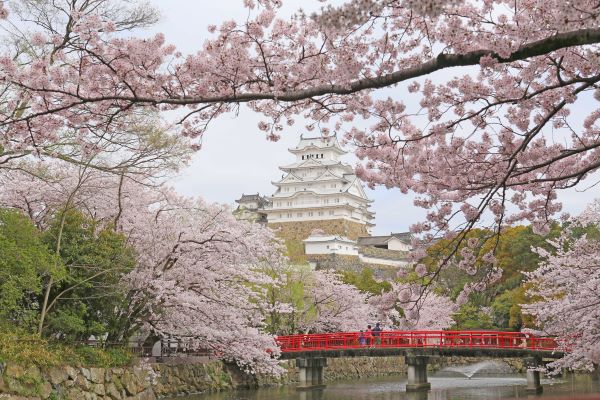
As one of Japan’s Top 100 Cherry Blossom Spots, if you visit the Kansai region in early spring (late March to early April), definitely drop by this beautiful castle!
There is even a nighttime party where you can enjoy various traditional Japanese music performances while watching the light-up show on the castle and the fully bloomed cherry blossoms!
For more information, please refer to our festival guide below!
Autumn Foliage at Himeji Castle
To be honest, rather than the Himeji castle, autumn foliage is a lot more stunning in the castle’s garden Kōkōen. Many people visit Himeji for the castle, but what they don’t realize is that the garden’s castle is just as awesome as the castle itself!
If you visit Himeji from late November to early December and don’t have time for both the castle and the garden, we would recommend choosing the garden for sure for the fall foliage! Refer to our Kōkōen article for more details and the stunning photos we took, and you will know why!
Witnessing the Shirasagi-jo Light-Up: Himeji Castle at Night
If you are planning a day trip, do not rush back to Osaka or Kyoto as soon as the castle gates close at 5 pm. Staying until dusk rewards you with a completely different experience: the magnificent Himeji Castle Night Light-Up.

Known officially as the “Saiun Light-Up (Iridescent Cloud, 彩雲ライトアップ) ,” this stunning illumination system was carefully developed by the world-renowned Motoko Ishii Lighting Design firm. They conducted extensive testing on the castle’s unique plaster walls to find the exact color temperature of white light that makes Himeji’s authentic white stucco gleam most beautifully against the night sky.
⏰ The Night Illumination Schedule
- Standard Light-Up: The castle is illuminated in its iconic brilliant white glow every single night from sunset until midnight (12 am).
- The Daily Special Light Shows: Twice every evening, the castle shifts colors for a brief, dynamic light performance. At 8:00 PM and 9:00 PM sharp, the lighting transitions into a 15-minute special colorful LED performance that changes themes to match the seasons (such as deep accent colors or awareness color campaigns like global blue illuminations).
📸 Best Vantage Points for Night Photography
Because the main keep sits majestically atop Himeyama Hill, it is visible from all across the city center. However, if you want the absolute best photos for your trip, check out these spots:
- Sannomaru Square (三の丸広場): Located right inside the outer gates, this wide, grassy lawn allows you to sit directly beneath the illuminated keep. It is completely free and accessible 24 hours a day.
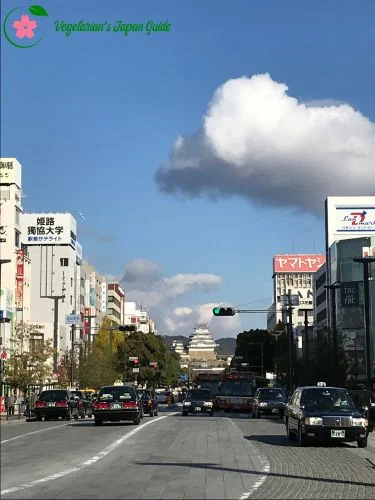
- Otemae-dori Street: As you walk back toward JR Himeji Station, look backward down the broad main avenue. The street’s e straight symmetry frames the illuminated castle perfectly.
- Himeji Station Castle View Deck: Located at the north exit of the station, this elevated public viewing platform lets you capture long-exposure street shots leading all the way to the glowing fortress.
Festivals and the Best Time to Visit Himeji Castle
World Heritage Himeji Castle Marathon (世界遺産姫路城マラソン)
The World Heritage Himeji Castle Marathon is held each year in February or March (February 22 in 2026). If you are interested in sports, planning your visit around the date will be worthwhile.
There are several courses that the runners can participate in.
- The full 42.195km course
- The fun courses are for people, especially primary school children, to enjoy.
In the meantime, you can check out the Full Himeji Castle Marathon Course Map!
Himeji Castle Night Time Cherry Blossom Party (姫路城夜桜会)
The cherry blossom season at Himeji usually starts in late March. By early April, the gorgeous pink flowers will fully bloom (albeit 10 days earlier than usual in 2021).
Each year, a nighttime cherry blossom party is held for around 10 days from the end of March to the beginning of April. Various traditional Japanese musical performances take place during the party for visitors to have a truly authentic Japanese sakura-viewing experience.
Apart from the lighting shows, traditional umbrellas are placed on the ground and lit up to enhance the traditional atmosphere!
The dates of the nighttime party are usually released in mid-March on Himeji City’s Website. You can get the website translated into English by using the multilingual function at the top of the website.
- In 2026, the party was held from March 27 to April 5 from 6:30 pm to 9 pm.
- The last admission is at 8:30 pm.
- The admission fee is 600 yen.
Himeji Castle Festival (姫路お城まつり)
If you plan to visit Himeji Castle in May, we recommend planning your visit when the Himeji Castle Festival is on!
The festival usually starts with a Noh play by the fire on the first night, followed by huge parades and stage performances over the next two days.
This is a great opportunity for you to experience Japanese culture. Check out below for some photos to know what you can expect on the day!
In 2026, the festival will be held from May 22 to 24.
Himeji Castle Opening Hours, Tickets & Prices
- Himeji Castle is open from 9 am to 5 pm (last admission at 4 pm).
- The castle is closed on December 29 and 30.
- Himeji Castle admission fee is
- 2,500 yen for those 18 years old and older (1,000 yen for Himeji citizens)
- Free otherwise (Be sure to bring a valid photo ID/passport to verify your age at the gate!)
- Himeji Castle and Kōkōen Garden Combined Ticket: 2,600 yen (Highly recommended as the garden add-on is only an extra 100 yen)
How to Get to Himeji Castle from Osaka and Kyoto
Himeji makes a perfect day trip from anywhere in the Kansai region. When deciding how to get there, your choice will depend entirely on whether you want to prioritize speed with the bullet train or maximize cost-effectiveness with standard rapid train lines.
Option 1: Departing From Osaka
The journey from Osaka changes slightly depending on your starting station.
- The Lightning Fast Way (Shinkansen): Head to Shin-Osaka Station. From here, you can board the JR Sanyo Shinkansen. The blistering commute takes a mere 23 to 30 minutes and costs approximately ¥3,520 to ¥4,270 one-way.
- The Budget-Friendly Way (Local JR Line): Head to Osaka Station (located in the Umeda commercial district). Board the direct JR Special Rapid Train (Shin-Kaisoku) on the JR Kobe Line. It takes exactly 1 hour and costs just ¥1,490. No train transfers are necessary.
- Non-JR Alternative: If you hold a Kansai Railway Pass, you can catch the Hanshin Limited Express from Osaka-Umeda Station straight to Sanyo-Himeji Station. It is the slowest route (100 minutes, ¥1,320), but it is fully covered under non-JR network passes.
Option 2: Departing From Kyoto
Getting to Himeji from Kyoto follows the same train networks but takes a bit longer due to the extra distance.
- The Lightning Fast Way (Shinkansen): From Kyoto Station, you can hop right onto direct Hikari or Nozomi Shinkansen trains. The journey takes around 45 to 55 minutes and costs roughly ¥5,000 for a one-way unreserved ticket.
- The Budget-Friendly Way (Local JR Line): Catch the direct JR Special Rapid Train (Shin-Kaisoku) straight from Kyoto Station. It takes 90 minutes to pull into Himeji, costing ¥2,210 one-way. This train runs frequently (roughly every 15 minutes).
🎟️ The Rail Pass Rules (Don’t Get Caught Off Guard)
💡 Regional JR Passes (Highly Recommended): If you are only touring the Kansai area, skipping the national pass and purchasing a regional pass like the JR Kansai Wide Area Pass or a 1-Day JR Kansai Area Pass is highly economical. The Wide Area variants actually allow you to ride all shinkansen trains, including the Nozomi, between Shin-Osaka and Himeji.
🗺️ Navigating from Himeji Station to the Castle gates
Once your train arrives at Himeji Station (姫路駅), getting to the actual castle grounds is completely foolproof.
- Exit out of the station’s North Exit. The moment you step outside, you will see the magnificent white castle towering prominently at the absolute end of the main boulevard. Simply walk straight down Otemae-dori Street for about 15 to 20 minutes.
- To get to Himeji Castle from Himeji Station, take a bus operated by Shinki Bus (神姫バス) from bus stop numbers 6 to 10. Please get off at Himejijō Ōtemon-mae (姫路城大手門前).
- The buses that depart from the stops arrive approximately every 5 minutes.
- From the bus stop, it is only a 5-minute walk.
- The one-way bus fare is 100 yen.
Where to Eat Vegetarian & Vegan Near Himeji Castle
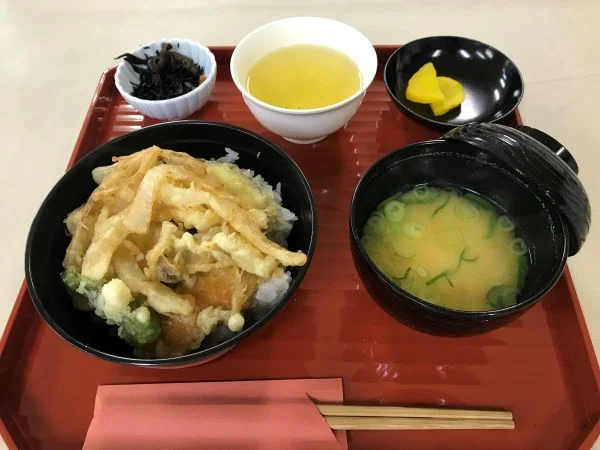
Finding authentic, plant-based meals in Japan can be a challenge because dashi (fish broth) is often used in everyday cooking. Fortunately, the area surrounding Himeji Castle and JR Himeji Station has some fantastic, accommodating options if you know where to look.
Whether you are looking for a quick macrobiotic lunch right outside the castle gates, a cozy vegan cafe hidden in the local shopping arcades, or traditional shojin ryori (Buddhist vegetarian cuisine) up on nearby Mt. Shosha, you won’t have to settle for just convenience store snacks.

Because restaurant hours and English menu availability change frequently, we have compiled a complete, up-to-date culinary guide to help you navigate your day trip without any cross-contamination worries.
👉 Read our full guide: The Best Guide to Himeji’s Vegan-Friendly Restaurants to discover exactly where to eat, complete with walking maps, opening hours, and must-try dishes.
Make it a Full Day Trip: The Ultimate Mountain Escape
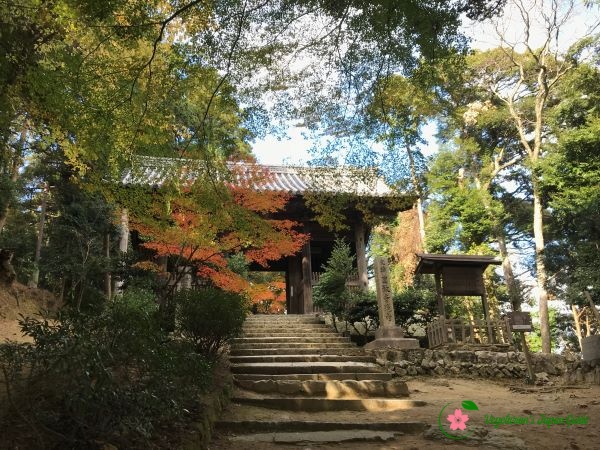
If you want to experience the deep spiritual roots of Japanese vegetarianism, pair your castle visit with a side trip to Mt. Shosha. Located just 25 minutes from the castle gates, this peaceful mountain is home to Engyo-ji, a 1,000-year-old temple complex famous as a filming location for The Last Samurai. Beyond its massive wooden structures and serene forest trails, Mt. Shosha is one of the few places in Hyogo where travelers can experience authentic Shojin Ryori, traditional Buddhist vegetarian cuisine served on historic lacquerware by the temple monks.
👉 Plan your journey: Check out our complete guide to Mt. Shosha to discover how to catch the ropeway, reserve a temple lunch, and explore this stunning mountain oasis.
Visit the Venice of Japan – Kurashiki Bikan Historical Quarter!
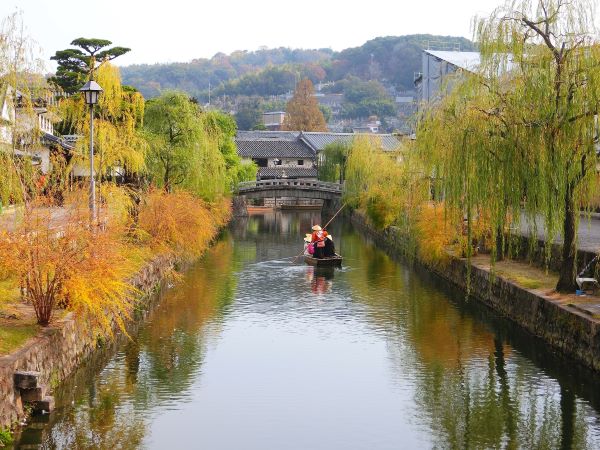
Just around a 60-minute train ride from Himeji Station, the Kurashiki Bikan Historical Quarter is famed as the Venice of Japan. The area with traditional houses and willow trees lining the banks of the canal is one of the country’s most popular filming locations. In addition to the trendy cafes and restaurants, the area also has many cultural facilities, including the Ōhara Museum of Art (which houses a collection of international masterpieces), the Kurashiki Museum of Folkcraft, and the Kurashiki Archeological Museum.
For more information, please refer to our article on Kurashiki Bikan Historical Quarter!