Step into the spiritual heart of the Tsugaru region at Iwakiyama Shrine (岩木山神社, Iwakiyama Jinja), a majestic 1,200-year-old sanctuary nestled at the foot of Aomori’s iconic “Tsugaru Fuji.” Often nicknamed “Oku-Nikko” for its ornate wood carvings and vibrant vermilion architecture, this historic power spot is a must-visit for travelers exploring the Hirosaki area. Whether you are walking the solemn, cedar-lined approach to pray for good fortune, photographing the unique “upside-down” guardian dogs, or starting a pilgrimage hike up the sacred Mount Iwaki (岩木山), our guide to Iwakiyama Shrine highlights the best of this ancient Aomori treasure.
How to Get to Iwakiyama Shrine?

The only way to get to Mt. Iwaki by public transport is to get a bus from bus stop no. 6 in front of JR Hirosaki Station (弘前駅) or bus stop no. 3 at Hirosaki Bus Terminal (弘前バスタミナール). You will need to catch the bus bound for Karekitai (枯木平) operated by Kōnan Bus (弘南バス) and get off at Iwakiyama Jinja-mae (岩木山神社前).
This trip should take about 40 minutes if traffic is clear. Refer to HERE and scroll down for bus services for Mt. Iwaki. Note that only the main bus stops are listed.
You can also use one of Japan’s Transport Apps to plan your visit.
What to Do at Iwakiyama Shrine?
Iwakiyama Shrine, established in the late 8th century, is located at the southeast foot of Mt. Iwaki. The shrine and Mt. Iwaki are places of worship for the guardian deity of agriculture and fisheries.
Throughout its 1,200-year history, the shrine has endured all weather conditions and been rebuilt a couple of times. But even so, some buildings we see today are over 400 years old!
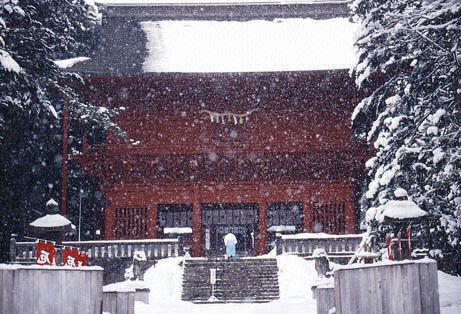

This red worship hall (社殿) is also known as Oku no Nikkō (奥の日光). The building was designed, and its intricate details, especially, resemble those of the Nikkō Tōshō-gū (日光東照宮) in Tochigi Prefecture. Unsurprisingly, the worship hall and a couple of gates are designated National Important Cultural Artifacts.
Ancient cedar groves line the pass leading to the worship hall. The solemn but relaxing atmosphere surrounding the shrine will ease the stress of the day-to-day hustle.
Just in front of the worship hall, remember to look down as you walk up the staircases.
You should find these two stone statues called Tamagaki Komainu (玉垣狛犬) holding onto a stone fence. One is facing up, and one is facing down. Taking pictures with them will boost your luck with money (with the one facing up) and relationships (with the one facing down)!
So what does Komainu (狛犬) mean? Komainu is often called “lion dogs” in English. It is the name for the lion-like statue guarding the main gate of Shinto Shrines (=゚ω゚)ノ.

Iwakiyama Sakurabayashi Park (岩木山桜林公園)
From the back of the shrine, if you walk straight for 20 minutes or so, you will find Iwakiyama Sakurabayashi Park.
It is a gorgeous park in spring when the cherry blossoms bloom from late April to early May.
Except for winter, it is also a free campsite that anyone can use. But no tents are available for rent.
Mountain Pilgrimage: Oyama Sankei

Oyama Sankei (お山参詣) is a 3-day pilgrimage event at Iwakiyama Shrine. If you are interested in joining the entire event, make sure you are at the shrine 2 days before August 1 on the LUNAR calendar (meaning sometime in September each year). Refer to the Iwakisan Tourist Association’s Website for the exact dates of the pilgrimage.
It is an event for the participants to pray for family safety and agricultural prosperity. The first two days of the pilgrimage take place at the Iwakiyama Main Shrine.
On August 1, worshipers get up at 2:30 in the morning and head for the inner shrine of Iwakiyama Shrine (岩木山神社の奥宮) at the summit of Mt. Iwaki.
As the sun begins to break over the horizon, the worshippers join their hands to it and offer their prayers.
On January 1, another pilgrimage event is held at Iwakiyama Shrine. Winter’s Oyama Sankei (冬のお山参詣) is the same ritual that is performed on the 1st day of the Oyama Sankei in August in the lunar calendar.

Hiking to the Summit of Mt. Iwaki for a Spectacular View
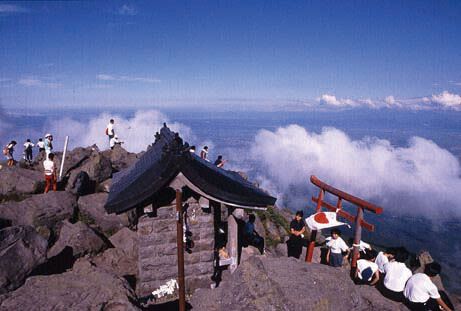
Your journey to the top of Mt. Iwaki CAN start from the symbol of the mountain, Iwakiyama Shrine. We say “can” because, during the warmer seasons, Kōnan Bus provides direct bus services to the gondola lift station, which stops at the shrine. Thus, although the mountain is 1,625 meters tall, getting to the summit isn’t a hard thing to do! You can, of course, climb your way up from Iwakiyama Shrine. This hiking course is known as the Hyakuzawa Route (百沢登山道). This 5-hour hiking course is suitable for those with at least some level of hiking experience.
For more information about Mt. Iwaki, refer to our article on Mt. Iwaki (=゚ω゚)ノ.
Discover the Hirosaki’s City Center
To get to Mt. Iwaki, you will surely arrive at Hirosaki’s city center first. It might also be where you will spend a night before departing for Mt. Iwaki.
As the cultural heart of Aomori Prefecture and Japan’s undisputed cherry blossom capital, this historic castle town offers a perfect blend of feudal history, stunning botanical gardens, and unique Western-style architecture.
Refer to our Hirosaki City article for all the attractions we recommend!