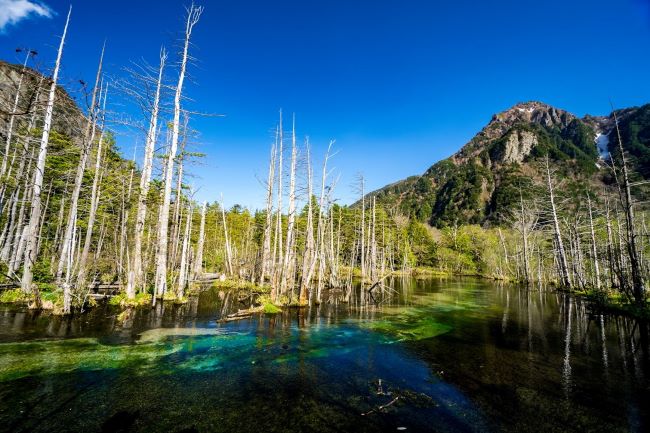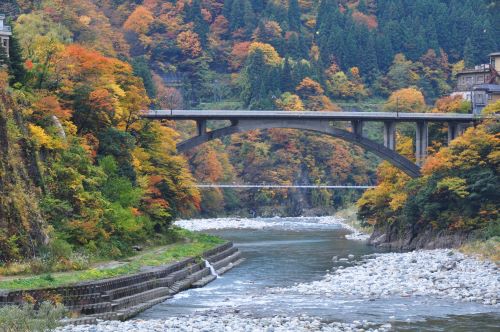
Perched on the edge of the mystical Lake Shibayama (柴山潟), Katayamazu Onsen (片山津温泉) offers a striking contrast to its more traditional sister towns in the Kaga region. Known for its sleek, glass-walled Sōyu Public Bathhouse designed by Yoshio Taniguchi, the town feels like a contemporary gallery where architecture meets the elements. Visitors are drawn here for the legendary “seven colors” of the lake, the massive water fountain that reaches toward the sky, and the breathtaking backdrop of the snow-capped Mt. Hakusan (白山). Whether you are making mineral-rich tofu at the historic Hanayakata or taking a sunset stroll to the floating Ukimi-dō Hall, Katayamazu is a serene destination where history and modern design find a perfect, watery balance.
Summer is probably the most lively time in Katayamazu Onsen, with various festivals held one after another. The fireworks launched at the lakeside are what many tourists around the country come to Katayamazu Onsen for. In winter, migratory birds from Siberia can be spotted resting around the lake.
Things to Do and What to See in Katayamazu Onsen
- How to Get from Kanazawa to Katayamazu Onsen
- Katayamazu Onsen’s Cherry Blossom Season
- Lake Shibayama Cruise (片山津温泉屋形船)
- Giant Water Fountain at Lake Shibayama (柴山潟巨大噴水)
- Ukimi-dō Hall (Uki Uki Benten) (浮御堂(うきうき弁天))
- Kaga Katayamazu Public Bathhouse (片山津温泉 総湯)
- Hanayakata (芸妓検番 花館)
- Aizenji Temple (愛染寺)
- Nakaya Ukichiro Museum of Snow and Ice (中谷宇吉郎雪の科学館)
- Sabō Misho (茶房実生)
- The Lake Shibayama Panorama Walk (2 to 3 Hours)
- Frequently Asked Questions: Visiting Katayamazu Onsen
Travel Tip for Plant-Based Travelers
Finding plant-based food in Katayamazu Onsen can be a challenge. It is best to bring plant-based food with you if you plan to visit Katayamazu Onsen. You can also grab vegan-friendly snacks from the convenience stores around Kaga-Onsen Station.
Refer to HERE for a list of vegan food available at convenience stores.
Tip: Soba noodles also taste nice with salt. It’s an option if you want to dine at a restaurant in Yamashiro Onsen.
How to Get from Kanazawa to Katayamazu Onsen
Yamashiro Onsen is located in Kaga City, Ishikawa Prefecture. The journey typically involves two stages: reaching Kaga-Onsen Station and then taking a short bus or taxi ride into the hot spring town. The two bus services you can take to get to Yamashiro Onsen are:
You can also use one of Japan’s Transportation Apps to plan your visit.
How to Get to Katayamazu Onsen from Kaga Onsen Station
- Best Value: The Local Bus is the quickest and cheapest non-shuttle option, taking you directly to the town center and the Sōyu public bathhouse in about 10 minutes.
- Sightseeing: The CANBUS Sea Route is better if you plan to visit other attractions, such as the Nakaya Ukichiro Museum of Snow and Ice, before heading to your hotel.
- Convenience: If you are staying at one of the lakeside hotels, always check whether they have a scheduled shuttle, as they often time these to coincide with the arrival of the express trains at Kaga Onsen Station.
| Method | Duration | Cost | Notes |
| Local Bus (Hokutetsu) | ~10 min | ~250 yen | The most direct option. Use Bus Stop no. 1. |
| CANBUS (Sea Route) | ~30–60 min | 500 yen | A tourist loop bus. Ensure you take the Sea Route. |
| Taxi | ~10–15 min | ~2,000 yen | Fast and convenient; best for groups or heavy luggage. |
| Hotel Shuttle | ~10 min | Free | Many ryokan offer free pickups; these typically require advance booking. |
Tip: The Shinkansen trip from Tokyo, Osaka/Kyoto, and Kanazawa Station to Kaga Onsen Station is covered by a few JR Passes. If you plan to travel from Tokyo to Kyoto/Osaka via Kanazawa/Kaga Onsen, there is a great chance that the Hokuriku Arch Pass will save you money.
How to Get to Kaga Onsen from Kanazawa by Train
The quickest way to get to Kaga Onsen from Kanazawa is via the JR Hokuriku Shinkansen (北陸新幹線) or the IR Ishikawa Railway (いしかわ鉄道).
- The travel time by taking the Hokuriku Shinkansen from Kanazawa Station to Kaga Onsen Station (加賀温泉駅):
- Hokuriku Shinkansen Kagayaki (かがやき): Around 15 minutes
- Hokuriku Shinkansen Hakutaka (はくたか) or Tsurugi (つるぎ): Around 18 minutes
- It takes about 45 minutes to get to Kaga Onsen Station by the local IR Ishikawa Railway from Kanazawa Station.
- The cost to get to Kaga Onsen Station from Kanazawa:
- It will cost 3,170 yen to take the Shinkansen from Kanazawa Station to Kaga Onsen Station.The trip is covered by the following JR Passes.
- If you don’t have a JR Pass and want to save on transportation, it costs only 880 yen to take the local trains operated by IR Ishikawa Railway to Kaga Onsen Station.
Kaga Tour Bus – CANBUS (加賀周遊バス キャン・バス)
Most attractions in Kaga can be accessed by taking the Kaga Tour Bus – CANBUS, which departs from and terminates at JR Kagaonsen Station (加賀温泉駅).
- Single-ride tickets can be purchased from the bus driver. Each ride will cost you 500 yen to board the CANBUS.
- For more information about the service, pricing, and timetable, please refer to their website HERE.
Tip: With your bus ticket, you can get discounts or freebies at some attractions along the bus route.
Eco Ride Coupon (ECO乗りクーポン)
If you don’t think you will visit many attractions in a day, then the 1,000 yen ECO Ride Coupon may be better. It allows you to board the CANBUS twice, have free access to one facility in the city and an exchange voucher for a traditional sweet at participating stores.
For more information, please refer to their website HERE and use Google Chrome’s translation function at the top right of the address bar. HERE is the English pamphlet for ECO Ride Coupons.
Kaga Hot Spring Town Passport (加賀温泉郷パスポート)
Another money saver is the Kaga Hot Spring Town Passport. Depending on how you plan to get around, you can either get a red passport (1,000 yen) that gives you access to three attractions or a blue passport (1,800 yen) for an additional CANBUS ticket. Both passports are valid for two days from the date of purchase.
For more information, please refer to their website HERE.
Katayamazu Onsen’s Cherry Blossom Season
The cherry blossom season at Katayamazu Onsen is usually from early to mid-April. If you are in the onsen town in spring, head to the places below for the stunning national flower of Japan!
- Shibayama Gatakohan Park (柴山潟湖畔公園), next to the Nakaya Ukichiro Museum of Snow and Ice
- Aizenji Temple
The Top Photo Spots in Katayamazu Onsen
| Location | Best Time of Day | Why it Works |
| Aizenji Temple Viewpoint | Early Morning | The morning sun hits Mt. Hakusan directly, making the snow-capped peaks glow against the blue lake. |
| Ukimi-dō Floating Hall | Late Afternoon | As the sun sets, the lantern-lit pier reflects beautifully on the water. Catch the hourly fountain show for extra drama. |
| Sōyu Public Bathhouse | Blue Hour | When the sky turns deep blue, the interior lights of the glass building make it look like a glowing lantern. |
| Machi Cafe Terrace | High Noon | The best time to see the “Seven Colors” of the lake. The high sun reveals the deep turquoise or emerald hues of the water. |
Lake Shibayama Cruise (片山津温泉屋形船)
Important: Lake Shibayama Cruise is currently suspended. Refer to the official website HERE. If there is no (運休中)next to “柴山潟周遊 屋形船”, then it is back operating. However, the fireworks cruise in August is on.

Board the boat for a cruise around Lake Shibayama if you want to get closer to the giant water fountain in the middle of the lake and/or get a photo of the Ukimi-dō Hall (浮御堂) that seems as though it is floating on the lake.
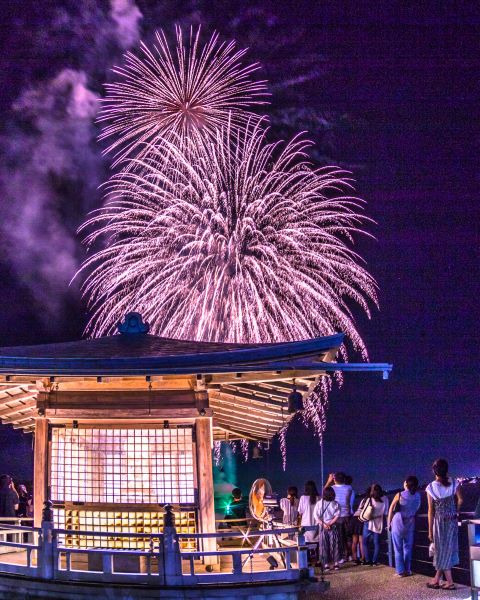
And if you happen to be at Katayamazu Onsen in summer, the cruise is a must to enjoy the fireworks launching into the nighttime sky during summer festivals!
Lake Shibayama Cruise’s Operating Hours, Cost, and Fireworks
- Reservation and check-in are at Kappa-dō (かっぱ堂), close to the pier
- The daytime cruise operates on weekends and public holidays from the end of April to the end of September.
- Sundays and public holidays: from 10 am to 3 pm
- Saturdays and during Obon Festival in mid-August: from 2 pm to 5:30 pm
- You can refer to their operating calendar HERE for the exact dates that the boat will be running.
- The departure time isn’t set. You might need to wait up to 30 minutes if there is a queue.
- There are two lighting show services each night from the end of April to the end of September. Please book your seats by 5:30 pm and arrive 15 minutes before departure.
- The departure times for the two services are 8:15 pm and 9:15 pm
- The 30-minute cruise usually costs 800 yen.
Fireworks at Lake Shibayama in Summer
- In 2026, from August 1 to 30, fireworks will be launched at Lake Shibayama from 9 pm for around 10 minutes.
- You can reserve a spot on the Lake Shibayama Cruise to see the fireworks on a traditional boat.
- The cost for the Lake Shibayama Fireworks Cruise is 2,000 yen per person (1,000 yen for children aged 4 to elementary school students).
- Children less than 4 years old won’t be allowed to board.
- The departing time is 8:45 pm. PLease check in between 7:30 pm and 8:20 pm.
- A reservation is required by calling +81-761-74-1123.
How to Get to Lake Shibayama
From JR Kagaonsen Station (加賀温泉駅), take one of the bus services below:
- Kaga Tour Bus – CANBUS’s (加賀周遊バス キャン・バス) sea route (海まわり) or Komatsu Airport route (小松空港線) and get off at Katayamazu Onsen Yunomoto Park (片山津温泉・湯の元公園).
- Refer to HERE for the service’s timetable.
- Hokutetsu Kaga Bus (北鉄加賀バス) Onsen Katayamazu Line (温泉片山津線) from JR Kagaonsen Station west exit’s bus stop no. 1 and get off at Katayamazu-go Ku (片山津5区). The bathhouse is less than a 5-minute walk from the bus stop.
- For the service’s timetable, please refer to their website HERE and click “片山津温泉 路線バス” and click open “運行時刻表を見る”.
- A one-way trip will cost you 250 yen.
Giant Water Fountain at Lake Shibayama (柴山潟巨大噴水)
Important: Due to the earthquake on January 1 2024, the water fountain is currently under repair.
At the center of Lake Shibayama lies one of Japan’s biggest water fountains. The water ejecting out can reach as high as 70 meters!
The water fountain show is scheduled hourly from 7 am to 9 pm, with additional shows at 5:30 pm, 8:30 pm, and 9:30 pm. The show will also be on in July and August at 3:30 pm and 4:30 pm.
If you plan to cruise on the lake, time your boarding time so you can experience all that Lake Shibayama has to offer!
Ukimi-dō Hall Uki Uki Benten (浮御堂 うきうき弁天)
At the end of the pier of Lake Shibayama lies the small worship hall that enshrines Benten (the goddess of music, wealth, and water) and the dragon god who looks after the lake.
According to local legend, the dragon god was an eight-headed giant serpent that attacked villagers at night. Responding to the villagers’ prayers, the Healing Buddha sent Benten to transform the serpent into a dragon god through the melody of her Japanese lute, and ordered the dragon to become the guardian god of the village.

Soon after the dragon god returned to the lake water, a hot spring was found springing forth from Lake Shibayama, which brought such fortune to the locals that they built the worship hall as a display of appreciation.
Light-up events are held each night here and at the water fountain so that you can enjoy your nighttime stroll even more!
Kaga Katayamazu Public Bathhouse (片山津温泉 総湯)
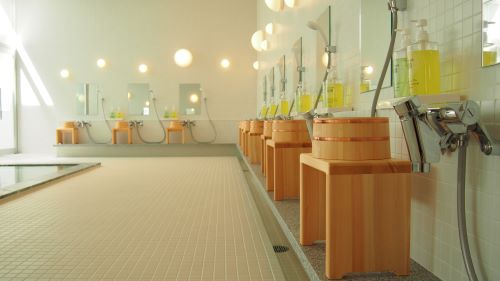
If you have ever wondered what the modern glass-panelled building standing on the shore of Lake Shibayama is, it is the public bathhouse of Katayamazu Onsen.
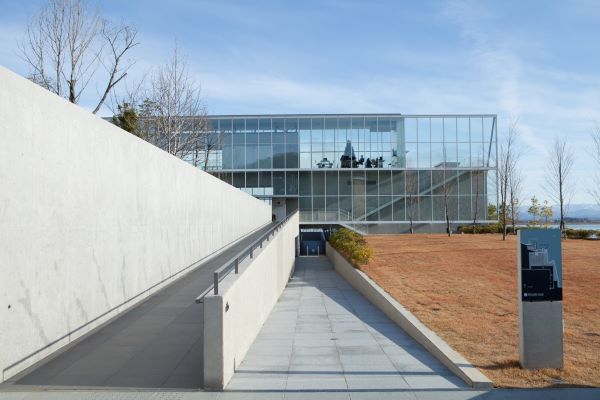
The bathhouse, which underwent a complete renovation and reopened in 2012, has a look that is completely different from our Japanese bathhouse stereotype.
Designed by Yoshio Taniguchi (谷口吉生), who has architectural works worldwide, the onsen pool with a lake view was designed to make you feel like you are bathing in Lake Shibayama itself! The other onsen pool, facing a dense garden, was designed to give people the illusion of bathing in a forest.
As their onsen pools aren’t divided into two separate sections for both genders to experience both onsen pools, the pool in front of the lake – Kata no Yu (潟の湯), is female-only on days with an odd number. On days with an even number, it will be male-only.
If public bathing isn’t your type of thing, head to their Machi Cafe (まちカフェ) on the second floor to relax on the outdoor terrace with a panoramic view of Lake Shibayama (^_-)-☆.
Tip: The facility is also popular amongst the locals. We will advise you not to utilize it if it is crowded, or you might need to wait for a shower space and/or hairdryer.
Important: Toiletries and towels aren’t provided free of charge.
Why Is the Bathhouse Called Sōyu
Kaga Katayamazu City Spa is pronoucned as Katayamazu Onsen Sōyu.
The term “Sōyu” is only found in Ishikawa Prefecture. The word “Sō (総, originally 惣)” refers to something that is owned by the general public. The locals treat the hot springs as god’s blessing, which should be treated as a public good and enjoyed by all members of society.
Kaga Katayamazu City Spa’s Opening Hours, Admission Fee, and Access Information
- The onsen pool is open from 6 am to 10 pm.
- The cafe is open from 11 am to 4 pm daily except Thursdays.
- The last order is taken at 3:30 pm.
- The cost is
- 500 yen for adults
- 150 yen for children who are between 6 and 11
- 70 yen for children between 3 and 5
From JR Kagaonsen Station (加賀温泉駅), take one of the bus services below:
- Kaga Tour Bus – CANBUS (加賀周遊バス キャン・バス)’s sea route (海まわり) or Komatsu Airport route (小松空港線) and get off at Katayamazu Onsen Sōyu (加賀片山津温泉 総湯).
- Refer to HERE for the service’s timetable.
- Hokutetsu Kaga Bus (北鉄加賀バス) Onsen Katayamazu Line (温泉片山津線) from JR Kagaonsen Station west exit’s bus stop no. 1 and get off at Katayamazu Onsen Sōyu-mae (片山津温泉総湯前). The bathhouse is just a one-minute walk from the bus stop.
- For the service’s timetable, please refer to their website HERE and click “片山津温泉 路線バス” and click open “運行時刻表を見る”.
- A one-way trip will cost you 250 yen.
Hanayakata (芸妓検番 花館): Mineral-Rich Tofu & Traditional Crafts
Important: The workshops at Hanayakata are currently suspended.
Just a few steps from the modern Sōyu, Hanayakata offers a step back into the cultural history of Katayamazu. Originally a training center for geisha and maiko, this beautifully preserved 1920s building has been transformed into a vibrant community hub.
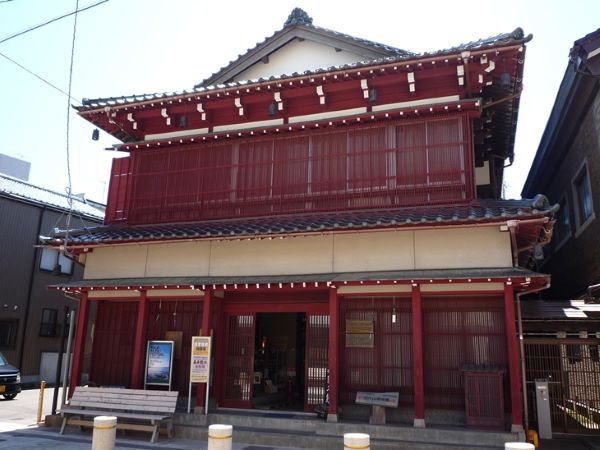
For plant-based travellers, this is one of the most exciting spots in town, not just for the atmosphere, but also for the unique, mineral-rich Tofu Making and Cloth Dyeing Experience.
The Ultimate Tofu Workshop, Perfect for Vegans and Vegetarians
What makes the tofu here truly special is the water. Using mineral-heavy water sourced directly from Lake Shibayama, the resulting tofu is denser and more calcium-rich than what you will find in a typical grocery store.
- Hands-On Fun: The workshop takes only about 20 minutes, making it a perfect mid-day activity.
- Dietary Note: While the tofu itself is naturally vegan, traditional dipping sauces often contain dashi (fish stock). We recommend bringing your own small bottle of vegan soy sauce, or asking for a simple pinch of salt, so the natural creaminess of the local soy beans can shine.
- Cost: Only 500 yen, making it one of the best value cultural experiences in the Kaga region.
- The workshop is available from 10 am to 4 pm.
Eco-Friendly Silk Dyeing
Beyond the kitchen, Hanayakata hosts Cloth Dyeing Workshops using natural materials. You can dye 100% silk handkerchiefs or scarves (ranging from 1,500 to 2,000 yen). It is a meditative way to spend an hour, and you walk away with a high-quality, sustainable souvenir that you actually helped create.
- It takes around 40 to 90 minutes, depending on the cloth that you chose to dye.
- The workshop is available from 10 am to 3 pm.
Hanayakata’s Traditional Cafe
If you aren’t in the mood for a workshop, the on-site cafe is a peaceful sanctuary. It serves traditional Japanese sweets that pair perfectly with a cup of hot green tea. The seating area provides a nostalgic look at the architecture of old Japan, with dark wood and soft lighting that feels worlds away from the glass-and-steel of the modern spa nearby.
Hanayakata’s Opening Hours and Access Information
- The facility/cafe is open from 9 am to 5 pm daily except Thursdays.
From JR Kagaonsen Station (加賀温泉駅), take one of the bus services below:
- Kaga Tour Bus – CANBUS (加賀周遊バス キャン・バス)’s sea route (海まわり) or Komatsu Airport route (小松空港線) and get off at Katayamazu Onsen Sōyu (加賀片山津温泉 総湯). The facility is a 2-minute walk from the bus stop.
- Hokutetsu Kaga Bus (北鉄加賀バス) Onsen Katayamazu Line (温泉片山津線) from JR Kagaonsen Station west exit’s bus stop no. 1 and get off at Katayamazu Onsen (片山津温泉). The facility is just a one-minute walk from the bus stop.
Aizenji Temple (愛染寺)
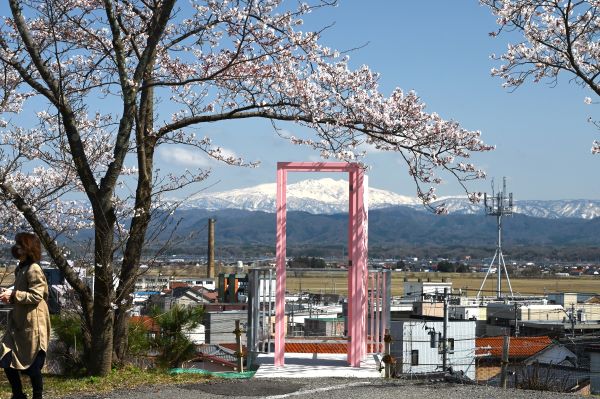
Located on a hill close to Lake Shibayama, Aizenji Temple has a Healing Buddha, Yakushi Nyorai (薬師如来), enshrined. Apparently, the Healing Buddha sent Benten to protect the village and the hot spring.
Because of its location, Aizenji is an excellent spot for a wide view of the township, Lake Shibayama, and Mt. Haku from afar on a sunny day.
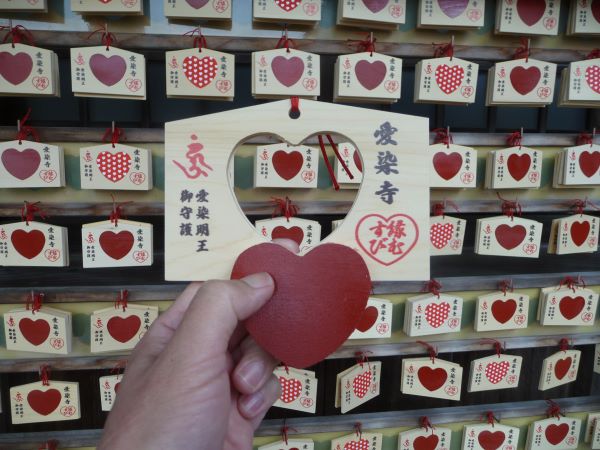
Since 2015, the temple has been best known for its heart-shaped ema (wooden plaque). Aizenmyōō (愛染明王), the god that is enshrined at its Gomadō Hall (護摩堂), is in charge of marriage ties. The ema at Aizenji Temple differs from those elsewhere in Japan in that the plaque comes in two parts. The red heart in the middle of the plaque is removable.
So you first write your prayer at the back of your heart, then fit it into the ema frame like a puzzle, sincerely praying in your head, before hanging it in the designated area on one side of the temple.
If you like glass art, check out the stained glass at the Gomadō Hall. Glass art is also found at the ossuary of the temple.
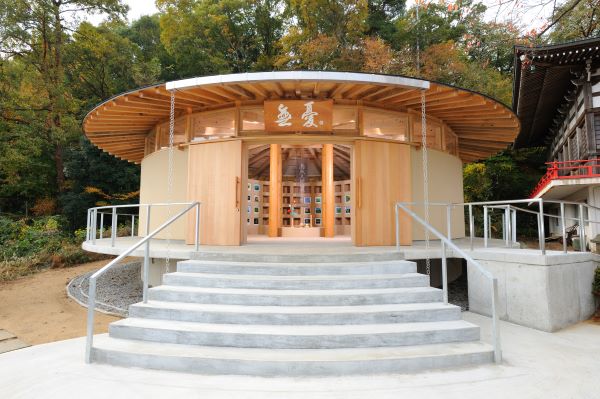
Moreover, a unique hand-drawn glass painting decorates the door of each shelving unit, which stores each individual’s remains.
Tip: The staircases leading to the gate can be tiring to climb. If you have a car, you can drive all the way up (there is a car park at the temple), or walking along the driveway should be less tiring (but watch out for traffic).
Lanterns Floating (灯籠流し) at Lake Shibayama
On August 16 each year, at the end of the Obon Festival, the temple holds a lantern-floating event on Lake Shibayama at night, making it another nice summer event at Katayamazu Onsen.
The lanterns are floated from the cruising boat, so if you are interested, don’t forget to reserve your spot during the day (^_-)-☆. The event usually starts at 8 pm, but please confirm with the cruise ticket office when you visit.
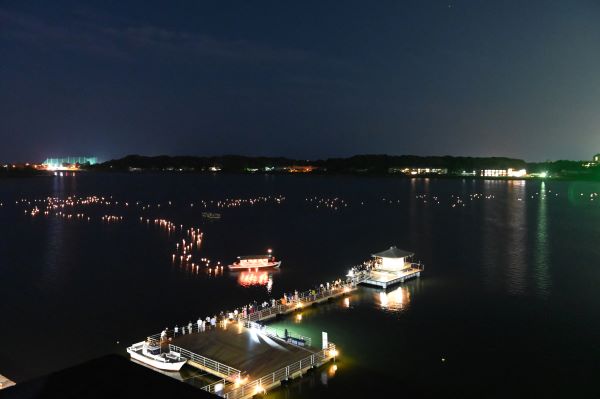
Important: Remember to apply insect repellant, whether you are just enjoying the event from the lakeshore or floating a lantern yourself. You really don’t want to become the food of the bugs that are particularly active in the area at night.
Aizenji Temple’s Opening Hours and Access Information
- The temple is open from 6:30 am to 5 pm.
- From Katayamazu Onsen Sōyu (加賀片山津温泉 総湯) bus stop, it is a 5-minute walk (it may take longer depending on how fast you climb the stairs).
- From Onsen Katayamazu Line (温泉片山津線) bus stop – Katayamazu Onsen (片山津温泉), it is a 3-minute walk.
Nakaya Ukichiro Museum of Snow and Ice (中谷宇吉郎雪の科学館)

For those passionate about scientific museums, remember to drop by the Nakaya Ukichiro Museum of Snow and Ice when you visit Katayamazu Onsen.
Even if you don’t understand the Japanese explanation of how artificial snow and ice crystals are made, you should be able to have fun browsing through the images and illustrations in the display area.
What is more interesting is that you can become a scientist in their ice crystal zone, creating your first ice pendant! In their experiment zone, you will see how diamond dust can be created artificially as well (=゚ω゚)ノ.
For more information about the museum, please refer to their English website HERE. While it doesn’t provide as much information as their Japanese website, it is still useful.
Nakaya Ukichiro Museum of Snow and Ice’s Opening Hours, Admission Fee, and Access Information
- The museum is open from 9 am to 5 pm daily except Wednesdays unless it is a public holiday.
- The last admission is at 4:30 pm.
- The admission fee is
- 560 yen for senior high school students and above
- 280 yen for anyone who is above 75 years of age
- Free otherwise
From JR Kagaonsen Station (加賀温泉駅), take one of the bus services below:
- Kaga Tour Bus – CANBUS (加賀周遊バス キャン・バス)’s sea route (海まわり) or Komatsu Airport route (小松空港線) and get off at Nakaya Ukichiro Museum of Snow and Ice (中谷宇吉郎雪の科学館).
- Hokutetsu Kaga Bus (北鉄加賀バス) Onsen Katayamazu Line (温泉片山津線) from JR Kagaonsen Station west exit’s bus stop no. 1 and get off at Yuki no Kagakukan-mae (雪の科学館前). The museum is just one min walk from the bus stop.
Sabō Misho (茶房実生)
Sabō Misho has been a Japanese tea maker since 1863. It is not only a place where you can taste delicious seasonal Japanese sweets, but you can also take a look at their tea leaf factory just next to the cafe!
In their gallery, various cultural-related exhibitions, such as flower arrangements, are on periodically.
Important: If you are interested in seeing the inside of their factory, come on Monday, Tuesday, or Thursday morning. Otherwise, you will need to book a time slot in advance.
Sabo Misho’s Opening Hours and Access Information
- The cafe is open from 10 am to 12 pm and from 1 pm to 4:30 pm.
- The last order is taken at 11:30 am and 4 pm.
- The cafe is closed on Wednesdays. If Wednesday is a public holiday, it will close on Thursday instead.
- It is a 15-minute walk from JR Iburihashi Station (動橋駅) or around a 30-minute walk from Lake Shibayama.
The Lake Shibayama Panorama Walk (2 to 3 Hours)
This circular route starts and ends near the main bus stop, taking you from the town’s modern heart to its spiritual heights.
Tip: From late October to March, look for migratory Tundra Swans resting in the lagoon. They make for incredible photos!
Stop 1: Katayamazu Onsen Sōyu & Machi Cafe
Start your walk at the striking glass-walled Sōyu. Even if you aren’t bathing yet, head to the 2nd-floor Machi Cafe terrace. This is the best place to check the “current” color of Lake Shibayama and get a clear photo of Mt. Hakusan across the water.
Stop 2: The Lakeside Promenade & Ukimi-dō Hall
Follow the path leading from the Sōyu down to the water’s edge.
- The Walk: A flat, paved promenade hugs the shoreline.
- The Highlight: Walk out onto the pier to Ukimi-dō, the “floating” temple. It enshrines the dragon god of the lake and offers a 360-degree view of the water. If you time it right (at the top of the hour), you’ll see the Giant Fountain erupt nearby.
Stop 3: Yunomoto Park & Sunahase Park
Continue along the shore to Yunomoto Park, where the hot spring source actually wells up. From here, walk one block inland to Sunahase Park.
- Pro Tip: Take a break at the “Ashi-no-yu” foot bath. It’s free and a great spot to chat with locals.
Stop 4: Hanayakata (Geiko Kemban)
Just a 2-minute walk from the foot bath is the historic geisha training hall. This is where you can stop for your tofu-making workshop or browse the local silk-dyed crafts.
Stop 5: Aizenji Temple (The “Heart” View)
Head toward the hill at the back of town. Be prepared for a short but steep climb up the stairs (or follow the sloped driveway for an easier walk).
- The Reward: At the top, you’ll find the “Inlaid Heart Ema” and a panoramic view of the entire town reflected in the lake. On a clear day, Mt. Hakusan looks close enough to touch from here.
Frequently Asked Questions: Visiting Katayamazu Onsen
Is Katayamazu Onsen tattoo-friendly?
The Kaga Katayamazu City Spa (Sōyu) is a public facility and is generally tattoo-friendly. Because of its modern, inclusive atmosphere, it is one of the easier spots in the Kaga region for tattooed travelers to enjoy a high-end soak without any issues.
When can I see the Lake Shibayama fireworks?
The fireworks typically light up the sky every night throughout August. The show starts around 9 pm and lasts for about 10 minutes. For the best view, you can watch from the lakeside promenade or book a special night cruise on a Yakatabune (traditional boat).
How do I see the “Seven Colors” of the lake?
Lake Shibayama is famous for changing its hue seven times a day depending on the weather and the angle of the sun. For the most dramatic shifts, visit on a clear day and check the water at sunrise, noon, and sunset. The view from the 2nd-floor Machi Cafe at the Sōyu is considered the best vantage point.
Is there a direct bus from Kaga Onsen Station?
Yes, you can take the CANBUS Sea Route or the local Hokutetsu Onsen Katayamazu Line. The bus ride takes about 10–15 minutes. If you are coming from Komatsu Airport, there is also a direct CANBUS line that stops right in the center of town.
Discover Other Exciting Attractions in Kaga Onsen Region

Katayamatsu Onsen is part of the larger Kaga Onsen region, a collection of four historic hot spring towns in Ishikawa Prefecture. While Yamanaka is famous for its artisan crafts and deep limestone gorges, the surrounding area offers even more to explore, from the traditional architecture of Yamashiro Onsen to the serene lakeside views of Katayamazu. Navigating between these resort towns is remarkably easy thanks to the local CANBUS loop bus.
For more information on other attractions close to Yamanaka Onsen, please refer to our Kaga Onsen article!