Miyajima Island (宮島), home to the iconic “floating” Great Torii Gate, stands as one of Japan’s most magical and spiritually significant UNESCO World Heritage Sites. From the moment you step off the ferry, you are welcomed by the island’s famous population of free-roaming, incredibly cute deer, who wander peacefully alongside travelers exploring this coastal paradise. Whether you are looking to marvel at the floating vermilion corridors of Itsukushima Shrine, walk the historic paths of Daishōin Temple, or take a scenic ropeway up the sacred peaks of Mt. Misen, Miyajima offers an unforgettable escape into nature and history. This ultimate guide covers everything you need to know to plan your perfect day trip, including essential travel logistics, top attractions, and a few helpful tips on navigating the island’s local food scene as a vegetarian traveler.
Ultimate Miyajima Visitor’s Guide & Directory
- Explore Itsukushima Shrine and Miyajima With a Guided Tour
- How to Get to Miyajima
- Heading to Your Accommodation on Miyajima First
- About the Deer in Miyajima
- Miyajima Omotesandō Shōtengai/Kiyomori-Dōri (宮島表参道商店街/清盛通り)
- Itsukushima Shrine (厳島神社)
- Itsukushima Shrine Treasure Hall (寶物館)
- Daishōin Temple (大聖院)
- Momijidani Park (紅葉谷公園)
- Mt. Misen (弥山) and Miyajima Ropeway (宮島ロープウエー)
- Toyokuni Shrine Five-Story Pagoda (五重塔)
- Senjokaku Pavilion (豊国神社(千畳閣))
- Cafe Tenshinkaku (天心閣)
- The Best Time to Visit Miyajima
- 📅 Miyajima Festival Calendar & Special Events
- The Vegetarian & Vegan Street Food Challenge on Miyajima Island
Explore Itsukushima Shrine and Miyajima With a Guided Tour
If you prefer a guide to introduce you to the charms of Itsukushima Shrine and Miyajima, how about joining one of the following tours?
Cultural Activities Tours on Miyajima
- Kimono and Calligraphy Experience in Miyajima
- Cultural activity in Miyajima: Kimono, tea ceremony, Calligraphy and Amulet
Island Profile: Miyajima at a Glance
Miyajima, formally known as Itsukushima (厳島), is a sacred island known for its lush forests, ancient shrines, and historic temples. This beautiful destination, renowned for its massive vermilion Great Torii Gate, which dips its legs in the ocean at high tide, has rightfully become one of the top travel destinations in Japan!
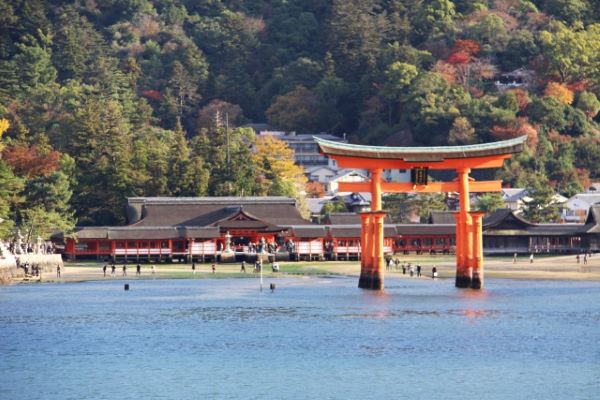
Spanning roughly 30 square kilometers within Hiroshima Bay, the entire island has long been revered in Shinto tradition as a sacred space, allowing its stunning natural ecosystem to remain meticulously preserved. Because the island is separated from Japan’s main island, catching a short, scenic ferry from the mainland near Hiroshima is practically the only way you can access it, unless you can kayak all the way across the sea!
Today, Miyajima is protected under a strict UNESCO World Heritage designation that covers both the architectural masterpiece of Itsukushima Shrine and the ancient primeval forests of Mount Misen. Sharing this pristine coastal terrain are hundreds of free-roaming, protected sika deer, making the island a rare sanctuary where ancient Japanese spirituality, vibrant wildlife, and historic architecture exist in absolute harmony.
🚄 How to Get to Miyajima Island
Because Miyajima is an island separated from the mainland, reaching it requires a combination of a train or tram ride followed by a short ferry crossing. Most travelers start their journey from major hubs like Hiroshima Station.
Here are the most efficient ways to reach the island smoothly:
Option 1: The Standard Train + Ferry Route (via Miyajimaguchi)
This is the most popular route, especially for rail pass holders. It involves two quick steps:
- Step 1: Head to Miyajimaguchi Station
- The Fast Route (JR Sanyo Line): Take the local JR Sanyo Line train from Hiroshima Station directly to JR Miyajimaguchi Station. This ride takes about 30 minutes and is fully covered by the JR Pass.
- The Scenic Route (Hiroden Tram): Take the Hiroshima Electric Railway (Hiroden) Line 2 tram from central Hiroshima to the Miyajimaguchi Tram Stop. While cheaper, this option takes roughly 50 to 75 minutes.
- Step 2: Catch the Ferry to Miyajima Exit the station at Miyajimaguchi and walk 5 minutes to the piers. Two companies operate side-by-side: JR West Miyajima Ferry (included in the JR Pass; sails slightly closer to the Great Torii Gate for a great photo opportunity) and Miyajima Matsudai Kisen. Both take only about 10 minutes to cross the water.
Option 2: The Direct Aqua Net World Heritage Sea Route (From the Peace Park)
If you want to skip the train platforms entirely and travel in style, you can take a direct high-speed boat right from the heart of the city.
- The Route: The Miyajima Heritage Route (Aqua Net Hiroshima) departs from the Motoyasu River pier, just next to the Hiroshima Peace Memorial Park (a short walk from the Atomic Bomb Dome).
- The Experience: This scenic boat ride cruises down the river and out into Hiroshima Bay, dropping you off directly at the Miyajima Ferry Terminal in about 45 minutes.
- The Catch: This option is more expensive than the train-and-ferry route and is not covered by the JR Pass. However, it saves you from changing transit lines and offers a completely unique perspective of the city’s waterways.
🎫 Want a detailed, step-by-step breakdown? Navigating Japanese train platforms, buying ferry tickets, and understanding how the JR Pass applies can be overwhelming. To avoid getting lost and to find alternative routes, including direct high-speed boats from the Hiroshima Peace Memorial Park, read our comprehensive article on The Best Guide to How to Get to Miyajima.

Tip: Below is a list of the most useful JR Passes covering Hiroshima and Miyajima.
☛ 5-Day JR Kansai-Hiroshima Area Pass: Most suitable for travelers starting their journey in Osaka, Kyoto, or Nara who want to make a fast, 5-day round-trip out west to see Himeji Castle, Okayama, and Hiroshima/Miyajima before returning to the Kansai region.
☛ 7-Day JR Sanyo-San’in Area Pass: Most suitable for a 7-day itinerary connecting Kansai (Osaka/Kyoto) all the way down to Fukuoka (Hakata), while also unlocking the rugged northern San’in coast to explore hidden gems like the historic sand dunes of Tottori and the castle town of Matsue.
☛ 7-Day JR-WEST All-Area Pass: Most suitable for an ambitious 7-day loop that covers Kansai, Hiroshima, and Fukuoka, but also allows you to head north into the scenic Hokuriku region (Kanazawa, Toyama, and Fukui) using the Hokuriku Shinkansen.
☛ 7-Day JR Sanyo-San in-Northern Kyushu Area Pass: Most suitable for travelers whose primary goal is to explore southern and western Japan deeply. It is perfect for a 7-day linear route starting in Osaka and moving into the island of Kyushu to visit Fukuoka and the hot springs of Beppu and Yufuin Onsen Town.
⚓ Arriving at Miyajima Pier: Your First Steps
The moment you step off the ferry at the Miyajima Ferry Terminal (Miyajima Pier), you officially enter the sacred grounds of the island. Before you rush out to see the deer, the terminal building is the absolute best place to gather your bearings and grab crucial real-time travel updates.

🗺️ Pick Up Multi-Language Guides
Right inside the main arrival hall, you will find a tourist information desk stocked with excellent, free sightseeing maps and pamphlets. They are available in multiple languages (including English, Traditional/Simplified Chinese, French, and Korean) and are incredibly helpful for navigating the island’s winding side streets.
⏱️ Check the Daily Tide Charts
Miyajima’s famous Great Torii Gate looks completely different depending on the water levels.
- The Pier Displays: Electronic boards and signs around the terminal entrance prominently display the exact high tide and low tide times for that specific day.
- How to use this: Take a quick photo of these times with your phone! You need a water level of 250 cm or higher to see the shrine and gate completely “floating” on the water, and 100 cm or lower if you want to physically walk out onto the sandy seabed to touch the gate’s massive pillars.
🚠 Verify the Miyajima Ropeway Status
If you plan on heading up Mount Misen, check the Miyajima Ropeway service status boards located inside the terminal pier before you make the long walk over to the mountain base. Because the cable cars can occasionally be suspended due to high winds, sudden heavy rain, or seasonal maintenance, knowing their operating status right away prevents a wasted trip up to Momijidani Park.
🧳 Heading to Your Accommodation on Miyajima First
If you are planning to stay overnight on the island, which we highly recommend to experience the peaceful, crowd-free evenings, the very last thing you want to do is drag heavy suitcases down narrow cobblestone streets.
First things first: head straight to your lodging to drop off your bags. Sightseeing around temples and climbing mountain paths is infinitely better when you travel as light as possible.
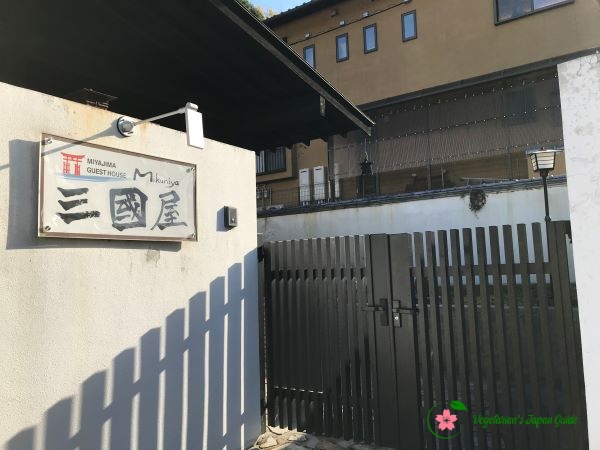
🏠 Our Stay: Miyajima Guest House Mikuniya (三國屋)
We chose Mikuniya, a highly rated, social guesthouse that perfectly blends the cozy feel of a traditional ryokan with an affordable budget. Check out our Miyajima Guest House Mikuniya Review for our experience!
- The Cost & Room: It is incredibly reasonable. Around 12,000 yen gets you a wonderfully spacious Japanese-style room for two people!
- The Location: It sits a little further back from the busy tourist strip, requiring a scenic 10-to-15-minute walk from Miyajima Pier, but the absolute tranquility makes it completely worth it.
- The Highlight: Beyond the fantastic guest reviews, a major highlight of our stay was getting to play with the owner’s incredibly friendly resident cat!
📌 Important Booking Tip: Because Miyajima is a small island with limited lodging options, hotels sell out months in advance. If you are planning a night here during the peak cherry blossom (spring) or autumn foliage seasons, you must book early!
🏨 Other Highly Recommended Miyajima Hotels & Ryokans
If you are looking for traditional multi-course dining (Kaiseki) but have strict dietary needs, finding a ryokan in Japan can be tough because most standard menus rely heavily on fish broth (dashi). However, these specific properties are excellent at accommodating special dietary restrictions if requested at the time of booking:
- Miyajima Seaside Hotel: Most suitable for travelers looking for a peaceful beachside retreat away from the main town center. This hotel features beautiful indoor mineral hot springs (onsen) facing the sea and is highly praised by international travelers for accommodating excellent, dedicated vegetarian dinner menus.
- Miyajima Hotel Makoto: Most suitable for families or couples wanting a classic, deeply authentic ryokan experience right in the heart of town. It features massive, beautiful 12.5-tatami mat rooms and an on-site public bath. Their kitchen can expertly prepare tailored vegetarian, vegan, or gluten-free traditional meals, just ensure you notify them several days in advance so they can pre-order the specialty ingredients.
🦌 Meeting the Famous Wild Deer of Miyajima
By the time you reach your accommodation, you will have already realized that Miyajima is home to a massive population of free-roaming sika deer. In the native Shinto religion, these gentle creatures are revered as “divine messengers” of the gods, and they coexist peacefully right alongside locals and tourists.
🚫 The Golden Rule: Do Not Feed the Deer (Miyajima vs. Nara)
If you have previously visited Nara Park, you will instantly notice a major difference when arriving here: no one is selling deer crackers (shika-senbei), and feeding the deer on Miyajima is strictly prohibited.
While it might feel a bit sad when a cute deer approaches you and you have nothing to give them, this rule is strictly enforced for their own survival and long-term health:
- Preserving Wild Instincts: Unlike the semi-domesticated deer in Nara, Miyajima’s deer are managed as purely wild animals. Feeding them causes them to lose their natural ability to forage for grass, leaves, and acorns in the Mount Misen forests.
- Health Risks: Human snacks, processed foods, and seasonings can make the deer incredibly sick.

🗺️ Keep an Eye on Your Paper and Maps!

While exploring the island, keep a very close eye on your belongings. The local wild deer have essentially become master pickpockets! It is incredibly common to have a cheeky deer casually stroll up and snatch a map, ticket, or pamphlet right out of your hands when you aren’t looking!
🎒 Our Firsthand Warning: They are incredibly sneaky! While we were resting and chatting on a park bench, a particularly cheeky deer completely buried his head straight into one of our backpacks and started munching on our papers before we even noticed what was happening. Keep your zippers closed and your bags high!
While it makes for a funny travel story, eating paper is actually very harmful to their digestive systems. To protect these beautiful sacred animals, always make sure to hide your trash, receipts, and travel brochures safely inside a zippered bag or pocket whenever they are around!
Miyajima Omotesandō Shōtengai / Kiyomori-Dōri (宮島表参道商店街/清盛通り)
The most vibrant, energetic area on the island is undoubtedly its main shopping street: Kiyomori-Dōri. Packed with bustling storefronts selling Miyajima’s famous local specialties, unique street foods, and traditional crafts, it is the absolute perfect spot to pick up souvenirs (and empty out your wallet!).
Don’t Forget to Redeem Your Snack Vouchers!
If you purchased a special combo ticket from Miyajima Matsudai Kisen that includes a ferry ride and a local treat, this street is where you want to cash it in:
- For Momiji Manjū or Momiji Croissants: Head over to the famous Momijidō (紅葉堂) or Torii-ya (とり居屋) storefronts located along this main strip.
- For Yamada-ya Vouchers: If you received a cash voucher for the legendary Yamada-ya (やまだ屋) confectionery shop, their main branch is right here on this street as well. Don’t leave the island without exchanging them for your delicious desserts!

A Vegetarian’s Guide to the Shopping Street
Because Miyajima is world-famous for its grilled oysters (Yaki-gaki) and conger eel (Anago), this particular shopping street can feel like a bit of a challenge for plant-based travelers. If you are looking for a proper meal while shopping, you have two great options to explore:
- TACHIBANA (お食事処 たち花): This local restaurant is a popular stop because it offers an English-language vegan and vegetarian menu. If you want to be completely certain that plant-based ingredients are used, feel free to use the practical dining translations found in our Essential Travel Phrases for Vegetarians in Japan article.
- Daishōin Temple Shōjin Ryōri (精進料理): If you prefer a 100% worry-free culinary experience, consider booking a traditional Buddhist vegetarian lunch at Daishōin Temple further up the hill. This entirely plant-based multi-course meal is guaranteed to be completely free of meat, fish, and seafood broths.
The Ō-Shakushi: Miyajima’s Giant Wooden Rice Scoop (おお杓子)

Beyond its stunning shrines, Miyajima has a deeply rooted history of master woodworking. It is thanks to these incredible local craftsmen that magnificent structures like Itsukushima Shrine have been beautifully maintained and preserved for centuries.
To honor this heritage, the most jaw-dropping monument on the island is on display right in the middle of the shopping district: a gigantic, record-breaking wooden rice scoop!
As the historical originator of the traditional Japanese rice scoop (shamoji), the island crafted this massive monument to showcase its woodworking pride. Spanning a massive 7.7 meters long, 2.7 meters wide, and weighing a whopping 2.5 tonnes, it is highly safe to assume that no one has ever used this giant scoop to serve a bowl of rice! It makes for a fantastic, uniquely quirky photo backdrop during your afternoon stroll.
⛩️ Itsukushima Shrine (厳島神社) & The Great Torii Gate
When people picture Miyajima, the first image that springs to mind is almost always the magnificent, vermilion Great Torii Gate. But this iconic landmark doesn’t stand alone. It serves as the sacred entrance to Itsukushima Shrine, an architectural masterpiece and the crown jewel of the island’s UNESCO World Heritage status.
Built over a tidal inlet, the entire shrine complex is a marvel of classical Japanese engineering. During high tide, the sea sweeps underneath the boardwalks, making the entire wooden shrine look as if it is magically floating on the water. When the tide recedes, the landscape shifts completely, revealing the sandy sea floor and allowing you to walk right out to the base of the massive Torii gate to admire its raw, natural timber pillars up close.
Go Deeper into Itsukushima Shrine: Want to know the absolute best times to catch the tides, how to book a magical night cruise that sails directly through the gate, or how to see the shrine via a guided sea kayak tour? Check out our complete, dedicated deep-dive guide: Our Ultimate Guide to Itsukushima Shrine.
Daishōin Temple (大聖院): Miyajima’s Oldest Spiritual Gem
While Itsukushima Shrine captures the spotlight on the water, Daishōin Temple sits tucked into the lush, forested hillside at the base of Mount Misen. Founded in 806 by the legendary monk Kōbō Daishi (the founder of Shingon Buddhism), this sprawling mountainside complex is the oldest and most historically significant Buddhist temple on the island.
Aside from offering sweeping, panoramic views of the Seto Inland Sea, the temple grounds are packed with mystical, interactive features you can hardly find anywhere else:
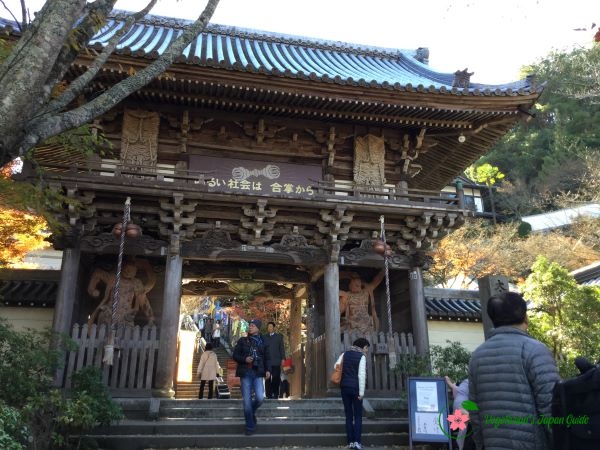
- The 500 Rakan Statues: As you walk up the entrance steps, you will find a garden filled with hundreds of unique stone statues representing the enlightened disciples of Buddha, each wearing a unique facial expression and maybe a colorful, hand-knitted winter cap.
- The Spinning Prayer Wheels: Along the main staircase, you can spin a row of metal prayer wheels inscribed with Buddhist scriptures. Spinning them as you ascend is believed to grant the same spiritual blessings as reading the sutras yourself.
- The Hidden Henjokutsu Cave: Tucked beneath the main hall, this mystical, dimly lit cavern houses icons from all 88 temples of the famous Shikoku Pilgrimage. Walking over the sand placed in front of these icons is said to bestow the spiritual merits of completing the entire pilgrimage route.
Experience Authentic Shōjin Ryōri at the Temple
For a truly unforgettable experience, Daishōin offers travelers the rare opportunity to dine inside their gorgeous temple halls. With advanced reservations, you can enjoy Shōjin Ryōri, traditional Japanese Buddhist vegetarian cuisine.
Crafted purely from seasonal vegetables, mountain plants, wild seeds, and tofu, this multi-course feast completely avoids meat, fish, garlic, or onions. It is not just a meal; it is a delicious, meditative culinary tradition that guarantees a 100% worry-free experience for strict vegetarians and vegans.
🌿 Plan Your Visit to Daishōin: Want to know how to book the Buddhist vegetarian lunch, find the pitch-black Kaidan-meguri underground meditation tunnel, or participate in weekend meditation sessions? Dive into our full, dedicated article: Our Guide to Exploring Daishōin Temple.
🍁Momijidani Park (紅葉谷公園): A Seasonal Paradise

Situated at the tranquil base of Mount Misen, Momijidani Park (literally “Maple Valley Park”) is one of Chūgoku Area’s most celebrated nature sanctuaries. The park’s history dates back to the Edo Period (1603–1867), when local residents began planting hundreds of maple seedlings along the valley floor.
Today, the quiet Momijidani River flows gracefully through the park, creating a serene landscape that looks spectacular in every season.
- The Ultimate Photo Setup: The park’s outskirts are a favorite gathering place for the island’s free-roaming sika deer. Capturing a photo of a gentle deer standing beneath a canopy of falling pink blossoms gives you the quintessential, postcard-perfect shot of spring in Japan!
🌸 Spring & Summer: Pink Blooms and Lush Greens
During the spring months, Momijidani Park transforms into one of the premier spots on the island to view iconic Japanese cherry blossoms (sakura).
As spring transitions into summer, the cherry blossoms make way for a brilliant, lush canopy of fresh green maple leaves (ao-momiji) that offers a cool, refreshing escape from the coastal humidity.

🍂 Autumn & Winter: Fiery Foliage and Quiet Snow

Autumn is the absolute peak season for Momijidani Park. Every year from mid to late November, travelers from across the globe flock to the valley to marvel at the fiery red, vibrant orange, and golden yellow canopy.
The park features stunning, traditional vermilion wooden bridges arching over the riverbed. Surrounded by the vibrant autumn leaves, every single angle looks like a work of art. We assure you that you won’t want to delete a single photo you take here!
When winter arrives, the autumn crowds dissipate, leaving a peaceful, silent forest. If you are lucky enough to visit after a fresh snowfall, the contrast between the white snow and the park’s bright red bridges is absolutely magical.
🚶 Getting There: To reach the park from town, we highly recommend taking the Momijihodō Nature Walk. This scenic pedestrian trail begins near the main gate of Daishōin Temple and follows the gentle curves of the hillside straight into the heart of the valley.
🚠 Mt. Misen (弥山) & The Miyajima Ropeway (宮島ロープウエー)
No trip to Miyajima is complete without ascending to the mystical summit of Mt. Misen, the island’s highest peak standing at 535 meters above sea level. Revered for over a millennium as a sacred mountain, its upper slopes are draped in protected primeval forests and offer some of the most jaw-dropping, panoramic views of the Seto Inland Sea’s scattered islands.
🚡 Riding the Miyajima Ropeway
While adventurous travelers can choose from three distinct hiking trails to reach the peak, the most popular and scenic route is via the Miyajima Ropeway.
The ropeway journey is divided into two distinct sections:
- The Momijidani Line: A smooth, continuous lift inside small, circular cabins that glides silently above the dense forest canopy.
- The Shishiiwa Line: After a quick transfer at Shishiiwa Station, you board a larger, classic cable car that crosses a dramatic mountain valley, offering breathtaking views of the ocean coastline.
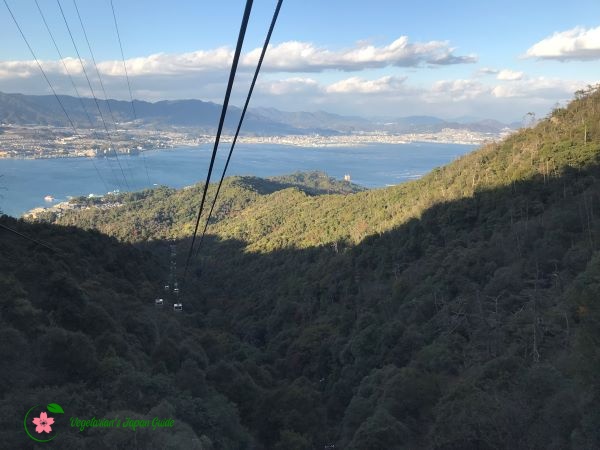
🕵️ Discovering Mt. Misen’s Seven Wonders

Once you step off the ropeway at Shishiiwa Station, a scenic 30-minute mountain walk brings you to the summit area. Along the paths, you will uncover the fascinating spiritual history of Mt. Misen’s Seven Wonders, a collection of mysterious landmarks steeped in ancient Buddhist folklore:
- The Kiezu-no-Hi (The Reikadō Eternal Flame): Located inside a mountain hall, this sacred fire was originally lit by Kōbō Daishi in 806 and has been burning continuously for over 1,200 years. Remarkably, this exact flame was used to pilot the Flame of Peace at the Hiroshima Peace Memorial Park!
- Kanman-iwa (The Tide Rock): A strange hole in a massive boulder where water mysteriously rises and falls in absolute sync with the ocean tides, despite sitting hundreds of meters above sea level.
- The Giant Boulder Formations: Near the summit observatory, you will pass beneath natural rock archways made of titanic, naturally stacked stones that feel completely prehistoric.
🗺️ Get the Complete Peak Guide: Planning your route up the mountain? Want to know the exact hiking trail difficulties, ropeway ticket pricing, and how to track down all seven of the mountain’s hidden wonders? Read our full, dedicated guide: Our Ultimate Guide to Mt. Misen and the Miyajima Ropeway.
Toyokuni Shrine Five-Story Pagoda (五重塔)
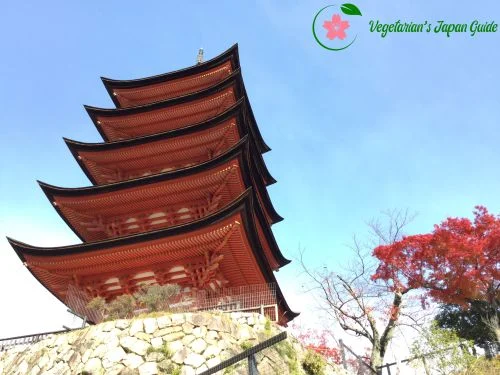
The Toyokuni Shrine Five-Story Pagoda (五重塔) on Miyajima Island is an absolute stunner, blending rich history with incredible architectural design.
Fast Facts
- Established: 1407 (Muromachi Period).
- Status: Designated as a National Important Cultural Property.
- Height: Stretches 27.6 meters into the sky.
- Admission: Free (you can admire and photograph its gorgeous exterior, but the interior is closed to the public).
Architectural Design & Hidden Details
Even though you can only view it from the outside, the craftsmanship is incredible. If you look closely, you will notice a unique architectural blend:
- East-Meets-East Style: The silhouette harmonises traditional Japanese (Wayō) and Chinese (Karayō) styles. For example, the rooflines curve dramatically upward in a distinct Chinese aesthetic.
- Built to Brave Earthquakes: The pagoda has a genius structural secret. Its massive central pillar (shinbashira) actually stops at the second story rather than anchoring deeply into the foundation. This creates a pendulum effect that helps prevent the tower from toppling during strong winds and earthquakes.
How to Get to Toyokuni Shrine Five-Story Pagoda
The pagoda sits on a hill right next to the massive, unfinished Senjokaku Pavilion (The Hall of One Thousand Tatami Mats).
- From Itsukushima Shrine: A quick 2-minute walk up the hill from the main shrine entrance.
- From the Ropeway Shuttle Bus: If you catch the free shuttle bus back from the Miyajima Ropeway, get off outside Hotel Iwaso (ホテル岩惣) at the entrance of Momijidani Park (紅葉谷公園). From there, it is a brief 4-minute walk to the pagoda.
- From Miyajima Ferry Pier: A scenic 10-to 15-minute walk along the main coastline street.
⚠️ Travel Note: Major preservation and repair work has been underway on the pagoda, with scaffolding occasionally obscuring the view. These restoration efforts are scheduled to wrap up by December 20, 2026, to keep its brilliant red lacquer and historical details pristine for future generations.
Senjokaku Pavilion / Toyokuni Shrine (豊国神社・千畳閣)
Your visit to Itsukushima Shrine won’t be complete without climbing the stone staircases up to the Senjokaku Pavilion, majestically positioned on the high ground right next to the Five-Story Pagoda. Commissioned in 1587 under the strict order of Toyotomi Hideyoshi (豊臣 秀吉), one of Japan’s most legendary historic unifiers, this massive wooden structure stands today as the single largest pavilion on Miyajima Island.
🔨 Why Was It Built?
Hideyoshi wanted a grand, monumental Buddhist library and chanting hall where monks could recite sutras for fallen soldiers. He chose the hilltop overlooking Itsukushima Shrine to showcase his immense power and religious devotion to the island’s deities.
The Story Behind “One Thousand Tatami Mats”
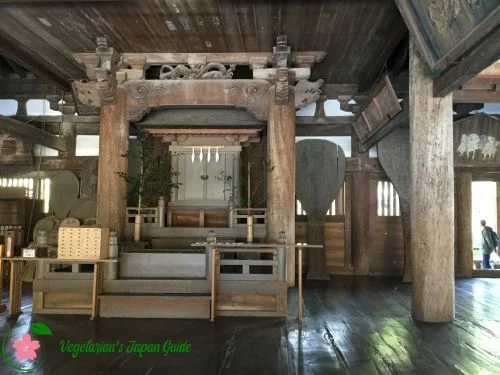
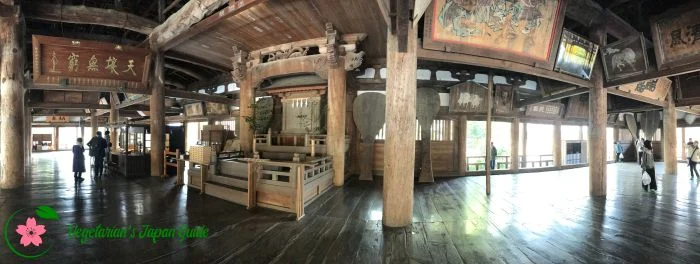
The pavilion is famously nicknamed Senjokaku, which translates directly to the “Hall of One Thousand Tatami Mats.” While it doesn’t hold a literal thousand, the vast expanse of the polished wooden floor is large enough to be covered by exactly 857 tatami mats!

As you walk through the pillars, you will immediately notice that large portions of the ceiling are missing and the pavilion has no outer walls. This is because construction ground to a sudden halt and was left permanently unfinished after Toyotomi Hideyoshi passed away in 1598. Following his death, political power quickly shifted to his fierce rival, Tokugawa Ieyasu (who would go on to establish the Tokugawa Shogunate). Because the Toyotomi clan lost their wealth and influence, funding for the massive project evaporated overnight. Work on the pavilion ground was completely halted, freezing this monument of the vibrant Momoyama Period architectural style in time forever.
Look for the Clues: How to Tell It Is Unfinished
When you step inside Senjokaku today, the architectural omissions are incredibly obvious once you know what to look for:
- No Ceiling Panels: The grand hall completely lacks a finished ceiling. When you look up, you can see the raw, exposed wooden beams and roof rafters completely bare.
- Missing Entrance Doors: The main entrance holds no grand, sliding wooden doors (shoji or amado). The pavilion is entirely open to the elements, allowing the coastal breeze to sweep straight through the pillars.
- The Uninstalled Alter: The main altar section was never fully completed in accordance with its original Buddhist grand designs.
From Buddhist Hall to Shinto Shrine
During the Meiji Period (1868–1912), a strict government decree forced the separation of Buddhism and Shintoism across Japan. Because of this, the pavilion’s original large Buddha statue was removed and relocated to the nearby Daishōin Temple. Today, the pavilion serves as a Shinto shrine where the spirits of Toyotomi Hideyoshi himself and his loyal warrior general, Katō Kiyomasa (加藤 清正), are formally enshrined.
Designated as an Important Cultural Property of Japan, it is a spectacular space where you can physically feel the sheer scale of Hideyoshi’s historical power while enjoying sweeping, elevated views of the coastline and town below.
Senjokaku Pavilion’s Opening Hours & Admission
Unlike the open-air pagoda outside, stepping onto the historic floorboards of Senjokaku requires a small entry fee to help maintain the 400-year-old timber structure:
- Opening Hours: 8:30 am to 4:30 pm daily.
- Admission Fees:
- Adults: 100 yen
- Elementary & Junior High Students: 50 yen
Cafe Tenshinkaku (天心閣): The Ultimate Hidden Viewpoint Cafe
If you are looking to rest and escape the bustling crowds of the main shopping street for a quiet moment, we recommend Cafe Tenshinkaku. Tucked away on the forested hillside right behind the Five-Story Pagoda and Senjokaku Pavilion, this gorgeous hidden cafe offers a perfect blend of specialty coffee, artisanal desserts, and a view that will take your breath away.
A Peaceful Oasis on the Hill
Reaching the cafe is half the adventure. You have to climb a narrow, unassuming set of stone steps winding up the hillside. Once you arrive, you are greeted by a beautifully renovated traditional Japanese house surrounded by a lush, manicured moss garden.
- The Indoor Vibes: The interior features classic wooden architecture, elegant modern furnishings, and floor-to-ceiling windows.
- The Outdoor Terrace: If the weather is nice, grab a seat on the outdoor terrace. It positions you at eye level with the upper stories of the iconic Five-Story Pagoda, with the blue waters of the Seto Inland Sea stretching out behind it. It is easily one of the most picturesque cafe views in all of Japan!
What to Order (and a Vegetarian Note)
The cafe is operated by the Miyajima-originated brand, Itsuki Coffee (伊都岐). The brand is well-known for its coffee roasting techniques. Including Tenshikaku, there are five cafes on Miyajima. It offers premium, slow-drip specialty coffees and exceptional house-made sweets.
- The Favorites: Their rich, velvety cheesecakes and seasonal fruit tarts are absolute crowd-pleasers.
- Vegetarian Tip: While their dessert menu is perfect for lacto-ovo vegetarians, strict vegans should note that traditional Japanese baking heavily utilizes fresh dairy, cream, and eggs. If you are a vegan, pairing their excellent black coffee or iced matcha with the stunning view is still well worth the stop!
📌 Important Traveler’s Tips:
- The Photography Rule: To protect the privacy and peaceful atmosphere of the cafe, photography is strictly limited to your own table’s food and the immediate scenery directly in front of your seat. Broad interior photography of the shop or other guests is not allowed.
Tenshikaku’s Business Hours and Access Method
- Tenshikaku is open only from 1 to 5 pm.
- The cafe is just a 10-minute walk from Miyajima Pier!
🌸 When is the Best Time to Visit Miyajima?
Miyajima undergoes a stunning transformation with each changing season. While there isn’t a “bad” time to visit the island, your experience will vary wildly depending on whether you are chasing cherry blossoms, autumn colors, or lively cultural festivals.
Here is a breakdown of what to expect each season, including a complete calendar of unique annual events.
| Season | Crowds | Weather | Travel Tip |
|---|---|---|---|
| Spring (Mar–May) | Very High | Mild & Pleasant | Heavy crowds; book your ryokan/hotel 4–6 months in advance. |
| Summer (Jun–Aug) | Medium | Hot & Humid | High humidity; ensure you pack hydration before starting the Mt. Misen hike. |
| Autumn (Sep–Nov) | High | Cool & Crisp | |
| Winter (Dec–Feb) | Low | Cold & Clear |
🗺️ Finding the Best Flora: To make navigating easier, you can refer to the official seasonal map. On the map, cherry blossom spots are marked with pink flowers, and prime fall foliage viewpoints are labeled with orange maple leaves.
Spring (March – May) | Best for Iconic Views & Festivals
Spring is undeniably beautiful on Miyajima. The island’s pale pink cherry blossoms (sakura) contrast beautifully against the vermilion wood of Itsukushima Shrine.
- The Highlight: Peak blooms usually hit between late March and early April. Spring is also the most festival-heavy season on the island.
- The Catch: This is peak travel season. The island gets incredibly crowded, especially during Golden Week (late April to early May).
- 💡 Vegetarian Survival Tip: Because crowds are massive, popular vegan-friendly cafes fill up fast. Book any sit-down lunch reservations weeks in advance.
Autumn (September – November) | Best for Foliage & Food
If you want the ultimate Miyajima experience, autumn is spectacular. Momijidani Park turns into a blazing canopy of fiery reds, oranges, and golds.
- The Highlight: November is the absolute peak for autumn foliage. This is also the prime season to enjoy freshly baked Momiji Manjū (maple-leaf pastries) cozying up with a hot tea.
- The Catch: Like spring, November brings heavy crowds. Photographers pack the bridges around Momijidani Park, making slow travel a bit difficult.
Winter (December – February) | Best for Avoiding Crowds
If you prefer peaceful temple steps, quiet mountain trails, and having the views of the Great Torii Gate mostly to yourself, winter is a hidden gem.
- The Highlight: Crisp, clear days offer the absolute best visibility from the peak of Mt. Misen. Seeing the shrine dusted in light snow is a rare, magical sight.
- The Catch: It gets very cold and windy on the water. The days are short, and some local shops or ropeway operations may reduce their hours for seasonal maintenance.
Summer (June – August) | Best for Vibrant Greens
Summer brings lush, vibrant green landscapes and lively evening energy. June also brings the rainy season (tsuyu), while July and August offer hot, sunny days perfect for grabbing refreshing shaved ice (Kakigori) along the shopping street.
📅 Miyajima Festival Calendar & Special Events
Apart from the spiritual events routinely held at Daishōin Temple, planning your trip around these annual cultural celebrations will add an extra layer of fun to your visit:
- Late March – Early April (Cherry Blossom Season): The island blooms in pink. It is the ultimate time for a scenic outdoor picnic.
- End of March (Kiyomori Festival, 宮島清盛まつり): A vibrant, historic costume parade honoring Taira no Kiyomori, the warlord who built Itsukushima Shrine.
- April 15th (Tōkasai, 桃花祭 / Peach Blossom Festival): A traditional festival featuring classical Bugaku court dances performed on the shrine’s floating stage.
- August (Miyajima Water Fireworks Festival, 宮島水中花火大会): Please note: This incredibly popular fireworks display is currently suspended due to local safety and crowd control concerns.
- October 15th (Kikkasai, 菊花祭 / Chrysanthemum Blossom Festival): A beautiful autumn festival celebrating the seasonal chrysanthemum with traditional music and dance performances.
🔗 For a complete, up-to-date look at specific event timings, ticketing, and seasonal schedules, check out the official Miyajima Tourism Association Website.
The Vegetarian & Vegan Street Food Challenge on Miyajima Island
Miyajima is famous for its bustling Omotesandō Shōtengai (Shopping Street), where the aroma of grilled seafood and sweet pastries fills the air. However, for vegetarian and vegan travelers, navigating Japanese street food is a minefield due to hidden ingredients like fish broth (dashi) and animal fats. While the island’s most famous savory snack, grilled oysters (Yaki-gaki), is off the menu, you certainly won’t go hungry. From historic sweets to plant-based twists on local classics, here is how to safely eat your way down Miyajima’s main street.
🍁 Momiji Manjū: Miyajima’s Iconic Pastry
You cannot visit Miyajima without trying Momiji Manjū, a fluffy, maple-leaf-shaped sponge cake typically filled with sweet red bean paste (Anko).
- Is it vegetarian? The vast majority of traditional red bean fillings are entirely plant-based, using just azuki beans and sugar.
- The Vegan Warning: Traditional Momiji Manjū batter contains eggs and sometimes dairy.
- Safe Flavors: Stick to traditional Koshian (smooth red bean) or Tsubuan (chunky red bean). Be cautious with custard, chocolate, or cheese fillings if you are avoiding dairy.
🍙 Savory Plant-Based Finds
If you want something savory while exploring, keep an eye out for these street vendors:
- Grilled Soy-Glazed Dango: Chewy rice dumplings on a stick, grilled over charcoal and brushed with a sweet, sticky soy sauce glaze (Mitarashi). It is naturally vegetarian and vegan-friendly, but always double-check that the glaze doesn’t use fish-based dashi as a flavor enhancer.
- Roasted Chestnuts (Yakiguri): During the autumn and winter months, you’ll find vendors roasting massive, sweet local chestnuts. These are completely natural, oil-free, and 100% vegan.
💡 Pro-Tip for Plant-Based Travelers: Because menus and ingredients can change seasonally, we have mapped out every single safe dining option on the island for you. For exact restaurant locations, English menu translations, and hidden vegan-friendly cafes, read our complete companion piece: A Guide to the Vegan and Vegetarian-Friendly Spots on Miyajima.
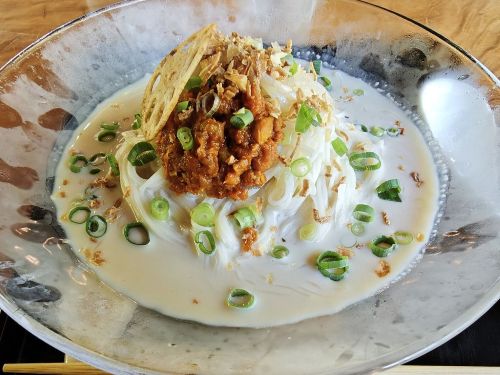
Discover the Best Places to Visit in Hiroshima City
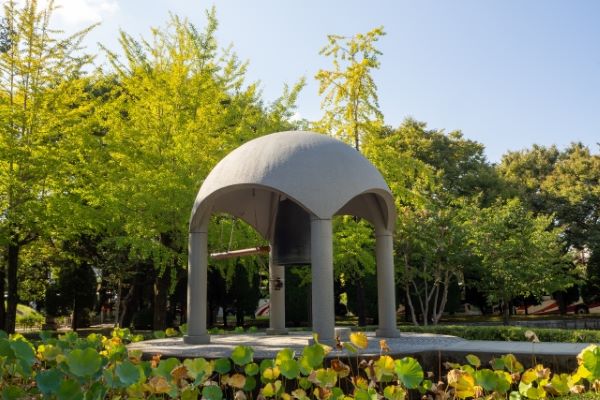
Extend Your Journey to the Mainland: Miyajima is only half of the story! To fully understand the region’s deeply moving history and vibrant modern culture, you will want to spend plenty of time exploring the mainland city as well.
From navigating the emotional paths of the Peace Memorial Park to tracking down the absolute best plant-based street food blocks, check out our comprehensive Hiroshima: Your Ultimate Guide to the City of Peace to perfectly round out your western Japan itinerary.